The best time to post on social media is Wednesday, and that is the only part of the answer the published data supports. Five cross-platform sources name a best day, and all five include Wednesday. Ask the same five for an hour and the agreement collapses completely: their recommended windows share no hour at all. The two largest studies in the category both say plainly that no single cross-platform time exists. Google prints one anyway, and the number it prints is Buffer's answer for TikTok.
Key takeaways
- Wednesday appears in all five cross-platform sources' best-day lists. No hour appears in all five.
- Google's answer panel quotes a sentence from Buffer's TikTok section as the universal answer.
- Eleven of the 27 slots in Sprout's own tables fall partly outside the window it recommends.
- CoSchedule calls Tuesday and Thursday its worst days. Three other sources call one or the other best.
- Two of eleven pages answering this question say when their data was collected.
What is the best time to post on social media?
The best day and time to post on social media, taken together, is Wednesday between 11am and 3pm. That is the most defensible answer available, and it is weaker than any page on this subject will admit. Here is every source with a cross-platform answer, its sample, and what it actually says.
- Sprout Social analysed nearly 2 billion engagements across roughly 307,000 profiles and says the best times are Tuesdays and Wednesdays, 11am to 6pm local time, with Sunday the worst day (Sprout Social, 2026).
- Buffer analysed over 52 million posts and declines to give a cross-platform time at all: "There is no single best time to post on social media that applies to all social media platforms" (Buffer, 2026).
- CoSchedule analysed 37,219,512 messages from more than 30,000 organisations across 107 countries and says 7pm, with the best days being Friday, Wednesday and Monday (CoSchedule, 2024).
- SocialPilot analysed around 7 million posts from over 50,000 accounts and says Wednesday and Thursday, at 7am to 9am, 1pm to 3pm, or 7pm to 9pm (SocialPilot, 2025).
- Hootsuite analysed over 1 million posts with a data science partner, normalised across 118 countries, and says 8am on Wednesdays (Hootsuite, 2025).
- Small Business Expo says Wednesday and Thursday, 9am to 3pm, on no data of its own, attributing "hundreds of thousands of posts" to Sprout (Small Business Expo, 2025). It is included below because it names a day, not because it counted anything.
- Later publishes per-platform windows and no data of its own, quoting four sample sizes without attributing any of them (Later, 2026).
Read that list again and notice what it does not contain: a single hour that all of them include. SocialPilot's three blocks overlap Hootsuite at 8am and CoSchedule at 7pm, but nothing reaches all five. Hootsuite's answer falls five hours before Sprout's window opens; CoSchedule's falls an hour after it closes.
Worth knowing: every company in that list except CoSchedule's respondents sells scheduling software, and each has a commercial interest in "when to post" being a hard problem with a purchasable answer. So does Zilfu. That is why this page prints each source separately with its sample attached, instead of averaging six incompatible clocks into one confident window, which is what the page you are reading replaced.
Google is quoting Buffer's TikTok answer as the universal one
Search for this question today and Google's result for Buffer reads: "The single best time to post is Sunday at 9 a.m., followed by Monday at 1 p.m. and Sunday at 1 p.m."
That sentence is real, and it is on the page. It is also about TikTok.
It sits inside the best time to post on TikTok section of Buffer's cross-platform article, directly after a chart whose own caption reads "Heatmap of TikTok engagement by hour and weekday highlighting Sunday mornings as peak ... based on 7.1 million posts data". The paragraph immediately following it begins "In general, views on TikTok tend to climb in the evening".
The reason it travels so well is that Buffer copied it from its own TikTok article, where the same sentence is prefixed "Peak posting time:", and dropped both the label and the platform on the way across. What is left is a sentence that reads like a universal claim and is not one.
Meanwhile, much further up the same page, Buffer answers the actual question:
"There is no single best time to post on social media that applies to all social media platforms. They're all used for different reasons, by very different users."
And again in its own FAQ:
"No, there's no single best time that works across all platforms. Each network has different user behavior and intent, so posting times that work on LinkedIn won't necessarily work on TikTok."
So the largest study in the category says there is no answer, and the most-quoted line from that study is an answer, for a platform nobody asked about. If you have read that Sunday 9am is the best time to post on social media, this is where it came from.
It happens twice on the same results page. The second organic result for this question is a Reddit thread from May 2024 titled "Is 'Best time to post' on social media a myth?". Google's answer panel cites that thread for the line "Aligning with Daily Routines: Optimal posting times often align with common daily routines like morning commutes (7-8 AM), lunch b...".
We read the thread. That sentence is not in it. Neither "Aligning with Daily Routines" nor "morning commutes" appears anywhere on the page, and the thread carries a moderator removal notice for AI-generated content. What the thread does contain is the opposite argument, from the person who started it:
"There are so many blogs around 'what is the best time to post on social media?'. Each suggest different time for the same country or same industry or even for the same day. Buffer suggest 7AM to 8AM are the best time for weekdays while SproutSocial suggest different. How relevant and accurate are those blogs?"
The highest-voted reply is blunter still: "the best time is the time where your followers are most active. i wouldn't listen to the websites, i'd instead look at page insights."
So on one search results page, the two most prominent citations are a platform-scoped sentence promoted to a universal claim, and a summary of a thread that says something the thread does not say. That is worth knowing before you copy an hour off any chart, including the ones below.
Sprout's own table breaks the window it recommends
Sprout Social is the top organic result for this question and the primary citation in Google's answer panel, so its number carries further than anyone else's. Its number does not survive its own tables.
The headline says 11am to 6pm. The summary table roughly forty words below says 12pm to 6pm. Both are on the page, in the same section.
Then there are the per-day, per-platform cells. Sprout publishes 27 of them across Monday to Friday. Eleven fall partly outside the 11am to 6pm window it recommends, including every one of its five Pinterest rows, which start at 7am, 8am or 10am. Its Instagram Wednesday row runs to 11pm, five hours past the stated close.
Friday is the sharpest case. Sprout gives Friday a window of 11am to 2pm, then lists three platforms under it, and two of them fall outside the window it just printed: Pinterest at 10am to 11am and TikTok at 3pm to 5pm.
Sprout is not being careless so much as compressed. The honest version of its own data is a range too wide to headline, so the headline gets a range that its rows then break. That is worth holding on to as a general rule for this subject: the tighter the recommended window, the more of the underlying table it had to leave out.
One more thing about Sprout's data. Its sample is enormous, at nearly 2 billion engagements, but it was collected 27 November 2025 to 27 February 2026. That is a single winter, spanning the northern hemisphere's holiday season. Nothing in the page says the windows would look the same in July.
What is the best day to post on social media?
Every cross-platform source that names a best day includes Wednesday. That is Sprout, Hootsuite, SocialPilot, Small Business Expo and CoSchedule, five for five, and they agree on nothing else. Drop Small Business Expo, which publishes no data of its own, and the four that do still come to the same answer.
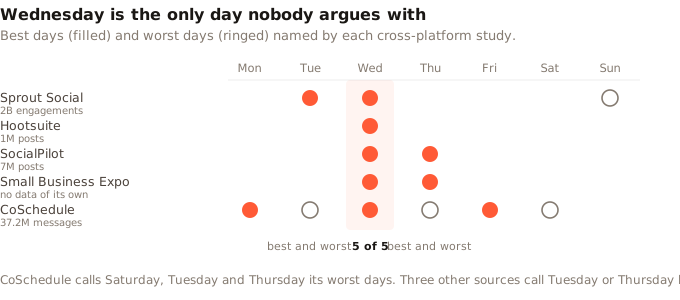
Buffer, which refuses a cross-platform day, points the same way underneath: Wednesday is the top day in five of its eight platform tables, losing only on TikTok (Saturday), YouTube Shorts (Friday) and long-form YouTube (Sunday).
The interesting part is what happens to the days either side of it. Sprout names Tuesday among its best. SocialPilot and Small Business Expo name Thursday. CoSchedule, working from 37.2 million messages, names both of them among its three worst:
"The worst days to post on social media are Saturday, Tuesday, and Thursday."
So Tuesday sits in Sprout's best column, Thursday in SocialPilot's and Small Business Expo's, and CoSchedule puts both in its worst. Wednesday is the only day that is named best by all five and worst by none. Monday and Friday escape every worst list too, but neither carries more than one vote for best. That is a thin thing to build a schedule on, and it is genuinely all there is.
Saturday and Sunday are the mirror image: no cross-platform source names either among its best days, and both appear in someone's worst list. The dissent is per network rather than overall, and it comes from Buffer, whose TikTok table makes Saturday its best day and whose long-form YouTube table does the same for Sunday.
What time of day is best to post on social media?
Put the five stated windows on one clock and the intersection is empty.
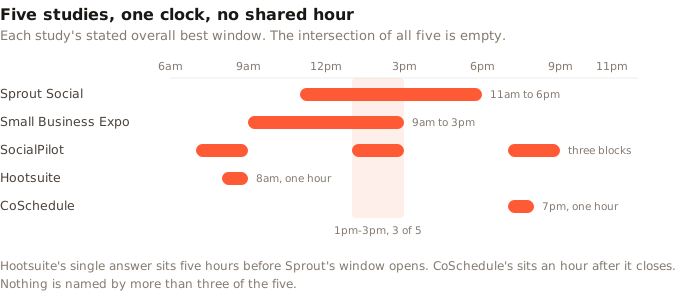
The most-agreed band is 1pm to 3pm, shared by Sprout, SocialPilot and Small Business Expo. Three out of five. Hootsuite's 8am and CoSchedule's 7pm are outside it and outside each other.
CoSchedule is worth dwelling on, because it is the only vendor in the set that names its rivals and says their data disagrees with its own:
"Research from 37,219,512 social media posts indicates 7:00 PM is the best time to share on social media. The top 10 best times are all in the afternoon and evening. This slightly contradicts original datasets from Sprout Social who found 9-10:00 AM is the best time to post. This also contradicts Hootsuite's original research that suggests 10:00 AM is the best time to post."
It then does something rarer still and reports that its own answer moved:
"This is a significant deviation from morning engagement to late-day engagement when compared to our earlier research published in 2013, 2014, 2016, and 2019."
A company with 37 million messages of data changed its own answer by ten hours over a decade. That is the strongest available evidence that the hour is not a stable property of the platforms.
Do not average these windows. Averaging 8am, 1pm and 7pm produces roughly 1pm, which looks like a consensus and is an artefact of arithmetic on three incompatible measurements. Two of the three sources would tell you 1pm is wrong.
When is the best time to post on social media each day?
Only two sources publish a cross-platform answer day by day, and even they cover only six days between them, because Sprout refuses to name one for Sunday. The two sources overlap between 11am and 2pm on four of the five weekdays and not at all on Sunday. Here is the full picture, computed rather than eyeballed.
| Day | Sprout Social | SocialPilot | Where they agree |
|---|---|---|---|
| Monday | 10am to 5pm | 9am to 12pm | 10am to 12pm |
| Tuesday | 11am to 6pm | 10am to 2pm, 3pm to 4pm | 11am to 2pm, 3pm to 4pm |
| Wednesday | 11am to 6pm | 9am to 3pm | 11am to 3pm |
| Thursday | 11am to 5pm | 9am to 2pm | 11am to 2pm |
| Friday | 11am to 2pm | 9am to 2pm | 11am to 2pm |
| Saturday | 11am to 6pm | 12pm, 7pm, 8pm | 12pm to 1pm |
| Sunday | none given | 8am, 11am, 4pm | nothing |
Do not average these columns. They come from different samples measured over different periods, one of them winter-only, and the right-hand column is an intersection rather than a blend. Across the whole week the two sources agree on 17 hours out of 168.
If what you actually want is the best time to post on social media today, read the right-hand column for today's row and treat it as a default rather than a finding. And if you want the worst time to post on social media, the published data is clearer about that than about the best. Hootsuite is the only source giving a worst-time window per network, and four of its five are the small hours: before 4am on Instagram and Facebook, before 5am on X, before 6am on TikTok. LinkedIn is the exception, where the worst stretch is evenings after 7pm and the weekend.
Best time to post on social media on Monday
The best time to post on social media on Monday is 10am to 12pm, the two-hour band where the only two sources with a per-day answer overlap. Sprout opens Monday at 10am, an hour earlier than any other weekday, which is the only day its stated window starts before 11am. SocialPilot closes Monday at noon, earlier than any other weekday. The two-hour band where they meet is the narrowest weekday agreement in the table.
Best time to post on social media on Tuesday
The best time to post on social media on Tuesday is 11am to 2pm, with a second agreed slot at 3pm to 4pm. Tuesday is also the day the sources split hardest on whether to post at all. Sprout names it one of the two best days of the week. CoSchedule names it one of the three worst. Both are working from tens of millions of data points, and both cannot be right.
Best time to post on social media on Wednesday
The best time to post on social media on Wednesday is 11am to 3pm. It is the widest agreed band of the week, on the only day all five cross-platform sources put in their best column. If you are going to move one post to one slot on the strength of published data, this is the slot the data supports.
Best time to post on social media on Thursday
The best time to post on social media on Thursday is 11am to 2pm. Thursday holds the single best hour in Buffer's Facebook, Instagram and Threads tables, all three landing on 9am, which is two hours before this window opens. Buffer's best day on all three is Wednesday. It is also, like Tuesday, on CoSchedule's worst list. Treat Thursday as a strong day with an unsettled hour.
Best time to post on social media on Friday
The best time to post on social media on Friday is 11am to 2pm, the same band as Thursday but from a much narrower Sprout window. Sprout's own note is worth quoting because it is unusually blunt: "Engagement begins to taper off on Friday as users wrap up the week." CoSchedule disagrees more sharply than on any other day, naming Friday its single best day of the week.
Best time to post on social media on Saturday
The best time to post on social media on Saturday is around midday, and it deserves to be treated as a test rather than a slot. The two sources share exactly one hour on Saturday. Sprout gives it a window and then warns against it in the same breath: "proceed with caution ... Save your major announcements for the workweek." Buffer is the dissenting voice here, with Saturday its best day for TikTok.
Best time to post on social media on Sunday
There is no supportable best time to post on social media on Sunday. Sprout declines to give one: "There's no optimal time to post on Sunday. Sunday is the lowest-performing day across every major network." SocialPilot offers 8am, 11am and 4pm. No cross-platform source names Sunday among its best days. The single exception anywhere in the set is Buffer's long-form YouTube table, where Sunday wins outright.
What is the best time to post on each platform?
The cross-platform answer above is not the answer for any individual network, and that is not a hedge. It is the arithmetic. Here is where each network actually lands, with the full working in its own guide.
| Network | Best-supported answer | The catch |
|---|---|---|
| Midweek afternoon, Tuesday or Wednesday | Buffer's posts point at evenings, Sprout's at midday, Later's at 5am | |
| Weekday mornings, 8am to 10am | Sprout's headline says noon to 8pm while its own industry tables open before noon | |
| TikTok | Thursday afternoon | Buffer calls Saturday the best day, Sprout calls it a dead zone |
| Tuesday to Thursday, 11am to noon | Buffer says 3pm to 8pm, Sprinklr says 10am to 2pm, and no window survives all five | |
| X (Twitter) | Weekday mid-morning, 9am to 11am | Sprout says noon to 6pm, opening after the other two have closed |
| Threads | Thursday 9am, or Monday 9am from the shared data | Meta says weekends, which Buffer ranks worst |
| Tuesday around midday | The two camps sit ten hours apart, and the largest Pinterest-only study found timing did not predict success |
Two things follow from that table. The first is that the cross-platform answer matches almost none of the per-network ones. Wednesday early afternoon is not Facebook's morning, not X's mid-morning, not TikTok's Thursday. It is the centre of mass of seven different distributions, and the centre of mass is not where any of them lives.
The second is a coverage problem nobody mentions. Only one of the six datasets covers all seven networks Zilfu publishes to, and it is the smallest of them. Buffer, the largest, omits Pinterest entirely. Sprout, SocialPilot and CoSchedule omit Threads, and Metricool omits both. That leaves Hootsuite, at 1 million posts, as the only study covering the full set. Threads appears in two of the six datasets; Pinterest in four.
Do the platforms themselves say when to post?
Mostly they refuse, and the refusals are more informative than the vendor charts.
Instagram answers the question and refuses to give a number. Its creator FAQ asks itself "What's the best time to post?" and replies in full: "When your audience is awake and most active. Use your insights to understand their habits" (Instagram). The same page is perfectly willing to give a figure for frequency, noting that top creators post ten or more reels a month. It gives one for cadence and none for the clock.
Instagram's head, Adam Mosseri, has said it outright. From a reel posted on 16 June 2026:
"There's no universal best time to post. If you really want to optimize, check your insights to see when your followers are actually online."
Facebook publishes no best time either. What Meta ships instead is a per-account answer: the Active times control in Meta Business Suite recommends slots "based on when followers were most active on Facebook and Instagram over the past 7 days" (Meta). Seven days, not the two years behind Buffer's chart. Instagram's ranking explainer does name recency, but files it under "more mundane information about the content itself, like when it was posted", which is not the language of a heavily weighted signal, and time of day appears nowhere on the page.
TikTok names no hour. Its published description of the For You recommender lists user interactions, video information, and device and account settings. Post age is not among them, and the one place "time of day" appears is as an attribute of the viewer, not the post.
Pinterest rules it out by omission. Its list of what affects distribution names "language, location, seasons, holidays, formats and trending topics", and time of day is not on it. Its on-record position is that the window never really closes: "There's no set engagement window for Pins, so it's possible that a Pin can gain engagement hours, days, months, or even years after it's first published" (Pinterest). Its actual timing advice is seasonal, not hourly: if the moment peaks in June, launch in April.
YouTube goes furthest and denies the premise. Under the heading "When is the best time to publish videos?", its help centre answers: "Publish time is not known to impact a video's long-term performance. Our recommendation system aims to deliver the right videos to the right viewers, regardless of when that video was uploaded" (YouTube). It allows only that publishing when your audience is active "can be beneficial for early viewership, but isn't known to impact a video's long-term viewership".
LinkedIn is the exception that proves the point. It does publish times, "Between 9 am to 12 pm, 12 to 3 pm, or 3-6 pm" (LinkedIn). Read the attributions and every one of those numbers belongs to HubSpot, Sprinklr or Buffer. LinkedIn, which owns every timestamp on LinkedIn, published vendor research rather than its own. And in 2017 its own blog argued the opposite case: "If anyone tells you they've got a silver-bullet answer for when to post on LinkedIn, don't believe them. No such thing exists."
Threads is the one platform that answered directly, and it still would not name an hour. Asked "What's the best time of day to post, and how often?", the official @threads account replied "It depends!" and suggested that "posting more frequently on the weekends may help drive higher engagement". Meta's creator guidance repeats it and adds a cadence number, "we recommend posting at least 2 to 5 times per week".
Hold that against the vendor consensus for a moment. Every cross-platform study in this article ranks the weekend at or near the bottom. The one platform that answered the question pointed at the weekend.
Both can be true. Meta is describing everyone who uses Threads. Buffer and Sprout are describing posts sent through scheduling tools by businesses and creators, who mostly work weekdays and whose weekend output is thin to begin with. A sample of scheduled business posts will find weekdays because that is when scheduled business posts happen.
Does posting time affect the algorithm?
On one network it demonstrably does, on one it is explicitly corrected for, and on the rest the platforms will not say.
X is the only major platform that documents post age as something its ranker rewards. Its published ranking code names time_since_tweet_creation outright. It does not publish a decay rate, so any specific half-life you read, including the "reach halves every six hours" figure that circulates widely, is somebody's estimate rather than a disclosed number.
Pinterest's engineering work points the other way. Its PinEqualizer paper, deployed across Homefeed, Related Pins and Search and covering 92% of total content impressions, names a content age signal as a debias: "it is critical to reduce the system's overall bias towards old content". On Pinterest, age is a thing the ranker is built to compensate for, not a thing it rewards.
Meta's disclosed Facebook Feed signals contain no post-age term. Recency gates what is eligible to appear, not the order it appears in. Instagram's explainer does name when a post was shared, but files it among the mundane attributes rather than the heavily weighted ones.
Threads splits the difference by having two feeds. The Following tab is chronological by Meta's own statement, so publish time sets position outright. The For You tab is ranked on interaction signals with no time-of-day term described.
The practical version: timing decides who sees a post in its first hour. On a chronological feed that is most of the story. On a ranked feed it competes with interest signals the platforms weight far more heavily, which is exactly why four studies with millions of posts each can land on four different hours and all be describing something real about their own users.
Almost nobody asks the question this way
Here is a finding from our own data rather than anyone else's. We pulled United States monthly search volume for the generic question and for each platform-specific version of it.
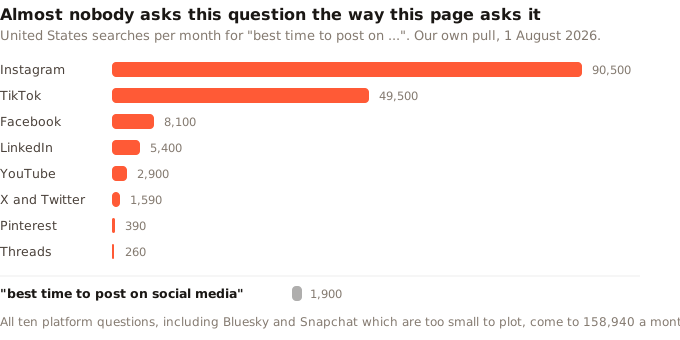
The generic question, the one this page answers, draws 1,900 searches a month. The platform-specific versions together draw 158,940 across ten networks, about 84 times as many. Instagram alone draws 48 times as many.
That ratio is the reader's instinct being right. People ask per platform because the per-platform answer is the one you can act on, and the generic answer, as the arithmetic above shows, is the centre of a distribution nobody lives in.
It is also moving. Over the last year the generic term is down 34% while the day-specific versions are up: Tuesday +120%, Thursday +75%, Wednesday +29%, and "best time to post on social media today" +80%. Demand is shifting away from the timeless cross-platform chart and towards "what should I do this afternoon", which is a question a published average cannot answer at all.
How reliable are these best-time studies?
Several of the pages that rank for this question have no data behind them, and one of them is quoting a source that no longer says what it is quoted as saying.
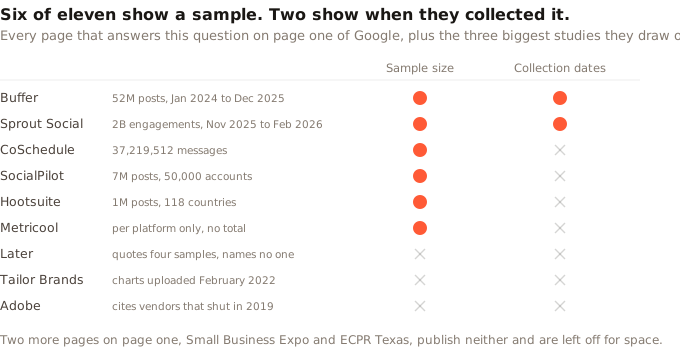
Two of eleven publish a collection window. Buffer's is January 2024 to December 2025, so a page titled for 2026 is describing 2024 and 2025. Sprout's is the winter already mentioned. Hootsuite, SocialPilot, Metricool and CoSchedule publish a sample size and no dates at all. Later publishes neither and quotes four sample sizes anyway.
Three specific things worth knowing before you trust a number from this SERP:
- Later's figures are Buffer's. Later writes "research analyzing 9.6 million Instagram posts identified Thursday at 9 AM, Wednesday at 12 PM, and Wednesday at 6 PM", which is Buffer's Instagram sample size and Buffer's three slots in Buffer's order. The same holds for its 14 million Facebook posts and its 7 million TikTok posts. Its page contains no link to Buffer or to anyone else. Two apparently independent sources agreeing is sometimes one source counted twice.
- The number three result is quoting a dead page. ECPR Texas ranks third for a 1,900-a-month term with times it credits to a HubSpot infographic based on a CoSchedule study. Both named sources have since been rewritten and neither now supports its figures: today's CoSchedule puts Facebook at 9am Friday, against ECPR's 3pm to 4pm Wednesday. The page still lists Snapchat among the platforms worth planning around and mentions TikTok nowhere at all.
- A "Last Updated: July 20, 2026" stamp is not a data date. Tailor Brands carries that stamp and serves all seven of its charts from a February 2022 upload folder. Its prose credits Statusbrew while every chart caption credits Sprout Social, and it links to neither.
The pattern across all eleven: nine of them assert. Only CoSchedule and Adobe tell readers that the studies disagree, and CoSchedule is the only one that names which rivals it contradicts and on what.
How do you find your own best time in 14 days?
Every window in this article is a hypothesis about people who are not your audience. The test that replaces it is cheap.
- Pick three candidate slots per network. Take one from your network's guide above, one from your own analytics peak, and one deliberate outlier, such as an evening if all your current posts are mornings. Three is the most you can evaluate honestly in a fortnight.
- Hold the content roughly constant. Same format, same length, comparable subject. If one slot gets your best idea of the month, you have measured the idea, not the slot.
- Run each slot twice over two weeks. Three slots over two weeks gives you two data points per slot and six in total. That is enough to drop the worst performer, not enough to crown a winner, and anyone promising more from a two-week test is selling something.
- Compare reach or impressions per post, not likes. Reach is the number timing actually moves. Likes follow the content. The label differs by network: Instagram Insights and Meta Business Suite report reach, X and TikTok report impressions and views, and Pinterest reports impressions, saves and outbound clicks rather than reach at all. Compare like for like within one network and never across them.
- Drop the worst slot, keep two, add one new candidate. Repeat monthly. After three rounds you have tested nine slots per network against your own audience, which is more evidence than any published study has about you specifically.
Two cautions. Use your audience's time zone, not yours, which both large studies already do. And do not run this test during a holiday fortnight, for the same reason Sprout's winter-only window should make you cautious about its numbers in July.
How do you hold seven schedules without doing it by hand?
The reason most teams never act on any of this is not that they disagree with it. It is that seven networks with seven different answers, in the audience's time zone, is a spreadsheet nobody maintains past week three.
Zilfu turns that into recurring weekly slots. You define each network's slots once, Facebook's weekday mornings, Wednesday early afternoon for the cross-platform default, Pinterest's Tuesday midday, and posts fill the next open window per network automatically. Scheduling across all seven networks is the whole product rather than a tier, and there is no per-network cap, so several Facebook pages or two LinkedIn organisations sit in one workspace and your plan caps the total rather than the per-network count. That is what makes a genuinely per-network schedule practical instead of theoretical.
Once posts have run, per-post analytics give you reach, likes, comments and saves per post, so the drop-the-worst-slot loop in the previous section is a matter of grouping your own numbers by the slot you used. That is the only dataset in this entire article that is actually about your audience.
If you want to run the same loop programmatically, the REST API and MCP server accept posts into the identical queue.
Start on Wednesday, then let your own numbers move you
If you take one thing from all of this: post on Wednesday, early afternoon, on the networks where you have no better information, and treat that as a starting position rather than a finding. It is the only slot in the published data that no cross-platform study contradicts, and it is still just the middle of six disagreeing clocks.
Then go per network, because that is where the useful answers are. Start with the Instagram timing guide if that is where your audience is, or the Facebook one, and plug the window you choose straight into the Instagram scheduler, TikTok scheduler or LinkedIn scheduler.
The free plan covers 2 connected accounts and 15 posts a month, which is enough to test two weekly slots on each of two networks for a fortnight before you pay anything.
Sources
All sources retrieved 1 August 2026.
- Sprout Social. Best times to post on social media in 2026. Published 31 March 2026, last modified 29 May 2026. Nearly 2 billion engagements across roughly 307,000 profiles and 30,000+ customers, collected 27 November 2025 to 27 February 2026, reported in local time. Covers six networks; Threads is not among them. Source for the 11am to 6pm window, the per-day tables, the Sunday verdict, and the 27 per-day cells used above.
- Buffer. Best time to post on social media in 2026: every platform. Published 25 March 2026, last edited 14 July 2026. Over 52 million posts; the collection window, January 2024 to December 2025, is stated only on Buffer's Instagram page. Covers seven networks in eight rows; Pinterest appears nowhere in the body. Source for "there is no single best time", the quick-guide table, and the misquoted TikTok sentence.
- CoSchedule. Best times to post on social media. Published 5 February 2024, updated 14 June 2024. 37,219,512 messages from more than 30,000 organisations in 107 countries, analysed in each organisation's own time zone. No collection window stated. The only source in the set that names the rivals it contradicts, and the only one that reports its own answer moving between 2013 and 2024.
- SocialPilot. Best times to post on social media. Published 2 December 2025, updated 17 March 2026. Around 7 million posts from over 50,000 accounts. No collection window stated. Source for the second per-day column above.
- Hootsuite. Best time to post on social media. Published 19 November 2025, updated 30 June 2026, title still says 2025. Over 1 million posts with data science partner Critical Truth, normalised across 118 countries and time-zone agnostic. No collection window stated. The only study covering all seven networks in this article.
- Later. Best time to post on social media. Published 6 May 2026. Quotes four sample sizes, attributes none, and contains no outbound link to any data source. Its Instagram, Facebook and TikTok figures match Buffer's samples and slot orders.
- Metricool. Best time to post on social media in 2026. Published 30 July 2026. Per-platform samples only, no aggregate and no collection window. Covers five of the seven networks here.
- Tailor Brands. What are the best times to post on social media?. Stamped "Last Updated: July 20, 2026"; all seven charts are served from a February 2022 upload path. Credits Statusbrew in prose and Sprout Social in every chart caption, and links to neither.
- ECPR Texas. Best and worst times to post on social media. No publication date anywhere in the page. Credits a HubSpot infographic based on a CoSchedule study; both have since been rewritten and neither now supports its figures.
- Meta. Threads for creators and the @threads reply of October 2024. Source for "It depends!", the weekend suggestion, and the two-to-five-posts-a-week cadence.
- Instagram. Creator FAQ, source for "When your audience is awake and most active", and the ranking explainer of 31 May 2023, source for "more mundane information about the content itself, like when it was posted". Adam Mosseri's reel of 16 June 2026 is the source for the "no universal best time" quote; only the written caption is quoted here, because the reel has no transcript and the paraphrases of its audio circulating elsewhere could not be confirmed.
- Meta. Schedule posts in Meta Business Suite. Source for the 7-day lookback behind the Active times control.
- YouTube. Upload and publishing best practices. Source for "Publish time is not known to impact a video's long-term performance".
- LinkedIn. What's the best time to post on LinkedIn?, published 25 July 2024, source for the three windows and for the fact that every figure in it is attributed to HubSpot, Sprinklr or Buffer. Its 2017 post Why I'll never tell you when to post on LinkedIn is the source for the contradicting quote.
- Pinterest. Pin performance and distribution. Source for "There's no set engagement window for Pins".
- r/SocialMediaMarketing. Is "Best time to post" on social media a myth?, posted 2 May 2024, 40 comments. Source for the quoted question and reply, and for the finding that the text Google's answer panel attributes to this thread does not appear in it.
- Small Business Expo. When is the best time to post on social media?. Published 26 August 2025, updated 22 July 2026. No data of its own; attributes "hundreds of thousands of posts" to Sprout. Counted above only because it names a best day.
- Adobe. When and how often to post to social media. One of only two pages in the set that tells readers the studies disagree, tabling six vendors' conflicting LinkedIn windows side by side. Publishes no data of its own and cites vendors that no longer exist.
- X. The algorithm, ranking features. Source for
time_since_tweet_creationandtweet_age_ratioas named inputs to the ranking model. No decay rate is published anywhere. - Pinterest. PinEqualizer, arXiv 2607.22518, Pinterest Inc., submitted 24 July 2026. Source for the content age signal being a debias and for the quoted line about reducing bias towards old content. Deployed across Homefeed, Related Pins and Search, covering 92% of total content impressions.
- TikTok. How TikTok recommends videos for you. Source for the For You signal list, which names user interactions, video information, and device and account settings, and no post age.
- Meta. Transparency Center, explaining Facebook Feed ranking. Source for the absence of a post-age term in the disclosed Facebook Feed signals.
- DataForSEO. United States monthly search volume, pulled 1 August 2026. Source for the demand figures and year-on-year trends in the search demand section.
The per-network claims summarised in the platform table are sourced in full in each network's own guide, linked from that table.