The best Metricool alternative depends on a number you have to work out yourself: your brand count. Metricool bills per brand, and a brand holds one profile per network, so a client running two Instagram accounts is two brands. Four of the ten page-one comparisons explain that rule. None works it through as an example, so if a single client of yours runs two profiles on one network, the prices you are comparing are not the prices you would pay.
Key takeaways
- Five clients with two Instagram accounts each is ten brands, the $36 tier.
- X costs $10 a month per account since 13 July 2026. It was $5.
- Metricool's own marketing page still prints the old price.
- Approvals and the API both start at Advanced, $53 a month.
- The MCP server is free, which is the reverse of the usual order.
What actually decides your Metricool bill?
Not accounts, and not users. Metricool's plans "scale by the number of brands you connect, not by the number of users", and its help centre is unambiguous about what fits inside one: "Each Brand can only have one profile per social network or platform" (Metricool). A second Instagram needs a second brand.
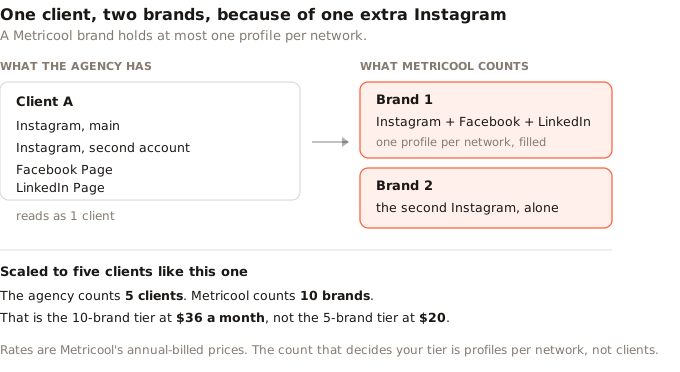
That rule is easy to read past and expensive to discover late. A connect-flow help page spells out the consequence: "Each brand supports only one account per platform. If you manage multiple accounts of the same type, you'll need one brand per account." On the free plan, which allows exactly one brand, a second Instagram is not a price problem at all. It is impossible.
Metricool argues its model is the fair one, and against per-seat pricing it has a point: "A tool priced per user can quietly cost five times more than one priced per brand once your team grows." That is true. The gap is that brands are not the same shape as clients. Per-brand pricing rewards many clients with few networks each, and punishes few clients with several accounts on the same network.
So the honest test before comparing anything: count profiles per network, not logos. Five clients each running two Instagram accounts, a Facebook Page and a LinkedIn page is ten brands, not five, which is the $36 tier rather than the $20 one.
Metricool pricing in 2026: what does it actually cost?
Annual-billed, Starter is $20 a month for 5 brands and $36 for 10; Advanced is $53 for 15 brands, $85 for 25 and $159 for 50 (Metricool pricing, 2026). Monthly billing runs $25, $45, $67, $107 and $210 for the same tiers. There is a free plan holding one brand.
The pricing page opens with the annual toggle already selected, labelled "Annual (save up to 24%)". That single default explains most of the confusion in the roundups: a page quoting Metricool at $20 and a page quoting it at $25 are describing the same Starter tier on different billing bases, and neither is lying.
Worth checking the headline claim while you are there. Across the five paid tiers the annual discount runs from 20.0% to 24.3%, and only the 50-brand tier reaches 24%. The four cheaper tiers save a fifth, not a quarter.
Worth knowing: Zilfu sells a competing scheduler, so treat the framing here the way you should treat every page on this search: as an argument, not a referee's decision. What we can do instead of asking for trust is show the arithmetic and quote Metricool's own pages, which is what the sections below do.
Does Metricool charge extra for X, and how much?
Metricool's X support is a paid add-on, and it doubled to $10 per month per connected X account. Its help centre gives the date plainly: "Current pricing took effect on July 13, 2026" (Metricool). Before that it was $5. Metricool's add-on page publishes no annual rate for it, so $10 a month is $120 a year either way.
Three details that are not on the pricing page
Three things make this sharper than a simple price rise:
- It needs a paid plan. The add-on is "available for premium plans (Starter or higher)", so X is unreachable on Free at any price. LinkedIn is excluded from Free too.
- One add-on covers one X account per brand. Five clients on X is five add-ons, or $50 a month on top of your tier.
- Legacy pricing is a trap door. Accounts that held an add-on before 13 July keep $5, for existing and new ones, but only "as long as you do not remove all of them". Remove them all once and Metricool's page describes no route back.
Metricool's own marketing page has been wrong about Metricool's price for nineteen days. Its euro-denominated pricing explainer still describes X as "available as €5 add-on", while the help centre has said €10 and $10 since 13 July. If the vendor's own site has not caught up, a third-party roundup published in May certainly has not, which is a good reason to price add-ons on the help centre rather than anywhere else.
Metricool gives away its MCP server and charges for its API
Metricool's MCP server works on every plan including Free, while its REST API requires Advanced. Metricool states both in one table: "Metricool MCP | Any plan, including Free" against "Metricool API | Advanced or Custom only" (Metricool). That is the most unusual split in the category, and six of the ten page-one comparisons never mention it.
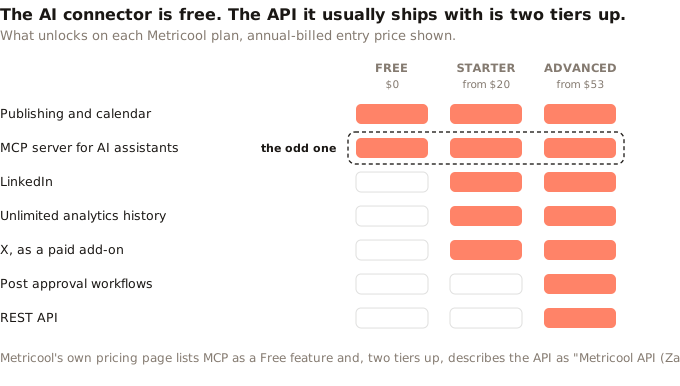
For most of this category's history, programmatic access was the upsell. Metricool has put the AI-assistant connector on the free tier and kept the HTTP API two tiers up, at $53 a month. If you want an assistant to draft and schedule, Free covers it. If you want a script or a Zapier lane, that is Advanced. Zilfu draws the line differently and ships both surfaces on every plan, which is a difference of policy rather than capability.
Metricool's own pricing page says it twice and disagrees with itself. It lists "Metricool MCP" as a Free bullet, then lists "Metricool API (Zapier, Make, and MCP)" under Advanced, bundling MCP into the paid line item. A reader comparing the two bullets cannot tell which tier MCP belongs to. The help centre table settles it, in favour of Free.
Approvals sit on the same tier
One more gate worth pricing properly: approvals are Advanced too. Metricool's help centre states that "User management is available on Advanced and Custom plans. Free and Starter plans include a single access and do not allow adding more users." If a client signs off on posts, your entry price is $53, not $20.
Metricool competitors: who is telling you to leave?
Ten comparison pages compete on page one. Every one of them is published by a company selling a scheduler, which is the part worth sitting with: unlike Buffer's equivalent search, this SERP has no independent control at all. Seven of the ten publish a numbered ranking, and all seven put their own product first: Planable, SocialBee, SocialBu, AdaptlyPost, Turrboo, PostFast and Distribution.ai. The other three, bundle.social, Ayrshare and Conbersa, skip the ranking and pitch directly. Treat every one of them, this page included, as an argument rather than a verdict.
The one signal none of them controls is how often a tool turns up on somebody else's list. SocialPilot appears on 5 of the 7 rankings, then Buffer, Hootsuite, Loomly and Sendible on 4 each. Between them the seven name 26 tools across 51 slots, half of those exactly once, and no tool appears on all seven. Read that as a shortlist of names you will keep meeting, not as a verdict on fit. We take the self-ranking pattern apart properly in our Buffer alternatives piece, where it held nine times out of nine.
Two things make this SERP stranger than that one. Metricool itself ranks on page one for its own alternatives query, with a comparison page covering twelve rivals, and it is more forthcoming about brand counts and billing bases than most of the pages ranking against it.
The other is SocialBu, whose page is titled "7 Metricool Alternatives for Social Media Analytics" and whose own heading promises "Top 7". It gives a write-up to two of them, itself and SocialPilot, and the other five never arrive. Its comparison table also marks Metricool's AI content generation as "None", which Metricool's own free-plan bullets contradict: they list an "AI social media assistant" with five credits a month (Metricool).
To be fair to the genre, the criticisms here land better than they do on Buffer's SERP. Several pages correctly flag the per-brand model, the Advanced-gated approvals and the API tier. The common failure is arithmetic rather than fabrication: quoting a price without saying whether it is annual or monthly, and pricing the X add-on at $5.
Four questions to ask about any tool similar to Metricool
Metricool's structure makes the useful questions obvious, because it is unusual on three of them. Ask these of any tools like Metricool before you look at a feature grid, and the field sorts itself without anyone's ranking.
- What is the bill counted in? Brands, accounts, seats, social sets or channels. Metricool counts brands, which is why your client list is the wrong starting number.
- What does a second account on the same network cost? On Metricool it costs a whole brand, which may mean a tier step. If you run several accounts per network, this usually outweighs the headline price.
- Which tier unlocks approvals? Metricool's is Advanced at $53. Price the tier you will actually be on, not the entry one.
- Is there an API, webhooks and an MCP server, and on which plans? These three are usually assumed to travel together. On Metricool they do not.
Here are the answers for Metricool, for Zilfu, and for nine tools that recur across the rankings or sit close to Metricool structurally. Every unmarked cell is quoted or paraphrased from the vendor's own pricing page or help centre, checked on 1 August 2026; cells we could not source that way carry an asterisk.
| Tool | Bill counted in | Second account, same network | Free forever plan | Approvals from | API / webhooks / MCP |
|---|---|---|---|---|---|
| Metricool | Brands | A whole brand, so possibly a tier step | Yes: 1 brand, 20 posts, no LinkedIn or X | Advanced, $53 | Advanced / undocumented / every plan |
| Zilfu | Accounts | One ordinary slot | Yes: one owner, 2 accounts, 15 posts/mo | Every paid plan, from $19 | Yes / yes / yes, every plan |
| Buffer | Channels | Another billed channel | Yes: 3 channels, 10 queued each | Team | Yes / no / yes, every plan |
| Later | Social sets of 8 profiles | Not sold on Starter; Growth includes 2 sets, then $11.25 | No, 14-day trial | Growth | None offered |
| SocialPilot | Social media accounts | One slot, then $4 a month | No, 14-day trial | Standard * | Enterprise / no / no |
| Hootsuite | Seats | One slot on Standard, free above it | No, 14-day trial | Advanced | Free, by developer approval / no / no |
| Sprout Social | Seats | One of 5, free on Professional up | No, 30-day trial | Professional * | Advanced / no / no |
| SocialBee | Social profiles | Its own slot, extra in blocks of 5 | No, 14-day trial | Accelerate | No public API |
| Publer | Social accounts | Add-on, $4 to $7 a month | Yes: 3 accounts, no X | Not stated * | Business / no / no |
| Planable | Workspaces | Social pages in a workspace * | No, 50 posts total then paid | Basic, and it is the tier ladder | Pro / no / MCP on paid plans |
| Zoho Social | Brands | A second brand, $17 a month up * | Yes: 1 brand, unlimited posts, X included | Premium | Not stated * |
* Marks an answer the vendor does not state outright. SocialPilot's pricing page renders its approval tiers inconsistently between passes. Sprout's approval tier comes from a support article rather than its live pricing page. Publer names no approval tier and Zoho Social names no API on the pages checked; Zoho's brand add-on price comes from a 2021 help article. Planable does not say whether two same-network accounts can share a workspace. Metricool's webhooks are marked undocumented rather than absent: none of the Metricool pages we checked describes one either way.
Zoho Social is the closest structural twin, and it has the same trap. It counts brands the same way, so a second Instagram there also means a second brand, though the only add-on price we could find for it dates to 2021. If the brand model is what you are escaping, Zoho is not the escape.
Where Zilfu fits, and where Metricool still wins
Zilfu counts accounts, flat and network-agnostic, so the brand multiplier simply does not exist: a second Instagram is one ordinary slot, like the first. The plan ladder is 2 slots on single-user Free, 10 on Pro at $19 a month, 100 on Business at $79 and 300 on Scale at $179. Free has a 15-post monthly cap; every paid plan adds unlimited posts, members, and collaborative approvals. Recurring weekly slots and the REST API, webhooks and MCP server ship on all four. That flat shape suits solo coaches and consultants running a handful of accounts as readily as it suits agencies.
Against the four questions, that is the whole difference: same answer to question one, no multiplier on question two, no gate on questions three or four. If your brand count is inflated by same-network accounts, the arithmetic is straightforward on the Zilfu and Metricool comparison.
Where Metricool wins is not close, and it is worth saying plainly. It publishes to ten networks against Zilfu's seven, including YouTube, Bluesky and Google Business Profile, none of which Zilfu reaches, and it connects five more on top for analytics only, Twitch and the Meta, Google and TikTok Ads accounts among them. Comparing the two on network count only works if you compare publishing to publishing. It tracks up to 100 competitors per network, ships a Looker Studio connector, PDF and PPT reports, a link-in-bio builder and an inbox that covers DMs and Google reviews as well as comments. Zilfu has no ads reporting, no competitor tracking and no built-in AI writer, its client reports are branded share links rather than a white-label dashboard, its inbox handles comments only on Threads, Instagram and Facebook, and its approvals are single-reviewer.
If analytics is your deliverable, Metricool is the better product and the brand maths is a cost of doing business. If publishing is your deliverable and your accounts cluster on a few networks, the model is working against you. For a wider field than Metricool specifically, Agorapulse and Pallyy are worth a look if the inbox is what you are really buying.
How do you leave Metricool without losing your reporting?
Export the reports first. Posts are not the switching cost here; accumulated analytics are, along with the competitor sets and report templates you have built up. No scheduler in this comparison imports another tool's history, so anything you have built up in Metricool stays in Metricool.
That matters more than usual because of how Metricool's history works. Its pricing page promises Starter "Analytics with unlimited history", while its help centre notes that a newly connected profile retrieves only "the previous 30 days of data" and that full-year history needs a manual request. History accumulates from the day you connect, in Metricool and in whatever replaces it.
So the sequence is: download your PDF or PPT reports and any Looker Studio views, note your competitor sets, then reconnect accounts elsewhere and schedule forward. Published posts stay live on each platform regardless of which tool queued them.
One timing note before you commit either way. Metricool's May 2026 product update says Campaign Dashboards and Metricool Studio are "available on Starter and Advanced plans for a limited time" and that "afterwards they'll be a paid add-on". No end date is given, so if either is load-bearing for you, ask before renewing.
If you want to sanity-check the account model against your own brand count, two slots on Zilfu's free tier are enough to connect the two same-network accounts that would have cost you a second brand, and see whether the difference is worth moving for.
Sources
All pages fetched 1 August 2026. The page-one listicles were retrieved as raw HTML and parsed programmatically rather than read.
- Metricool. Pricing and plan tiers.
- Metricool. Metricool vs. other top social media management tools, updated 13 July 2026.
- Metricool. What's a brand in Metricool and how does it work?
- Metricool. How to connect social media and ad platforms.
- Metricool. Main differences between Free and Premium.
- Metricool. Your guide to the X/Twitter add-on.
- Metricool. Your guide to the Advanced Analytics add-on.
- Metricool. MCP limits and plan requirements.
- Metricool. API access: export your Metricool data.
- Metricool. User management in Metricool.
- Metricool. How to send posts for review with the approval system.
- Metricool. Getting started: start guide and FAQs.
- Metricool. Product updates, May 2026.
- Planable. 7 best Metricool alternatives in 2026.
- SocialBee. Top 5 Metricool alternatives.
- SocialBu. 7 Metricool alternatives for social media analytics.
- AdaptlyPost. Top Metricool alternatives for 2026.
- Turrboo. Best Metricool alternatives in 2026.
- PostFast. 12 best Metricool alternatives for 2026.
- Distribution.ai. 8 best Metricool alternatives in 2026.
- bundle.social. Metricool alternative for products that need API-first publishing.
- Conbersa. Best Metricool alternative in 2026.