The best time to post on Threads is 9am on Thursday if you go by Buffer's 2.5 million posts. That study is the only one with a stated Threads-only sample size, and as of 1 August 2026 it owns the United States search results for the question: Buffer holds the top organic result, its own Threads and Instagram posts rank below it, and it is the answer panel's primary citation. Meta was asked the same question directly. It answered "It depends!" and pointed at the weekend, which Buffer ranks worst.
Key takeaways
- Meta's only day-level advice is the weekend. Buffer calls Saturday the worst day.
- Buffer gives Threads the same peak it gives Facebook and Instagram.
- None of its 21 slots falls after 1pm, so "avoid evenings" cannot fail.
- Meta says post 2 to 5 times a week, not per day.
- Threads Insights has no hour-of-day view.
What is the best time to post on Threads?
9am on Thursday, if you want the single best-supported number. It comes from Buffer's 2.5 million Threads posts, the only study of this platform with a stated Threads-only sample size. Treat it more loosely than the equivalent answer on any other network, because there are fewer sources here than you would expect and they do not line up.
- Buffer analysed 2.5 million Threads posts sent through Buffer and names 9am on Thursday the peak, with weekday mornings between 6am and 11am the strongest window (Buffer, 2026).
- Hootsuite analysed over 1 million posts across networks with a data science partner and says 8am on Tuesday (Hootsuite, 2025).
- SocialPilot says Wednesday, in a headline window printed as "between 8 AM and 1 AM", a seventeen-hour span whose late end its own day table never comes near, stopping at 9pm (SocialPilot, 2025).
- Later says Tuesday through Thursday, 9 to 11am and 6 to 8pm, and publishes no sample size, window or dataset for Threads (Later, 2026).
- Meta names no hour at all, and suggests the weekend (Meta).
Two of the biggest names in the category are missing from that list. Sprout Social and Metricool both cover six networks and neither covers Threads. SocialPilot's own cross-platform hub omits it too, even though it published a dedicated Threads page two days later.
So the honest picture is not five studies disagreeing. It is one real Threads study, one cross-network study that includes Threads, and a lot of pages with no data at all.
Worth knowing: every company above except Meta sells scheduling software, and each has a commercial interest in "when to post" being a hard problem with a purchasable answer. So does Zilfu, which is why this page prints every source separately instead of averaging them into one recommendation. That is not a reason to dismiss the numbers. It is a reason to notice who is missing from the list.
Meta was asked this exact question and would not answer it
In October 2024 someone asked the official @threads account: "What's the best time of day to post - and how often?"
The reply began "It depends!" and went on:
"Posting more frequently on the weekends may help drive higher engagement. You can also use insights to see where your community is and help you determine when to post... we recommend posting at least 2 to 5 times per week."
That is the platform answering the question this article is about, and declining to name an hour. The same guidance appears on Meta's creator site under a tip headed "Meet your audience when they are active":
"Look back at the performance of your Threads to see if some get more views, likes or replies on a given day of the week. For example, posting more frequently at the weekends may help drive higher engagement."
Read that against Buffer, and the two point in opposite directions. Buffer names Saturday the lowest-engagement day of the week. The weekend is the only day-level example Meta gives.
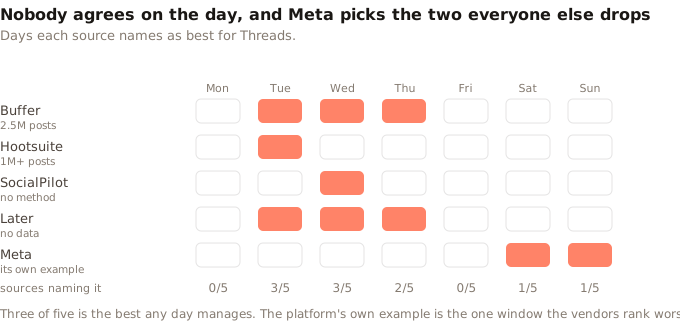
Neither side is obviously wrong. Meta is describing its whole user base; Buffer is describing 2.5 million posts sent through Buffer, whose customers are businesses and creators who mostly work weekdays. But it does mean the confident weekday-morning consensus you will read everywhere rests on a sample that is unlikely to be posting much on a Sunday in the first place.
Note also what Meta does not claim. It says to use insights to see "where your community is". That is geography, not time of day.
Buffer gives Threads the answer it gives Facebook and Instagram
Buffer's single best slot for Threads, for Facebook and for Instagram is the same hour of the same day.
Buffer runs the same study across the networks it covers. Its single best slot for Threads is 9am Thursday. Its single best slot for Facebook is 9am Thursday. Its single best slot for Instagram is 9am Thursday. Three networks, three separate datasets of 2.5, 14 and 9.6 million posts, one identical answer.
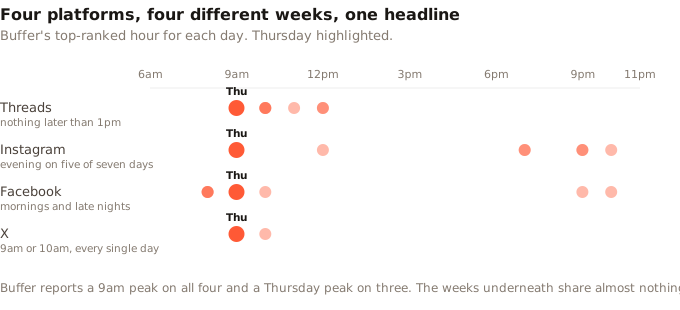
Look at the weeks underneath and only two of the four have the same shape. Threads stops dead at 1pm, and X sits at 9am or 10am every single day, so those two really are alike. The other two are not: Instagram's top slot is an evening hour on five of seven days, and Facebook is mostly early mornings with two late nights bolted on.
Instagram is the sharpest case. Buffer's Instagram peak is Thursday 9am, and Thursday is the only day in Instagram's entire week whose top slot falls before noon. The headline sits on the one day that contradicts the pattern behind it.
That is what taking the single highest cell out of a grid does. It finds the tallest bar and reports it as the answer, whether or not the surrounding shape supports it. When the same method returns the same hour on three networks with different audiences and different formats, the number is telling you at least as much about the method as about the platforms.
Buffer's own summary goes one step further and gets it wrong. Its cross-platform page says Threads' 9am Thursday is "the same as Facebook, Instagram, and X". Buffer's own X table says X peaks on Tuesday. Its Facebook post makes the identical claim and then withdraws it mid-caption: "The best time to post on Instagram, Facebook, Threads, and X is exactly the same. Well, almost! ... On X, it was also 9 a.m., but on Tuesday."
Buffer's table cannot disagree with Buffer's advice
Buffer lists three recommended hours for each day, twenty-one in total. Every one of them falls between 6am and 1pm.
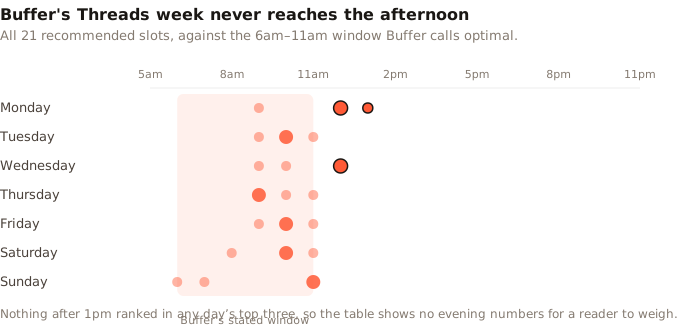
That matters for the most-quoted line on the page. Buffer says evening hours, 6pm to 11pm, "consistently underperformed across all days of the week". No evening hour ranked high enough to appear anywhere in the table, which is consistent with the claim rather than a test of it. The table prints the top three hours per day and nothing else, so a reader sees no evening numbers at all and has nothing to weigh.
The window has a second problem. Buffer names 6am to 11am as the optimal stretch, then gives Monday and Wednesday a top slot of 12pm, outside it. Wednesday is the day Buffer names best overall, so its best day's best hour sits outside its own recommended window. Buffer's cross-platform page quietly widens the window to 7am to 12pm, which catches the two noon slots, still misses Sunday's 6am and Monday's 1pm, and disagrees with the dedicated page either way.
Three smaller cracks in the same article:
- Wednesday is the best day, but Thursday holds the best hour. Both are stated plainly, four sections apart.
- Monday and Wednesday publish the same top two hours, 12pm then 9am. Buffer calls Wednesday the best day of the week and says Monday is "underperforming". Whatever separates them is not in the table.
- The second-worst day is named twice, differently. The days section says Saturday is worst "with Monday also underperforming". The Sunday section says Sunday is "the second-worst day to post on Threads after Saturday".
There is no collection window anywhere on the page. Buffer gives a sample size and a publish date but never says which months the data covers. At 2.5 million posts, Threads is Buffer's smallest sample of the four networks compared here, about a sixth of its Facebook figure.
When is the best time to post on Threads each day?
The three sources that publish a per-day table. Do not average these columns. Buffer says its times need no conversion, Hootsuite says its times are "normalized across 118 countries" and time-zone agnostic, and SocialPilot reports Eastern Time. Those are three different quantities. The cross-platform comparison lines Threads up against the other six networks.
| Day | Buffer (2.5M posts) | Hootsuite (1M+, all networks) | SocialPilot (EST) |
|---|---|---|---|
| Monday | 12pm, 9am, 1pm | 9am | 9am, 12pm, 1pm |
| Tuesday | 10am, 9am, 11am | 8am | 8am, 10am, 1pm |
| Wednesday | 12pm, 9am, 10am | 12pm | 11am, 1pm, 4pm |
| Thursday | 9am, 10am, 11am | 9am | 8am, 12pm, 3pm |
| Friday | 10am, 9am, 11am | 2pm | 12pm, 2pm, 3pm |
| Saturday | 10am, 11am, 8am | 12pm | 7am, 10am, 12pm |
| Sunday | 11am, 6am, 7am | 1pm | 2pm, 7pm, 9pm |
Monday is the only day where all three name the same hour, and that hour is 9am. It is also the only day with a point of contact between all three pairs of sources. Monday is the day Buffer describes as underperforming.
Best time to post on Threads on Monday
9am is the best-supported hour anywhere in the week: Buffer, Hootsuite and SocialPilot all name it, and Monday is the only day where that happens. Buffer's own top Monday slot is 12pm, which SocialPilot also lists. The awkward part is that Buffer calls Monday an underperforming day while giving it the same top two hours as Wednesday, the day it calls best.
Best time to post on Threads on Tuesday
10am is the pick: Buffer ranks it first for Tuesday and SocialPilot lists it too. Hootsuite disagrees by two hours with 8am, which SocialPilot also names, so the morning is well covered even though no hour is named by all three. Tuesday is Hootsuite's best day of the week and one of Buffer's top three.
Best time to post on Threads on Wednesday
12pm is the only shared hour, named by both Buffer and Hootsuite. SocialPilot spreads out to 11am, 1pm and 4pm and shares none of them. Wednesday is the day Buffer names best overall and the day SocialPilot's headline picks, so it ties Tuesday for the most day-level support of any weekday, even while its best hour sits outside Buffer's own stated morning window.
Best time to post on Threads on Thursday
9am carries the week's most famous claim: Buffer's single best slot of all seven days, and Hootsuite names 9am on Thursday too. SocialPilot is elsewhere entirely at 8am, 12pm and 3pm. Thursday 9am is the famous number, but Monday 9am has one more source behind it.
Best time to post on Threads on Friday
10am is Buffer's Friday pick, and Friday is where the sources scatter. Buffer stays in the morning with 10am, 9am and 11am, while Hootsuite jumps to 2pm and SocialPilot lists 12pm, 2pm and 3pm. Hootsuite and SocialPilot agree on 2pm, and Buffer shares nothing with either. Friday is the only weekday where the largest study is isolated from both of the others.
Best time to post on Threads on Saturday
10am is Buffer's top Saturday slot, on the day Buffer simultaneously names the lowest-engagement of the week. Saturday is where the sources contradict the platform. Hootsuite gives 12pm and SocialPilot also lists 12pm, along with 7am and 10am. Meta, meanwhile, suggests weekends may drive higher engagement. Buffer quietly gives Saturday three slots while ranking it last, and SocialPilot gives it three more without ranking the day at all.
Best time to post on Threads on Sunday
11am is Buffer's Sunday pick, and no two sources share an hour on this day. Buffer says 11am, 6am and 7am, Hootsuite says 1pm, and SocialPilot goes into the evening with 2pm, 7pm and 9pm. Sunday is the only day in the table with zero agreement, and it is also half of the window Meta points at. If you are going to test Meta's weekend suggestion, Sunday is where the published data is least able to argue with you.
What is the best day to post on Threads?
There is no day every source names. Buffer and Later say Tuesday to Thursday. Hootsuite says Tuesday. SocialPilot says Wednesday. Meta says the weekend. Because Hootsuite and SocialPilot give single-day answers that do not match, the intersection across all of them is empty.
Counting how many of the five name each day: Tuesday and Wednesday reach three, Thursday two, Saturday and Sunday one each, and Monday and Friday none. Three of five is the most any day manages.
That is a weaker answer than the other articles in this series can give, and it should be. On X, Wednesday and Thursday survive all four studies. On Threads nothing survives, because there are barely four studies to survive.
If you want a single starting point from the published data, take Monday at 9am: the only hour all three per-day tables name, on a day one of them tells you to avoid. Then test it against a weekend slot, because that is the one Meta itself suggests and no vendor has measured properly.
Does posting time affect the Threads algorithm?
On one of the two feeds, timing does not just influence position. It is position.
Adam Mosseri stated in May 2024 that "your Following feed is also in chronological order, so you'll always see the most recent posts first in that feed as well". For anyone who already follows you, publish time determines where you land, full stop. That is a sorting fact rather than a ranking claim, and it is as direct as the link between publish time and visibility gets.
The For You feed is different and much less documented. Meta describes it as personalised "based on a number of signals, such as accounts and posts you have interacted with in the past on both Threads and Instagram", with like and hide activity named explicitly. No Meta description of Threads ranking that could be checked names post age or time of day, which matches what we found for Facebook and Instagram. One caveat worth stating: Meta's Transparency Center has a card titled "Instagram Threads Feed" whose body would not load for us, so that page is the one place this negative has not been confirmed.
Be careful here, because this topic has an unusual amount of folklore attributed to a real person. Claims that Mosseri said replies count as much as posts, that the first thirty to sixty minutes decide distribution, or that engagement velocity is the dominant factor, circulate widely. None of them could be traced to a Mosseri post on threads.com, searching his profile and the platform for his statements on ranking, recency, replies and frequency. What he has actually said about ranking is narrower: that Threads ranks posts "lightly", that recommendations increase total reach, and that Threads rebalanced in November 2024 to favour accounts you follow over recommendations.
How often should you post on Threads?
Meta publishes a number, and it is much smaller than the one you will read elsewhere.
"Higher post frequency is linked to higher views per post, so we recommend posting at least two to five times per week."
That is per week. The footnote dates the analysis: "Based on internal analysis over a 30-day period in H1'24 among global Threads creators", which makes it more than two years old and still live on Meta's site.
For an upper bound, the Threads API caps a profile at 250 published posts and 1,000 replies per 24 hours. Those are anti-abuse ceilings rather than advice. The gap between two to five a week and 250 a day is wide enough to fit any recommendation you will read, which is worth remembering when one of them sounds authoritative. Meta's own number is the conservative one.
The more useful frequency statistic Meta publishes is about replies: "Replies account for almost half of the views on Threads and people spend time reading replies on posts they find interesting." Roughly half the reach on this platform is not the post.
How do you schedule Threads posts in advance?
Threads has native scheduling in the app, and third-party schedulers work differently from it in a way worth knowing.
The Threads API has no scheduling parameter. The create-post and publish endpoints take text, media, topic tags and link attachments, and nothing that sets a future publish time. Meta anticipates third-party queues directly, telling developers: "We recommend that your app also enforces the publishing rate limit, especially if your app allows app users to schedule posts to be published in the future."
So any scheduler, Zilfu included, holds your queue on its own side and fires the create call at the target minute. Nothing is handed to Threads in advance. One practical consequence: Meta advises waiting "on average 30 seconds" after uploading a media container before publishing it, so a media post scheduled for 9am starts its upload slightly before 9am rather than exactly on it.
Be careful where Threads timing numbers come from
Three traps are specific to this topic.
"Data-backed" is doing a lot of work. The page ranking above several vendors for this query is titled "Best Time to Post on Threads in 2026 (Data-Backed Guide)" and names no dataset, no sample size and no collection window. Another page on the first results page is a gated tool that publishes no times at all. A third result is a country-localised page written for India that surfaces in United States results.
Mosseri did not say most of what he is quoted as saying. See the algorithm section above. When a claim about Threads ranking is attributed to him, check it against his actual posts, which are public and searchable.
AI summaries are inventing quotes on this topic. While researching this article, a search engine's own answer panel attributed to Buffer a comparative claim about Threads peaking during "morning coffee hours" unlike other Meta platforms. Buffer's actual caption says nothing of the kind. The invented version is more quotable than the real one, which is exactly why it spreads.
How do you find your own best time on Threads?
Threads Insights has no hour-of-day and no day-of-week breakdown, so you have to generate the comparison by posting.
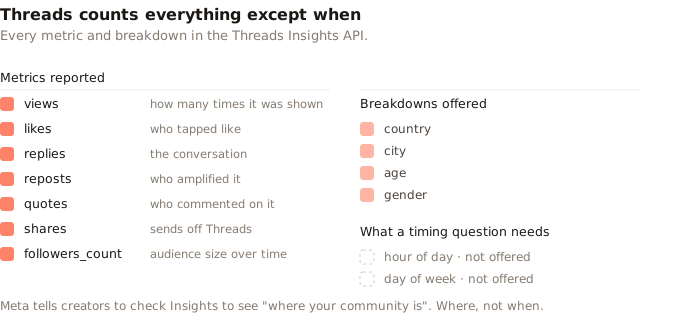
- Accept that Insights will not tell you. Threads Insights, which is what most people mean by Threads analytics, reports views, likes, replies, reposts, quotes, shares and follower count, and breaks them down by country, city, age and gender only. There is no hour-of-day or day-of-week view, so unlike Instagram or Facebook there is no active-times chart to read. You have to generate the comparison yourself by posting.
- Test the real disagreement, which is the weekend. A weekday morning slot against a Saturday or Sunday slot settles the one question where the platform and the published studies actually conflict. Testing 9am against 10am does not.
- Judge on replies, not likes. Meta says replies are close to half the views on Threads. A post with fewer likes and more replies is usually the better post, and it is the one whose reach keeps growing.
- Stay in the conversation after publishing. On Threads a reply is not a comment attached to your post, it is another post carrying a reply id. Answering people is publishing, which means the hour you post is only the start of the window that matters.
- Run it for at least three weeks. Meta's own cadence advice is two to five posts a week, so a fortnight gives you a handful of posts per slot at most. Three weeks is the minimum for the comparison to mean anything at this frequency.
How do you hold those slots without doing it by hand?
The weekend slot you most need to cover is the one you are least likely to be at a desk for.
Because the Threads API takes no future publish time, your scheduler is holding that slot rather than Threads, and it has to fire on a Sunday. Zilfu checks for due posts every minute, and recurring weekly slots keep the weekday and weekend halves of the test running for the full three weeks. Media posts need a little headroom either way, since Meta advises about thirty seconds between uploading a container and publishing it.
The part that matters more here than the hour does is what happens after publishing. Because replies carry roughly half the views, Zilfu can auto-post a follow-up comment the moment a Threads post goes live, which on Threads is itself a post in the same conversation rather than a comment bolted onto one. Per-post analytics then report replies as their own metric alongside views, likes, reposts, quotes and shares, so you can compare slots on the number that actually drives reach here rather than on likes.
The best time to post on Threads is the one you can sustain
The published answer for Threads is as thin as any network in this series. One real Threads study, one cross-network study, and three major vendors that either skip the platform or publish a range with no data behind it. Buffer's Thursday 9am is the best-supported number available, and it is the same number Buffer reports for Facebook and Instagram, drawn from a table whose every slot lands between 6am and 1pm.
Meanwhile the platform itself declined to name an hour, suggested the weekend, and published one number: two to five posts a week. That number comes from the company that can see the whole platform. None of the others can.
So post two to five times a week, put something in a weekend slot to test the one claim Meta actually makes, and spend the effort you would have spent on the clock on replying to people instead. Zilfu's free plan covers 2 connected accounts and 15 posts a month, which holds the low end of Meta's cadence on one account.
Threads appears in only two of the six cross-platform datasets. The comparison of all seven networks shows who covers what, and what survives when you line the studies up.
Sources
All sources retrieved 1 August 2026.
- Meta. Threads for Creators. Source for the "Meet your audience when they are active" tip, the weekend suggestion, the two-to-five-posts-a-week recommendation, and the statement that replies account for almost half of the views on Threads. Methodology footnote as printed: "Based on internal analysis over a 30-day period in H1'24 among global Threads creators."
- Meta. @threads, 21 October 2024. The official account answering "What's the best time of day to post - and how often?" with "It depends!"
- Adam Mosseri. Threads post, 15 May 2024. Source for the Following feed being chronological.
- Adam Mosseri. Threads post, 5 July 2023 and 21 November 2024. Sources for Threads ranking posts "lightly" and for the November 2024 rebalance toward followed accounts.
- Meta. Threads API overview. Source for the 250-post and 1,000-reply daily limits and for Meta's note about apps that schedule posts.
- Meta. Threads API insights. Source for the metric list and for the absence of any time-of-day breakdown.
- Buffer. The best time to post on Threads in 2026. Published 4 February 2026, 2.5 million Threads posts, median engagement by hour and day. No collection window stated. Source for the per-day table, the 6am-to-11am window and the day ranking.
- Buffer. The best time to post on social media in 2026. Published 25 March 2026, over 52 million posts. Source for the 7am-to-12pm Threads window and the "same as Facebook, Instagram, and X" claim.
- Buffer. Best time to post on Instagram in 2026 (9.6M posts), Best time to post on Facebook (14M posts) and Best time to post on Twitter/X in 2026 (8.7M posts). Sources for the cross-platform peak comparison.
- Hootsuite. Best time to post on social media. Published 19 November 2025, over 1 million posts across networks with Critical Truth; times normalised across 118 countries. No Threads-only sample size is given.
- SocialPilot. Best time to post on Threads. Published 4 December 2025, times in Eastern Time. Describes its method as "trial and error" alongside a reference to monitoring 50,000+ Threads accounts.
- Later. Best time to post on social media. Updated 6 May 2026. Gives Threads a range and, unlike every other network on the page, no per-day table.
- Sprout Social. Best times to post on social media. Published 31 March 2026. Covers six networks; Threads is not among them.
- Metricool. Best time to post on social media. Covers six networks; Threads is not among them.