The best time to post on Pinterest is Tuesday to Thursday, 10am to 1pm if you trust Sprout Social's two billion engagements, and 8pm if you trust the number nearly every other page prints. Those answers sit ten hours apart. The largest study run on Pinterest alone went looking for whether either one matters.
Key takeaways
- Tailwind's 1.2 million Pins found timing did not predict success.
- Tuesday is the only day in all five best-day lists. No hour survives.
- Every 8pm answer on page one traces to one CoSchedule dataset.
- Buffer sells Pinterest scheduling and left it out of its study.
- Pinterest's ranking paper treats content age as a bias, not a boost.
What is the best time to post on Pinterest?
Five organisations publish an answer. Four of them fall into two camps ten hours apart, and the fifth says the question has no answer.
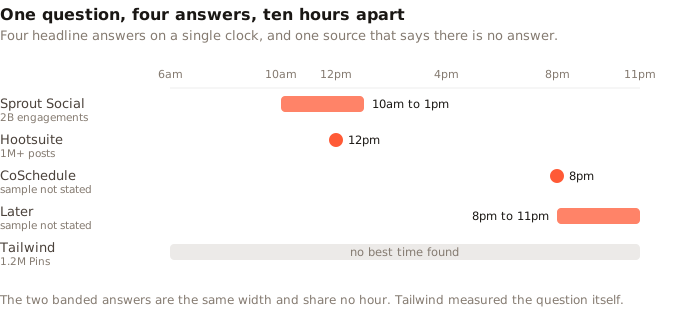
- Sprout Social analysed nearly 2 billion engagements across roughly 307,000 profiles between 27 November 2025 and 27 February 2026, and lands on Tuesday to Thursday, 10am to 1pm local time (Sprout Social, 2026).
- CoSchedule names 8pm its top hour, then 4pm, 9pm, 3pm and 2pm, from research it describes only as "proprietary research… conducted in mid-2022" (CoSchedule, 2024).
- Hootsuite analysed over 1 million posts with a data science partner and says 12pm on Tuesdays and Fridays (Hootsuite, 2025).
- Later says Tuesday through Friday, 8pm to 11pm, with no sample size, window or method stated for its Pinterest figures (Later, 2026).
- Tailwind studied 1.2 million organic Pins from more than 17,000 accounts and concluded there is no best time at all (Tailwind, 2026).
Sprout's headline window closes at 1pm. Later's opens at 8pm. Neither headline touches the other, and seven hours sit between them. This is not the usual argument about which hour is marginally better; it is a disagreement about which half of the day to work in. Sprout does name scattered afternoon hours further down its own table, which turns out to be the first crack in it. Whichever peak hours you believe, the practical range across the four that name a time runs from early morning to late evening.
Worth knowing: every company whose timing numbers appear on this page, Pinterest excepted, sells social media software or marketing services, and each one has a commercial interest in "when to post" being a hard problem. That does not make the numbers wrong. It does mean the most useful finding here comes from Tailwind saying the thing that helps it least.
The biggest Pinterest-only study found timing did not predict anything
Tailwind has been a Pinterest partner since 2012, which makes what it published worth more than its ranking position suggests.
Its study covers 1.2 million organic Pins published by 17,000+ accounts between 2023 and 2024, with paid Pins excluded. It measured success by outbound click volume, which is traffic to your own site rather than saves or impressions. It also discloses its own sampling bias: 26% of the Pins were scheduled through Tailwind and 74% were not.
It is the only page here that quantifies its own sampling bias. The finding, as its Pinterest page summarises Finding #14 of the benchmark study:
"There is no universal best time to post on Pinterest. Different content types attract audiences at different times, and trends change as audiences evolve."
And directly beneath it, four words: "Timing didn't predict success." What did, according to the same study, was consistency and fresh content with alt text on every Pin.
Tailwind is not alone in saying so, and this is the part the SERP hides. Two of the vendors that do publish a Pinterest schedule undercut it on the same page. Hootsuite prints its seven-day table and then heads the next subsection "Focus on SEO over timing", with its own strategist adding that "the platform prioritizes your SEO strategy over the time you post". Later gives an 8pm to 11pm window directly after saying Pinterest "functions more like a search engine than a social platform, which makes timing less critical".
One caveat worth stating plainly. Tailwind also reports that high-traffic Pins were "up to 54% more likely" to have been published through Tailwind. That is a vendor claiming its own customers do better. Nothing controls for the fact that people who pay for a scheduler already differ from people who do not. Take the null result, which cuts against Tailwind's commercial interest. Leave the 54%.
Where does the 8pm answer actually come from?
One dataset, collected in mid-2022, reprinted by four of the eight page-one results and by a fifth vendor off it.
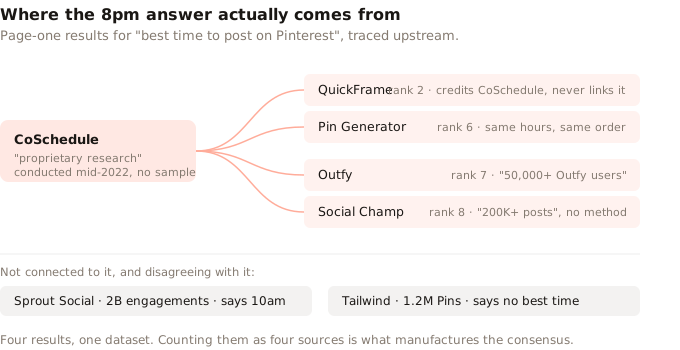
CoSchedule is upstream. Its Pinterest page ranks all 24 hours for each day of the week and puts 8pm first overall. Its stated basis is "proprietary research on the best times to post on social media conducted in mid-2022". No Pinterest sample size, no collection window, no methodology section. It was published 5 February 2024 and last updated 2 May 2024.
SocialPilot publishes three slots per day for Pinterest. All 21 of them fall inside CoSchedule's top four hours for the same day, on all seven days. SocialPilot's page says why. The site-wide 7-million-post dataset it advertises does not cover Pinterest. For this platform it "dived into a sea of Pinterest studies done by multiple leading websites" instead, and it names none of them.
Pin Generator, at rank six, reproduces CoSchedule's hourly ranking on all seven days, in exact rank order, truncated to the first 11 to 14 hours of each. Its one outbound citation on the page is the CoSchedule article. QuickFrame, at rank two, names CoSchedule four times and links to it zero times. Outfy, at rank seven, presents the same best days as a finding from "50,000+ Pinterest users on Outfy".
Social Champ, at rank eight, is the one to be careful with. It publishes a comparison table crediting Tailwind with "Evenings (8 to 11 PM); weekends" and Later with weekends. Tailwind's published position is that timing did not predict success. Later's published recommendation is Tuesday to Friday, which are weekdays. Both attributions are wrong on the page that presents itself as the data-backed study.
CoSchedule's own numbers put 3am in Friday's top seven
Read one level below the headline and the dataset starts to look like noise.
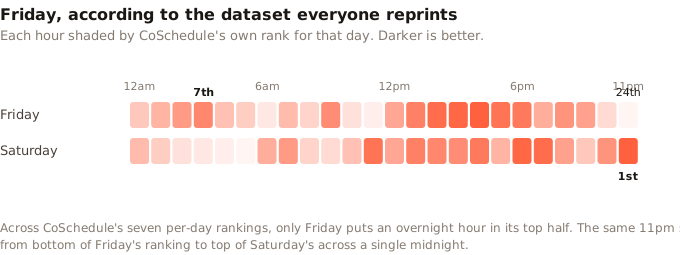
CoSchedule's aggregate list places the overnight hours, meaning midnight to 5am, where you would expect: 12am, 1am, 6am, 4am and 5am are its five worst. But its Friday ranking puts 3am seventh and 2am tenth out of 24. Across CoSchedule's seven per-day rankings, Friday is the only one that places any overnight hour in its top half.
The same day produces a second oddity. 11pm is Friday's 24th-ranked hour, dead last. On Saturday, 11pm is ranked first. One hour, bottom of one day's ranking and top of the next, separated by a single midnight.
Neither of these is a finding about Pinterest users. They are what a thin per-day sample looks like when it is published as guidance. And they propagate: the overnight half of Pin Generator's headline advice, to post "as well as 2 am and 4 am", starts in that Friday artefact and gets promoted to a general rule.
CoSchedule also disagrees with itself across two live pages, and this is the sharpest contradiction in the topic. Its Pinterest page names Sunday, Monday and Tuesday the best days and Thursday, Friday and Saturday the worst. Its social media page names Friday, Tuesday and Thursday best and Sunday, Saturday and Monday worst.
Line those two up and four of the seven days switch sides. Sunday is the single best day on one page and the single worst on the other. Monday does the same. Thursday and Friday move from worst to best. Only Saturday holds its position, at the bottom of both, and only Tuesday holds at the top of both.
Sprout's headline names a window its own table denies
The other camp has the same problem, in a smaller way.
Sprout's headline is "The best times to post on Pinterest are Tuesdays, Wednesdays and Thursdays 10 a.m. to 1 p.m." The table printed directly beneath it gives Thursday as 10am to 11am, and 2pm to 4pm. Thursday's data stops at 11am and does not pick up again until 2pm. The headline claims a window that runs to 1pm, and for the last two hours of it Sprout's own table says nothing.
Two more mismatches sit in the same block. The headline names three days; the "best days" row immediately below names all five weekdays. And Wednesday's row runs 8am to 1pm, two hours wider on the front end than the headline admits.
Sprout also breaks with itself across pages, on the weekend. Its study page lists "Worst days to post on Pinterest: Weekends". Its Pinterest scheduling article, published the previous month, says the opposite: "During the weekend, the audience shifts from a work mindset to personal inspiration and planning, making them highly receptive to discovery content." Same vendor, same quarter, same platform.
Buffer sells Pinterest scheduling and will not tell you when to post
This one is easy to miss, and it is worth the detour.
Buffer's 2026 study is the largest in the category: 52 million posts, and it is titled "Times for Every Major Platform". It covers Facebook, Instagram, LinkedIn, TikTok, YouTube Shorts, YouTube long-form, X and Threads. It splits YouTube into two entries to get there. Pinterest is not in it, and Pinterest is absent from the stated methodology too, which points to a data-collection exclusion rather than an editorial cut.
Buffer has not dropped Pinterest as a product. It actively markets Pinterest scheduling. Its help centre, updated 25 July 2026, says so and then adds one line:
"The 'best time to post' feature in Analyze is not available for Pinterest at this time."
A company with 52 million posts of publishing data, that sells Pinterest scheduling, neither collected Pinterest for its study nor ships the feature in its product. Its Pinterest help page then sends readers who want timing advice to the study that leaves Pinterest out.
When is the best time to post on Pinterest each day?
The three sources that publish per-day numbers, side by side. Do not average these columns. Sprout reports local time, Hootsuite says its times are "normalized across 118 countries" and time-zone agnostic, and CoSchedule tells you to apply its numbers in your audience's zone. Those are three different quantities and blending them produces a figure none of them measured. Both of the stated sample sizes are also cross-network totals: neither Sprout nor Hootsuite publishes how much of its data is Pinterest, and Pinterest is very likely the smallest of the six networks Sprout covers. The cross-platform comparison lines Pinterest up against the other six networks.
| Day | Sprout Social (2B, six networks) | Hootsuite (1M+, all networks) | CoSchedule (mid-2022) |
|---|---|---|---|
| Monday | 10am to 12pm, and 2pm to 3pm | 10am | 8pm, 4pm, 2pm |
| Tuesday | 7am, and 10am to 1pm | 12pm | 8pm, 9pm, 3pm |
| Wednesday | 8am to 1pm, and 3pm | 10am | 2pm, 4pm, 3pm |
| Thursday | 10am to 11am, and 2pm to 4pm | 6pm | 8pm, 2pm, 6pm |
| Friday | 10am to 11am | 12pm | 4pm, 3pm, 2pm |
| Saturday | Worst day, no window given | 1pm | 11pm, 6pm, 7pm |
| Sunday | Worst day, no window given | 4pm | 8pm, 12pm, 9pm |
Count the hours any two sources share and the week splits four days to three. Monday, Wednesday and Thursday each have two points of contact. Tuesday has one. Friday, Saturday and Sunday have none at all.
One result is worth sitting with. Across all seven days and all three sources, there is not a single hour that all three name. Not one. Every point of contact in the table above is a pair, never a trio.
Best time to post on Pinterest on Monday
10am is the best-supported Monday hour: it is Hootsuite's only Monday slot and it sits inside Sprout's 10am to 12pm window. A second option is 2pm, CoSchedule's third-ranked Monday hour, which lands inside Sprout's 2pm to 3pm window. Both points of contact run through Sprout. CoSchedule names 8pm its Monday peak and nothing else supports it.
Best time to post on Pinterest on Tuesday
12pm is the Tuesday hour with the most behind it: Hootsuite names it outright and it falls inside Sprout's 10am to 1pm window. Sprout adds an early 7am slot. CoSchedule goes elsewhere entirely with 8pm, 9pm and 3pm. Tuesday is the one day every source puts on its best-days list, as the next section shows, but that agreement stops at the day. On the hour, only Sprout and Hootsuite meet.
Best time to post on Pinterest on Wednesday
Wednesday has Sprout's widest window of the week, 8am to 1pm, plus a separate 3pm slot. Both of the other sources touch it. Hootsuite's 10am falls inside the wide window, and CoSchedule's third-ranked 3pm lands on Sprout's separate 3pm slot exactly. Wednesday gives you the widest margin for error on the hour, where Tuesday gives you the firmest footing on the day.
Best time to post on Pinterest on Thursday
2pm is the best-supported Thursday hour, sitting in Sprout's 2pm to 4pm block and ranking second on CoSchedule's Thursday list. 6pm is the runner-up, named by Hootsuite and ranked third by CoSchedule. Thursday is the only day where the two sources that are not Sprout agree with each other. It is also where Sprout's headline breaks: its table runs 10am to 11am and then 2pm to 4pm, leaving a hole in the middle of the window the headline claims.
Best time to post on Pinterest on Friday
Friday has no agreed hour at all. Sprout gives 10am to 11am, Hootsuite says 12pm and calls Friday its best day, and CoSchedule says 4pm, 3pm and 2pm. No two of the three share an hour. Friday is the only day where all three sources name times and none of them overlap, since the weekend rows are empty for Sprout rather than contradictory. It is also the row that puts 3am seventh, so it is the least trustworthy in the table. Treat anything you post on a Friday as your own experiment.
Best time to post on Pinterest on Saturday
1pm and 11pm are the two Saturday candidates, and they come from sources that disagree about whether to post at all. Hootsuite gives 1pm and defends it, arguing weekend afternoons are when people act on what they saved. CoSchedule ranks 11pm first on Saturday, the same hour it ranks 24th and last on Friday, while separately naming Saturday one of its three worst days. Sprout omits Saturday entirely and files the weekend under worst days. CoSchedule's top-ranked hour for the day sits on a day the same page tells you to avoid.
Best time to post on Pinterest on Sunday
8pm is CoSchedule's top Sunday hour and 4pm is Hootsuite's, with Sprout naming none because it files the weekend under worst days. Sunday is where that contradiction bites hardest: CoSchedule's Pinterest page ranks it the best day of the week, while CoSchedule's social media page lists Sunday among the worst. If you sell to consumers planning their week, Sunday evening is a reasonable bet. Just know you are betting on one four-year-old dataset that its own publisher contradicts.
What is the best day to post on Pinterest?
Tuesday, and it is the only day that survives. Take each source's best-days list and intersect them, the same method the X article uses to land on Wednesday and Thursday there:
| Source | Best days as printed |
|---|---|
| Sprout Social | Monday to Friday |
| CoSchedule, Pinterest page | Sunday, Monday, Tuesday |
| CoSchedule, social media page | Friday, Tuesday, Thursday |
| Hootsuite | Tuesday and Friday |
| Later | Tuesday to Friday |
Tuesday is in all five sets, including both of CoSchedule's mutually contradictory pages. Friday is next at four, and nothing else clears three.
Two honest caveats. Sprout's contribution is weak, because its best-days row names every weekday, so the work here is really done by CoSchedule, Hootsuite and Later. And Hootsuite's own summary table drops Tuesday and prints Friday alone, even though its per-day list puts Tuesday and Friday at the same hour. The intersection holds on what the detailed tables print rather than on what the summary boxes say.
The day has an answer and the hour does not. No hour anywhere in the week is named by all three sources with per-day tables, which is why the rest of this article is about provenance rather than a schedule.
Does Pinterest say when to post?
No. No best hour and no best day turned up on any Pinterest-owned property that could be checked: the business help centre, the business blog, Pinterest Create, the newsroom and the developer docs.
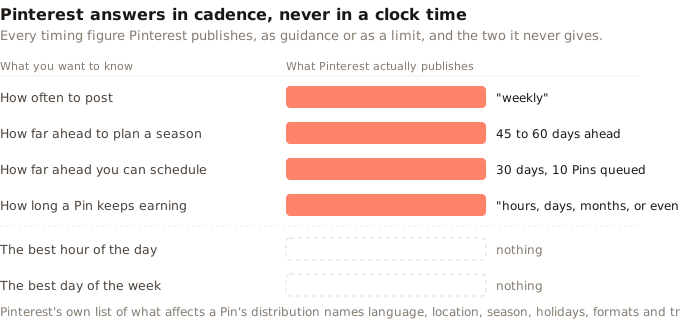
What Pinterest publishes instead is cadence and season. Its help centre says to "aim to create original content weekly", and three other Pinterest pages repeat the weekly figure. Its creator education tells you to "plan your content calendar 45 to 60 days in advance". Every timing figure Pinterest publishes as guidance is measured in days, weeks or months. The only hours it names run the other way, describing how long a Pin keeps earning rather than when to publish it.
The most useful thing on any of those pages is what is missing from a list rather than what is on it. Pinterest enumerates the things that affect a Pin's distribution: "language, location, seasons, holidays, formats and trending topics". Time of day is not among them.
Pinterest is also unusually blunt about how long a Pin works for. Its help centre states there is "no set engagement window for Pins" and that one can gain engagement "hours, days, months, or even years" after publishing. Its business site adds that content "isn't chronological, it's personal" and "lives forever on Pinterest".
While we are here: the "a Pin has a 3.5-month half-life" statistic you have seen everywhere is not Pinterest's. It traces to a 2013 study by Piqora, an analytics vendor that no longer operates. The "1,680 times longer than a Facebook post" line is arithmetic performed on that same study. Both are thirteen years old, and no modern measurement has replaced them.
Does posting time affect the Pinterest algorithm?
Content age does, and it runs backwards from what everyone assumes. Time of day appears nowhere in Pinterest's published ranking work.
On 24 July 2026 Pinterest published a paper describing PinEqualizer. It is the system that handles new content across Homefeed, Related Pins and Search, which together carry 92% of total content impressions on the platform. The paper names a "content age signal" as an input to its ranking model. That sounds like the recency term X publishes in its own ranking features.
It is the opposite. Pinterest built it to fix a bias toward old content. The paper's own words:
"it is critical to reduce the system's overall bias towards old content to ensure new content has a fair chance"
and, on why the correction was needed at all:
"the model will tend to under-predict for fresh content and over-predict for old content"
The reason is structural and it explains a great deal about this platform. Pinterest's retrieval leans on a graph of which Pins are saved to which boards, and older Pins have had years to accumulate those edges. Left alone, the system rewards Pins for having existed. Age on Pinterest is a handicap the platform actively corrects for, not a decay curve you can outrun by posting at the right hour.
Compare that with X and Instagram. X's published ranking features include time_since_tweet_creation, an explicit post-age feature. Instagram files timing under "more mundane information about the content itself". Pinterest is the only one of the three whose published work treats content age as something to compensate for.
How do you schedule Pins on Pinterest in advance?
Pinterest has a native scheduler. It takes four steps, and three of them carry a hard limit.
- Switch to a business account. Scheduling is a business-account feature; converting is free and keeps your existing Pins and boards.
- Create the Pin as normal, then choose "Publish at a later date" and pick the day and time.
- Stay inside the limits. Pinterest allows up to 30 days in advance, one Pin scheduled at a time, and up to 10 Pins queued for the future.
- Edit afterwards if you need to. The date, title, board, description and link can all be changed later. The image or video cannot.
That is the whole native feature, and it is not the same thing as a queue.
Note a wrinkle worth knowing before you plan around it: a second Pinterest help page says you can schedule "up to two weeks in advance". Both pages are live. The scheduling page is the one that matches the product, so 30 days is the number to work with.
The bigger constraint is invisible from the outside. Pinterest's v5 API has no scheduling parameter for organic Pins. The published OpenAPI specification, version 5.28.0, contains no publish_at, scheduled_at or publish_date field anywhere, and the create-Pin endpoint takes no time parameter of any kind. The scheduling concepts that do exist in the spec belong to ad campaigns and catalog feed processing, not to organic Pins. Every third-party Pinterest scheduler must therefore hold the queue on its own side and fire the create call at the target minute, Zilfu included. Nothing is handed to Pinterest in advance.
That matters for two practical reasons. Pinterest's 30-day, 10-Pin ceiling does not apply to a third-party queue, and a scheduler that goes down at 8pm means the Pin does not go out at 8pm.
How often should you post on Pinterest?
Weekly is the only cadence number Pinterest publishes, and it declines to give a daily one.
Pinterest tells creators to focus on the content itself "rather than anchoring to a specific number of Pins per week". The single per-day figure anywhere in its documentation is a technical ceiling of 200 Pins per day on RSS auto-publishing, which is a rate limit rather than advice. Every "3 to 5 fresh Pins a day" rule in circulation is third-party.
"Fresh Pins" is worth a moment too, because the term is treated as a Pinterest feature and is not one. Pinterest never defines it. The word appears once in its distribution help page, as an ordinary adjective: publish Pins "with fresh, new content instead of saving other people's Pins". The elaborate rules you have read about new images on existing URLs are built on that one sentence.
Be careful where Pinterest timing numbers come from
Two traps are specific to this topic.
The Pinterest.com result is not Pinterest's advice. The third organic result for this query is pinterest.com/ideas/best-times-to-post-on-pinterest/, which reads as an official answer and is not one. Pinterest's robots.txt blocks generic crawlers site-wide, blocks Googlebot from its search, explore and board paths, and deliberately leaves /ideas/ open. It then submits eight separate ideas_hub sitemaps, one of them named for Google Search Console query terms and another marked auto-publish. This is a keyword-seeded page factory, populated with Pins that users saved. It ranks third for a question about Pinterest by collecting other people's claims about Pinterest.
Recency in the headline is not recency in the data. Three of the page-one results carry 2026 in the title. The numbers underneath the largest cluster of them were collected in mid-2022, before the current ranking system described above was deployed. Check the methodology date rather than the title date, on this topic more than most.
How do you find your own best time on Pinterest?
Pinterest is the one network in this series where the test design matters more than the schedule, because the metric behaves differently.
- Test the halves of the day, not the hours. The disagreement is 10am against 8pm, so run those. Anything finer than that is measuring noise, which is exactly what the Friday chart above shows happening to a dataset that had a whole year to average out.
- Measure outbound clicks, not impressions. Tailwind used outbound clicks precisely because it is the metric that reflects traffic rather than browsing. Pinterest reports impressions, saves, Pin clicks and outbound clicks separately, and they can move independently.
- Hold the Pin itself constant. Same board, same aspect ratio, same keyword-led title and description. Pinterest's own distribution list is dominated by relevance factors, so an untitled Pin at the perfect hour tells you nothing.
- Read the results late, then read them again. This is the big one. Pinterest states there is no set engagement window, and per-post analytics report Pinterest metrics over a rolling 90 days. A Pin's numbers keep moving for months. Comparing a 10am Pin and an 8pm Pin at 24 hours measures the first few hours of home-feed distribution and almost nothing about the Pin.
- Expect the answer to be "it does not matter much". That is what the largest study found, and it is a genuinely useful result: it frees you to spend the effort on cadence and keywords instead.
How do you hold those slots without doing it by hand?
The awkward part of a Pinterest test is not the posting, it is the months of patience that come after it. Pinterest reports on a rolling 90 days, so the fortnight of posting is the short part.
Because nothing is handed to Pinterest in advance, your queue has to fire on time. Zilfu polls for due posts once a minute, so an 8pm Pin publishes at 8pm. Recurring weekly slots then hold both halves of the test for the full fortnight.
Pinterest also wants a business account and a board for every Pin. Zilfu lists your boards when you compose, then lets you set a title and a destination link per Pin. That link is the whole point of the exercise. Without one there is no outbound click to count.
For reading the result, Pinterest's metrics are genuinely unlike the other networks and the analytics reflect that. There is no like count and no comment count, because Pinterest's analytics API serves neither metric. What you get is impressions, saves, Pin clicks and outbound clicks, each over a rolling 90-day window, refreshed every few hours. Compare two Pins at the same age rather than at the same wall-clock moment, or the earlier one will always look better.
Running this across several Pinterest accounts works the same way, one workspace per brand or client; see Zilfu for business or Zilfu for agencies.
Start with cadence, not the clock
The honest summary is that this question has a weaker answer than the internet's confidence suggests. The largest Pinterest-only study, 1.2 million Pins, found that timing did not predict success. The vendor with the largest stated post corpus in the category excluded Pinterest from its study and does not ship the feature in its product. The most-repeated hour on the internet traces to one undisclosed dataset from mid-2022 that contradicts itself within its own tables and across its own pages.
So take the thing Tailwind and Pinterest itself agree on: post consistently and make the Pin findable. Weekly is Pinterest's own number. If you want a starting slot while you build that habit, Tuesday around midday is the best-supported guess: Tuesday is the only day named by every source that names days, and 12pm is the only Tuesday hour with more than one source behind it. CoSchedule dissents and says 8pm, which is exactly the test to run. The free plan covers 2 connected accounts and 15 posts a month, which is a full month of twice-weekly pinning with room to test an extra slot.
Pinterest is the network most often left out of these studies altogether. The cross-platform comparison shows which datasets cover it and which quietly skip it.
Sources
All sources retrieved 1 August 2026.
- Tailwind. The best time to post on Pinterest. Originally published January 2021, last updated March 2026. 1.2 million organic Pins across 17,000+ accounts, 2023 to 2024, paid Pins excluded, measured by outbound clicks. The only page in this set that discloses its own sampling bias.
- Sprout Social. Best times to post on social media. Published 31 March 2026, nearly 2 billion engagements across roughly 307,000 profiles, 27 November 2025 to 27 February 2026. Sample spans six networks; no Pinterest-only figure is given.
- Sprout Social. How to schedule Pinterest posts for maximum reach. Published 25 February 2026. Source for the weekend statement that contradicts the study page.
- CoSchedule. Best times to post on Pinterest. Published 5 February 2024, updated 2 May 2024, data described only as conducted in mid-2022. No sample size stated. Source for the full 24-hour per-day rankings.
- CoSchedule. Best times to post on social media. Source for the Pinterest best-day list that contradicts the page above.
- Hootsuite. Best time to post on social media. Published 19 November 2025, over 1 million posts with Critical Truth; times normalised across 118 countries. Its own advice for this network is to focus on search over timing.
- SocialPilot. Best times to post on social media. Published 2 December 2025. Its Pinterest section states its numbers came from other websites' studies rather than its own dataset.
- Later. Best time to post on social media. Updated 6 May 2026. Gives Pinterest one line and no per-day table.
- Buffer. The best time to post on social media in 2026. Published 25 March 2026, 52 million posts. Pinterest appears nowhere in the body or the methodology.
- Buffer. Using Pinterest with Buffer. Updated 25 July 2026. Source for the best-time feature being unavailable for Pinterest.
- Pin Generator. When is the best time to post on Pinterest? Published 8 May 2024. Reprints CoSchedule's rankings on all seven days in exact rank order, including the Friday overnight artefact. Its one outbound citation is the CoSchedule page.
- QuickFrame. When is the best time to post on Pinterest in 2026? Published 15 July 2026. No dataset, sample or window of its own; names CoSchedule four times and links to it zero times.
- Outfy. Best time to post on Pinterest in 2026. Updated 24 April 2026. Cites "50,000+ Pinterest users on Outfy" and reaches CoSchedule's best-days list verbatim; no post count, window or metric stated.
- Social Champ. Best time to post on Pinterest in 2026. Published 13 November 2025, updated 1 January 2026. Source for the misattributed comparison table; its "200K+ posts" figure appears in the title and nowhere in the body.
- Pinterest. Auto-publish Pins from your RSS feed. Source for the 200 Pins per day ceiling.
- Pinterest. Create: fundamentals and best practices. Source for the 45 to 60 day planning lead time.
- Pinterest. robots.txt. Source for the sitewide crawler block, the Googlebot rules that exclude
/search/,/explore/*and/board/*but not/ideas/, and the eightideas_hubsitemaps. - Forbes. Study finds Pins on Pinterest drive sales and have legs. Published 15 November 2013. Contemporary reporting on the Piqora study behind the "3.5 month half-life" figure.
- Pinterest. Schedule Pins. Source for the 30-day, one-at-a-time, 10-queued limits.
- Pinterest. Pin performance and distribution. Source for the weekly cadence line, the distribution factor list, the no-set-engagement-window statement, and the conflicting two-week scheduling figure.
- Pinterest. How Pinterest works. Source for content not being chronological and Pins lasting indefinitely.
- Pinterest. PinEqualizer: full funnel content exploration and debiasing system at Pinterest. Submitted 24 July 2026. Source for the content age signal, the old-content bias, and the 92% impression share.
- Pinterest. API v5 OpenAPI specification, version 5.28.0. Source for the absence of any scheduling parameter on organic content endpoints.