Playbook
Best Time to Post on Instagram 2026: 5am or 7pm?
The best time to post on Instagram is midweek afternoon, Tuesday or Wednesday. That is the only ground the three major 2026 studies share. Past those two days they stop agreeing about the hour, the day, and even which half of the day is right: Buffer's 9.6 million posts point at evenings, Sprout Social's data at midday, and Later's 6 million posts at 5am.
Key takeaways
- Later's core window, 3am to 6am, shares no hour with either of the other two studies.
- Later's own industry table contradicts its 5am headline: none of its 8 industries is told to post before 6am.
- Sprout's "2 billion engagements" covers six networks. No Instagram-only sample size appears on the page.
- Instagram's ranking explainer files when a post was published under "mundane information".
What is the best time to post on Instagram?
Midweek afternoon is the safest answer, because Tuesday and Wednesday are the only days any two of the three actually agree on. Everything else is contested. Three large analyses were published for 2026 and they disagree at the level of half-days, not hours.
- Buffer analysed 9.6 million Instagram posts from over 200,000 accounts published between January 2024 and December 2025, scoring them by median engagement rate. It names Thursday at 9am the single best slot, and says evenings from 6pm to 11pm are strongest on every weekday except Thursday. Its own day-by-day table then puts Wednesday's peak at noon, so even that summary does not quite survive its own numbers (Buffer, 2026).
- Sprout Social identified peak windows between 27 November 2025 and 27 February 2026 and points at the middle of the day: Wednesdays noon to 9pm, Tuesdays 1pm to 7pm (Sprout Social, 2026).
- Later analysed more than 6 million Instagram feed posts and concluded the best time is 5am, with Monday the best day (Later, 2026).
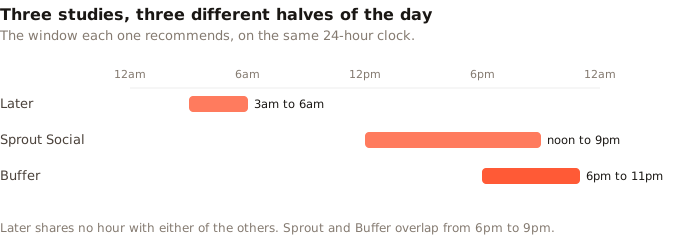
Put the three dominant windows on one clock and the scale of the disagreement is obvious. Later's core window shares no hour with either of the other two. Sprout and Buffer at least overlap, from 6pm to 9pm. This is not three studies quibbling about whether 11am beats noon. It is three studies that cannot agree whether Instagram is a pre-dawn, midday or evening platform.
Why do the studies disagree?
Because they measured different things over different periods, and only one of them tells you exactly what it counted.
- Different metrics. Buffer is the only one that publishes its formula: median engagement rate, defined as likes plus comments plus shares plus saves, divided by followers. Sprout describes "peak engagement windows" and Later "engagement rate", neither with a definition. You cannot reconcile numbers whose denominators are undisclosed.
- Different periods, and one badly stale. Sprout's window is three months ending February 2026. Buffer's runs two years to December 2025. Later's data is from January to October 2024, roughly eighteen months old when the page was updated in April 2026, and the page does not flag this anywhere.
- Different clocks. Sprout reports in local time. Buffer says its data scientist normalised the times so they "apply to any timezone". Later says its figures are normalised to your audience's local time zone. Three different treatments of the one variable that decides whether any of this transfers to you. The cross-platform comparison names the source behind every network's windows for the same reason.
Worth knowing: Buffer adds a caveat that quietly undercuts the entire genre, including its own table. Its times, it says, are "times your followers are using Instagram, not necessarily when they are most likely to engage with your content". Those are different questions, and every chart on this topic answers the first while being read as the second.
One article, two incompatible answers
Later is the clearest case, and it is worth looking at closely because it shows how little scrutiny these tables get.
Every one of Later's day-by-day recommendations falls between midnight and 6am, plus two entries at 11pm. Its reasoning is stated and not unreasonable: post before the crowd, meet less competition, and still catch people on their first scroll hours later. But further down the same page sits a table of best times by industry, and every row but one recommends business hours or evening. The exception, health and wellness at 6am, is the single point of contact between the two sections.
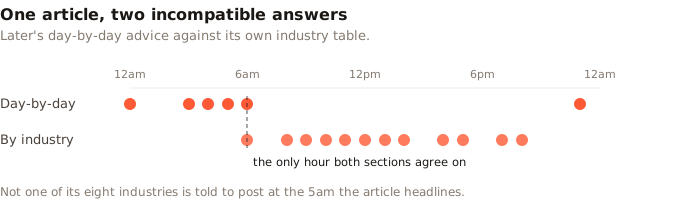
Retail is told noon and 7pm. Travel 9am and 1pm. Tech 10am and 2pm. Not one of the eight industries is told to post at the 5am the article headlines, and the only hour the two sections share at all is 6am. The page never acknowledges the gap.
That is not a reason to dismiss Later's dataset, which is large and its logic is coherent. It is a reason to stop treating any of these tables as a finished answer.
What Sprout's headline number does not tell you
Sprout's figure is the one most often quoted second-hand: nearly 2 billion engagements across roughly 307,000 profiles. Read the methodology and that sample spans six networks, Facebook, Instagram, LinkedIn, Pinterest, TikTok and X. No Instagram-only sample size appears anywhere on the page. The headline number is not the Instagram number, and almost nothing citing it says so.
Its own sections also disagree with each other twice.
- It states there are no significant peak engagement hours on Fridays, then lists Friday peaks for six of the nine industries it breaks out. Retail gets noon to 3pm, food and beverage 11am to 1pm.
- It names weekends the worst days, then gives schools and education a five-hour Saturday window of 3pm to 8pm.
Sprout's industry tables are the most useful part of its page and the part least likely to be quoted. The Facebook version of this question shows the sharper form of it: there, all nine of Sprout's industry tables open before noon, against its own afternoon headline.
When is the best time to post on Instagram each day?
All three, side by side, in each source's own words. Buffer gives ranked slots, Sprout gives windows, Later gives single hours.
| Day | Buffer (9.6M posts) | Sprout Social | Later (6M posts) |
|---|---|---|---|
| Monday | 7pm, then 6pm or 8pm | 2pm to 4pm | 5am, 11pm |
| Tuesday | 7pm, then 3pm or 5pm | 1pm to 7pm | 5am |
| Wednesday | 12pm, then 6pm or 8am | 12pm to 9pm, and 11pm | 3am |
| Thursday | 9am, then 8am or 7am | 12pm to 2pm | 4am to 5am |
| Friday | 10pm, then 9pm | No significant peak hours | 3am to 6am |
| Saturday | 9pm, then 10pm or 8pm | Lowest engagement of the week | 5am |
| Sunday | 9pm, then 10pm or 8pm | One of the worst days | 12am, 5am, 11pm |
What is the best time to post on Instagram today?
If you want a good time to post on Instagram today rather than a perfect one, take today's row in the table above and pick the column whose method you trust most. Buffer publishes its formula, so it is the defensible default; Sprout is the most recent; Later is the outlier worth testing rather than following.
Two shortcuts if you would rather not choose a side. If today is Tuesday or Wednesday, post in the afternoon, because those are the only days two of the three land on the same hours. On any other weekday, early evening is the safest general answer: it sits inside Buffer's strongest band on every weekday except Thursday, and inside Sprout's Tuesday and Wednesday windows.
If today is Saturday or Sunday, the sources split hardest. Buffer gives both days a 9pm peak while Sprout writes the weekend off entirely, so treat anything you publish then as a test.
Best time to post on Instagram on Monday
Buffer's Monday peak is 7pm, then 6pm and 8pm. Sprout gives a narrow 2pm to 4pm. Later says 5am, and separately 11pm. Three sources, three different parts of the day, with no shared hour. Monday is the least settled day on the calendar, and a poor place to spend your best post.
Best time to post on Instagram on Tuesday
Buffer peaks at 7pm, then 3pm and 5pm. Sprout runs a wide 1pm to 7pm and ranks Tuesday joint-best of the week. Later says 5am. Buffer's 3pm and 5pm both fall inside Sprout's window, and its 7pm sits on the boundary. Tuesday and Wednesday are the only two days where the two datasets land on the same hours at all, which makes Tuesday afternoon the joint-best-supported block in this article.
Best time to post on Instagram on Wednesday
Buffer peaks at 12pm, then 6pm and 8am, and names Wednesday the best day of the week. Sprout gives Wednesday its widest window of any day, noon to 9pm, plus a spike at 11pm. Later says 3am. Buffer's noon and 6pm both sit inside Sprout's window. Wednesday is one of only two days where that happens, and the one where Buffer also ranks the day first outright, which is what edges it ahead of Tuesday. If you take one thing from this page, take Wednesday midday.
Best time to post on Instagram on Thursday
Buffer peaks at 9am, its single best slot of the entire week, then 8am and 7am. Thursday is the one weekday where Buffer finds mornings beat evenings. Sprout runs noon to 2pm, three hours later. Later says 4am to 5am. Thursday morning has one strong dataset behind it and no corroboration.
Best time to post on Instagram on Friday
Sprout gives up on Friday: it names no peak at all in its all-industry data, though six of its nine industry tables list one anyway. Buffer's picks are 10pm and 9pm, the latest of its week, and Later says 3am to 6am. Friday is the day the sources are least useful on, and the day Sprout openly gives up.
Best time to post on Instagram on Saturday
Sprout calls Saturday the lowest-engagement day of the week. Buffer disagrees flatly, giving it a 9pm peak followed by 10pm and 8pm, and Later says 5am. Buffer treats the weekend as ordinary while Sprout writes it off, and Sprout's own schools and education table then recommends Saturday afternoons anyway.
Best time to post on Instagram on Sunday
Buffer peaks at 9pm, then 10pm and 8pm, the same shape as Saturday. Sprout calls Sunday one of the worst days to post. Later gives it three slots, midnight, 5am and 11pm. If you post on Sunday, the evening has the only real support.
What is the best day to post on Instagram?
Wednesday, on the balance of evidence. Buffer names it the best day, followed by Thursday and Tuesday. Sprout puts Tuesdays and Wednesdays highest and gives Wednesday its longest window. Later disagrees and names Monday, which is consistent with its pre-dawn framing and inconsistent with everyone else. The disagreement is wider still on TikTok, where one study calls Saturday the best day of the week and another calls it a dead zone.
Two of three point at Wednesday, and both it and Tuesday are days where their actual hours coincide rather than merely their rankings. Wednesday's edge is that Buffer ranks it first outright while placing Tuesday third. The cross-platform comparison lines that pattern up against the other networks.
Does Instagram say when to post?
No, and it is worth knowing how far that goes. Instagram's creator best-practices hub covers how often to post and how long Reels should be. It does not address time of day or day of week at all. The audience-insights guidance that used to sit on the Instagram business blog now redirects away to Meta's general business news.
How do you check your best time to post on Instagram?
What Instagram offers instead of a universal answer is a per-account one. On a Professional account, Insights includes a followers view reporting when your followers are most active, and that reading beats every table on this page because it is drawn from your actual audience.
Two things before you rely on it. The labels and the route to that view have moved more than once, so go by what your app currently shows rather than by any guide, including this one. And Instagram does not document the period the figures cover, so read the shape of the curve rather than treating the numbers as precise.
Does posting time affect the Instagram algorithm?
It is a signal, and Instagram says so, but it says so in a revealing way. Its ranking explainer, published under Adam Mosseri's byline, groups the signals it uses. Popularity and velocity come first: how many people liked a post and how quickly people are liking, commenting, sharing and saving it. Then it adds "more mundane information about the content itself, like when it was posted, and what location, if any, was attached to it" (Instagram).
Timing is in the list, filed under mundane. That framing fits the evidence on this page better than any of the tables do. Posting time does not make a post rank. It decides who is nearby to react in the first minutes, and the speed of that reaction is what Instagram says it actually weighs.
Which is why the honest version of the advice is unglamorous: post when your people are awake, then be there to reply.
Be careful with Instagram quotes you find in search results
One thing surfaced while researching this article that will affect anything else you read on the subject.
In December 2025 Meta confirmed it had begun using AI to generate the titles of Instagram posts as they appear in search engine results, saying it did so to help people understand the content. Those AI-written titles are served to search engines and are not what a visitor sees on Instagram itself. Meta acknowledged they are not always accurate, and reporting on the change documented headlines that described things the creator never said (Social Media Today, 2025; Engadget).
The practical consequence: an instagram.com result that appears to quote someone at Instagram is not necessarily quoting them. The same trap runs on x.com, covered in the X version of this question. If a claim about Instagram matters to a decision you are making, trace it to a page Instagram publishes rather than to a search result pointing at a post. This article's ranking material comes from Instagram's own blog for exactly that reason.
What is the best time to post Instagram Reels?
Exactly one of the three actually measured it, and it is not the one usually quoted.
Later analysed over 975,000 Reels separately from its main sample and puts the best time at midnight, best day Monday, with strong engagement running to 6am. That is consistent with its pre-dawn finding for everything else, which is either corroboration or the same methodological quirk showing up twice.
Buffer suggests 6pm to 11pm on Wednesdays and Thursdays, but the same page states it "looked at all post types together rather than splitting the numbers out by format". Its Reels recommendation is therefore not derived from Reels data. Sprout takes a third position entirely and argues format is irrelevant, saying the algorithm prioritises user activity times over content type.
So the only Reels-specific sample on the table says midnight, and the most-quoted Reels advice is not really about Reels. What Zilfu can schedule to Instagram, including Reels and carousels, is set out on the Instagram channel page.
How do you find your own best time in 14 days?
The three studies point at three different parts of the day, so pick one representative from each camp and let your own account settle it. Two weeks gives a directional answer.
- Take one slot from each camp. Wednesday noon represents Buffer and Sprout together, Tuesday 7pm represents the evening case, and an early slot represents Later. Testing three times within one camp cannot tell you which camp your audience belongs to.
- Check your own followers-activity view first. If it points somewhere none of the three suggest, use that as a fourth slot. It is the only reading taken from your actual followers.
- Hold everything else constant and let a queue fire the slots. Same rough format and topic mix. A slot missed by an hour is a data point lost, which is what recurring weekly slots are for. The routes that can fire them, and what each one breaks on, are in automating Instagram posting.
- Compare early reach, not lifetime totals. Totals are contaminated by how good each post was. Reach at the first snapshot after publishing isolates the timing effect better, and early reaction speed is the thing Instagram says it weighs.
- Drop the weakest, double the strongest, repeat. Three cycles gives you a schedule built on your audience rather than someone else's sample.
One limit worth naming: this measures people who already follow you, not Instagram at large. That is the right population anyway, because their early reaction is what decides whether the post travels further.
How do you hold those slots without doing it by hand?
An evening-versus-midday test is exactly the kind that dies from inconsistency. Wednesday noon is easy to hit; Tuesday 7pm and a pre-dawn slot are not, and a fortnight of comparisons falls apart if half the posts land whenever you remembered. Defining the slots once and letting a queue fire them is what makes the comparison mean anything. Zilfu checks for due posts every minute, so a 7pm slot goes out at 7pm.
Two details matter for the test itself. A post that fails to publish lands in an Error state with the reason attached, so a broken slot never gets mistaken for a weak one. And per-post analytics pull reach, likes, comments and saves back from Instagram, which is the comparison the whole exercise depends on. Those refresh every few hours rather than instantly, so read each slot at the same point in its life.
If you run more than one Instagram account, several accounts on one workspace count against a single flat cap, so running the same test on two of them does not change the bill.
Start midweek, then let your own data argue
The three largest 2026 studies disagree about which half of the day Instagram belongs to, and each one contradicts itself somewhere. That is not a reason to ignore them; it is a reason to treat the little they agree on as the starting line. Post midweek in the afternoon, Wednesday for preference, since Tuesday and Wednesday are the only days two independent datasets land on the same hours.
Then stop reading tables and generate your own. The best time to post on Instagram for your account is a number only your followers can supply. Check your followers-activity view, run the fortnight against it, and let the result overrule everything above. Zilfu's plans start at $19/month for 10 connected accounts, with unlimited posts, team members, approvals, and API access.
Instagram is one of seven networks these studies cover, and they contradict each other differently on each. The cross-platform comparison works through where they agree and where they do not.
Sources
All sources retrieved 31 July 2026.
- Buffer. Best time to post on Instagram in 2026: new data from 9.6 million posts. Published 14 July 2026, covering January 2024 to December 2025.
- Sprout Social. Best times to post on Instagram in 2026. Published 31 March 2026, covering 27 November 2025 to 27 February 2026. Sample spans six networks.
- Later. Best time to post on Instagram in 2026. Updated 21 April 2026, data from January to October 2024.
- Instagram. Instagram ranking explained, by Adam Mosseri. Source for how timing is classified among ranking signals.
- Instagram. Best practices for creators. Covers posting frequency, not time of day.
- Meta. Introducing Best Practices, an education hub for creators on Instagram.
- Social Media Today. Instagram is using AI to generate SEO summaries of posts. Published 10 December 2025.
- Engadget. Instagram is generating SEO-bait headlines for its users' posts.
Frequently asked questions
What is the best time to post on Instagram in 2026?
There is no agreed answer. Buffer puts the single best slot at Thursday 9am and finds evenings strongest on every other weekday. Sprout Social points at midday, noon to 9pm on Wednesdays. Later says 5am. Start midweek afternoon: Tuesday and Wednesday are the only two days where Buffer's slots land inside Sprout's windows.
What is the best day to post on Instagram?
Wednesday has the most support. Buffer names it the best day of the week, followed by Thursday and Tuesday, and Sprout Social gives Wednesday its widest window of any day at noon to 9pm. Later disagrees and names Monday. If you post once a week, Wednesday is the safest choice.
Does Instagram say when to post?
No. Instagram publishes guidance on how often to post in its creator best-practices hub, but no guidance on time of day or day of week anywhere. What it offers instead is a followers-activity view inside Insights on Professional accounts, which reports on your own audience rather than a universal answer.
Does posting time affect the Instagram algorithm?
It is a signal, but a minor one by Instagram's own description. Its ranking explainer lists when a post was published under "more mundane information about the content itself", separate from the popularity and velocity signals it describes first. Timing decides who is around to react early; the reaction is what carries the post.
What is the best time to post Instagram Reels?
Only one source has actually measured it. Later analysed over 975,000 Reels specifically and puts the best time at midnight, best day Monday. Buffer suggests 6pm to 11pm on Wednesdays and Thursdays but states on the same page that it analysed all post types together rather than splitting by format, so its Reels answer is not derived from Reels data. Sprout Social argues format does not matter at all.
Is 5am really the best time to post on Instagram?
It is Later's finding, from more than 6 million posts, and its reasoning is that early posts meet less competition and still catch the first scroll hours later. But Later's own industry table recommends business hours or evening for seven of its eight industries, the eighth opens at 6am, and none is told to post at 5am. Test it rather than adopting it.
What is the worst time to post on Instagram?
Sprout Social names Saturday the lowest-engagement day of the week and Sunday one of the worst. Buffer disagrees, giving both weekend days a 9pm peak, and Later gives Saturday 5am. There is no unanimous worst day, which is a reasonable signal that the differences between these datasets outweigh the differences between days.
What is the most active time on Instagram?
That is a different question from the best time to post, and no source on this page answers it. Buffer notes its own figures are "times your followers are using Instagram, not necessarily when they are most likely to engage with your content". Nobody publishes a platform-wide activity curve. Your followers-activity view in Insights is the only honest answer.
What is the golden hour to post on Instagram?
It usually means the first hour after publishing. There is no Instagram-published definition, but the underlying idea is sound: Instagram's ranking explainer says it weighs how quickly people like, comment, share and save a post, not just how many do. Being present to reply in that window is worth more than moving the timestamp.
What is the 5-3-1 rule on Instagram?
A popular posting-mix heuristic, usually given as five of one content type, three of another and one of a third per week. Instagram publishes no such rule and no Meta source endorses it. Treat it as a content-planning convention rather than anything the algorithm recognises.
What is the 5 3 2 rule on Instagram?
Another mix heuristic, commonly framed as five pieces of curated content, three original and two personal. Like the 5-3-1 rule it is a creator convention with no Meta-published basis. Useful as a planning prompt, but it says nothing about when to post.
What is the best time to post on Instagram for likes?
No study isolates likes. Buffer bundles likes with comments, shares and saves over followers in a single engagement-rate formula, and neither Sprout Social nor Later defines its metric at all. So a likes-only ranking would be invented rather than measured. The windows on this page apply; the lever for likes is the post, not the hour.
What is the best time to post an Instagram Story?
Later suggests early morning, 6am to 8am, and late evening, 7pm to 9pm, and recommends posting Stories daily. No source publishes a Stories-only sample the way Later does for Reels, and Sprout Social argues format does not change the answer. Treat Stories timing as the least evidenced part of this topic.
Should I post in my time zone or my audience's?
Your audience's, though the three studies handle this differently and it matters. Sprout Social reports in local time. Buffer says its data scientist normalised the times so they apply to any time zone with no converting needed. Later says its data is normalised to your audience's local time zone. Read each table's rules before mixing them.