Ten ranked lists of the best Buffer alternatives sit on page one of Google. Nine of them put their own product first: Planable, Blotato, Postoria, Apaya, Distribution.ai, OneUp Today, Zernio, Post Planner and Social Champ. The tenth is the only one with nothing to sell, and it names somebody else. We fetched all ten on 1 August 2026 and counted.
Key takeaways
- Across the 10 lists, 36 tools are named and none appears on all of them.
- One of the nine discloses the conflict.
- Nine of the ten barely mention Buffer's API. Ours got it wrong outright.
- Buffer's real remaining gaps are webhooks and single-user plans below Team.
- Zilfu is one of these vendors, which is why this page shows its counts.
Why does every Buffer alternatives list have a different winner?
Because the list and the winner are the same company. Of the ten ranked listicles on page one for buffer alternatives and free buffer alternatives, nine are published by a company that sells a scheduler, and all nine rank their own product first. There are no exceptions among those nine.
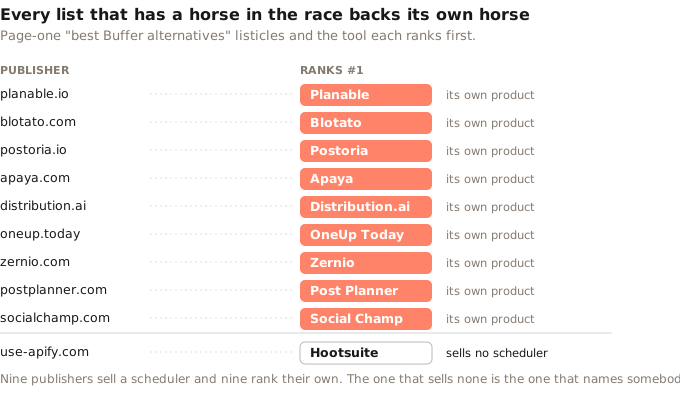
The tenth list is the control. use-apify.com belongs to Apify, a web scraping platform with no scheduler to sell, and it is the only page in the set that opens with a third party, Hootsuite. One data point is not proof of anything. It is a suggestive one when the other nine break the other way without a single exception.
Now, is that dishonest? Not necessarily. A company that builds a scheduler genuinely believes its scheduler is good, and it knows the category better than a freelance writer would. The problem is narrower and worse: you cannot tell the difference between the two explanations from the outside, so the ranking carries no information. Nine pages saying "we are number one" is nine advertisements arranged as research.
Worth knowing: Zilfu sells a scheduler too, so this page has exactly the conflict it is describing. That is why the sections below print counts, quotes and links rather than an ordering, and why Zilfu appears in the comparison table under the same four questions as everything else instead of at the top of a list.
Only one of the nine discloses the conflict. OneUp Today writes that it starts "with our own tool, OneUp Today, but include real options so you can choose well". We searched all nine for disclosure language, and that is the only body-text acknowledgement. The other eight mention "affiliate" solely in footer links to their own affiliate programmes.
One page deserves separate mention. blaze.ai ranks on page one under the title "Top 10 Buffer Alternatives for Effortless Social Media Scheduling" and publishes no numbered list at all. Its headings are generic capability descriptions rather than tool names, it names nine competitors in total, and it says "Blaze" 33 times, more than all nine of them put together.
Buffer competitors, ranked by how often the lists agree
Frequency is the one signal here that no single publisher controls, so it is worth counting. Across the ten lists, 36 distinct tools fill 90 ranked slots, 22 of them named by exactly one list, and no tool appears on all ten. The most-named is Later, on 8.
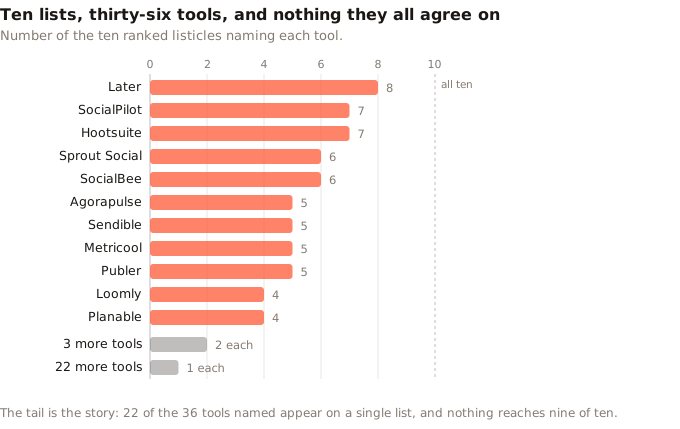
Read that chart as a shortlist, not a ranking. A tool appearing on 7 of 10 lists means it is well known and widely covered, which correlates with being an established product and also with having a marketing team. It says nothing about whether it fits your channel count or your budget. Popularity among people writing alternatives to Buffer is not the same as fit.
The recurring names are worth writing down, because they are the ones you will keep meeting: Later (8 of 10), SocialPilot and Hootsuite (7), Sprout Social and SocialBee (6), then Agorapulse, Sendible, Metricool and Publer (5 each), with Loomly and Planable on 4.
What the long tail tells you is that the category is crowded and the lists are padding. Twenty-two tools appear once. Several of those single appearances are the publisher's own product, which is the same finding from a different angle.
What do the Buffer alternatives lists get wrong about Buffer?
Mostly they get Buffer's developer surface wrong by ignoring it. Buffer launched a GraphQL API on 27 May 2026 and states it is "available on every Buffer plan, including Free" (Buffer, 2026), and nine of the ten lists use the word "API" five times or fewer across the whole page. Two never use it at all.
The developer surface is now substantial. Buffer publishes docs at developers.buffer.com covering authentication, a data model, rate limits, pagination, an interactive explorer, a CLI and around twenty worked examples, with a changelog carrying 44 entries between 28 January and 28 July 2026. It shipped an official MCP server on 10 June 2026 that connects to Claude, ChatGPT and Perplexity (Buffer changelog, 2026). The old REST API is closed to new applications and retires on 1 February 2027.
The one page that does engage with it is the one that contradicts itself. Zernio's developer-focused list uses "API" 74 times, opens with "Buffer wasn't built for developers", lists "No API" among Buffer's cons, and elsewhere states, correctly, that "Buffer shipped a new GraphQL API in 2026 that can create, schedule, edit, and delete posts, manage ideas, attach media, and pull post metrics". All of that is on one page.
We got this wrong too, and not by accident of timing. The version of this page we published on 21 June 2026 said Buffer "closed its public API to new third-party apps" with "no webhooks and no MCP server". We then revised that page on 7 July and left the sentence in, four weeks after Buffer's API went live and nearly a month after its MCP server did. Nobody re-checked the claim because it was already in the file. The same sentence is still sitting on eleven other pages of this site as we publish this one.
Two more claims on page one do not survive contact with Buffer's own pages.
Are Buffer's analytics locked behind a paywall?
No. Social Champ runs that line as a heading, supported by a G2 review saying that deeper analytics and competitor tracking are missing or gated. Three Buffer surfaces put core analytics on the free tier: its pricing page lists Insights as a free-plan bullet, its plan-comparison article marks Analytics "Yes" for Free, and its Insights page states "The core of Insights is included on Buffer's free plan, so you can see how your content is doing before you pay for anything" (Buffer, 2026). The heading is broader than the review beneath it. What is genuinely paid is advanced analytics, longer history, branded exports, and X analytics specifically.
The "2026 Pricing Shift" that is not one
The same page runs that phrase as a heading, and the section under it describes how Buffer's per-channel cost compounds rather than any change Buffer made. None of the Buffer pages we checked announces a 2026 pricing change, and its changelog's twenty entries from December 2025 to July 2026 are all features. The closest thing is Buffer's 2025 recap, published 14 January 2026, which describes a volume-discount rollout that began in 2025 and gives no date.
What does Buffer actually cost in 2026?
Buffer bills per connected channel, from the first one. Essentials is $6 per channel per month and Team is $12, or $60 and $120 per channel per year (Buffer help centre, updated 15 July 2026). A channel is one social account, so a second Instagram profile is a second channel at full rate.
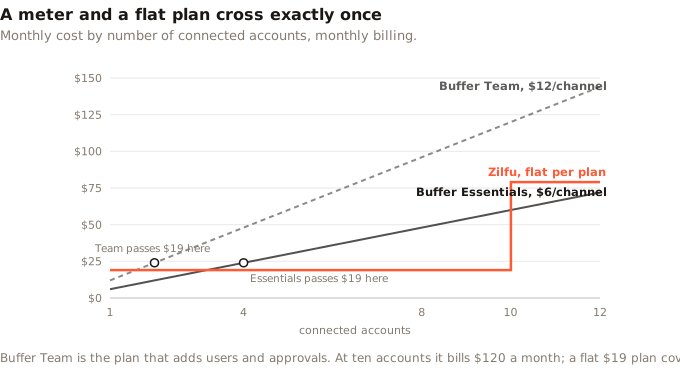
The arithmetic is the whole argument for leaving, and it is simple. Per-channel pricing is a straight line through the origin; a flat plan is a horizontal line until it steps. On Essentials the crossover against a $19 flat plan lands at 4 channels; on Team, the plan you need for approvals, it lands at 2.
The honest caveat is that flat plans step too, so the advantage is not permanent. A $19 plan that stops at 10 accounts hands the lead back the moment you need an eleventh and jump to the next tier, and Buffer's undisclosed volume discount above 10 channels widens that window further. The gap is largest in the range most people actually occupy, which is roughly 4 to 10 accounts.
Buffer's pricing page defaults to annual billing and displays $5 and $10, which are the annual rates expressed monthly. The help centre carries the $6 and $12 monthly figures. Both are Buffer pages and neither is wrong, but a reader comparing the pricing page against a rival's monthly price is comparing an annual rate to a monthly one.
One more gap worth knowing before you model your own bill. Buffer's pricing page states that "channels 1 to 10 are priced at the standard rate, and any channels above 10 cost less per channel", and that same page publishes no figure for what "less" means. The rate card lives in the help centre instead, where its 51-plus band prints a monthly rate below its own annual equivalent, so we have not reproduced it here.
Where does Buffer genuinely still lose?
Three things survive the fact check. The first is the meter itself. The second is collaboration: Buffer is single-user below Team, stated plainly in its help centre as "On Free or Essentials, there's only one user (the account owner)" (Buffer, updated 28 July 2026).
That one is sharper than it looks. Approvals are the reason most agencies shop for a scheduler at all, and reaching them on Buffer means moving every channel to the $12 rate, not just the seats. Ten channels with a client reviewer is $120 a month before anyone writes a post. That arithmetic is why the per-channel model tends to break first for agencies rather than for solo creators.
The third is webhooks. Buffer has none, and this is an absence you can at least go looking for: the word appears on none of the six developer surfaces we checked, its published roadmap included. If your workflow needs to react when a post publishes or fails, you are polling.
Set against that, Buffer's pricing page names 11 networks, including YouTube, Bluesky, Mastodon and Google Business Profile. Later publishes to eight and Zilfu to seven, and neither reaches any of those four. If one of them is core to you, the per-channel meter may simply be the price of coverage.
Buffer is deprecating a product it still bills for. Its pricing page states "A Start Page counts as a channel towards your plan" and its supported-channels article still lists Start Pages, while its GraphQL changelog records that "StartPage is being deprecated as a product" on 16 June 2026. Three Buffer surfaces, two positions. Worth asking about before you count a Start Page into your channel maths.
Four questions to ask about any apps similar to Buffer
Ignore the ordering and ask four structural questions instead. These decide your bill and your workflow, and unlike feature lists they rarely change quietly. The second question alone swings the cost of one extra Instagram account from nothing at all to a whole brand slot at $17 a month, depending only on which tool you picked.
- What is the bill counted in? Channels, seats, brands, social sets or accounts. This single choice determines how your cost behaves as you grow, and it is the thing per-channel pricing gets criticised for.
- What does a second account on the same network cost? A second Instagram or a second Facebook Page. Some tools charge nothing beyond an ordinary slot, some consume a whole brand or set, some force a tier jump. If you run multiple accounts per network, this question decides your bill more than the headline price does.
- Which plan unlocks approvals? If a client or a manager has to sign off before publishing, find the tier that allows it and price that tier, not the entry one.
- Is there an API, webhooks and an MCP server? These three travel together in marketing copy and separately in reality. Buffer now has two of the three. If you plan to drive publishing from a script or an assistant, read the automation and agents surface before the feature list.
Run those four questions against any shortlist and the field sorts itself without anybody's ranking. It also exposes the tools whose entry price looks cheap because the thing you actually need sits two tiers up.
Here are the answers for Buffer, for Zilfu, for eight of the tools that recur most across the lists, and for two the lists undersell: Zoho Social, which ranks on page one with its own comparison page, and Postiz, which appears on none of the ten and is the open-source, self-hostable option people are usually asking for when they search for one. Every unmarked cell is quoted or paraphrased from the vendor's own pricing page or help centre, checked on 1 August 2026; cells we could not source that way carry an asterisk.
| Tool | Bill counted in | Second account, same network | Free forever plan | Approvals from | API / webhooks / MCP |
|---|---|---|---|---|---|
| Zilfu | Accounts | One ordinary slot | Yes, one owner, 2 accounts, 15 posts/mo | Every paid plan, from $19 | Yes / yes / yes, every plan |
| Buffer | Channels | Another billed channel | Yes, 3 channels, 10 posts each | Team | Yes / no / yes, every plan |
| Later | Social sets of 8 profiles | Not sold on Starter; Growth includes 2 sets, then $11.25 | No, 14-day trial | Growth | None offered |
| SocialPilot | Social media accounts | One slot, then $4 a month | No, 14-day trial | Standard * | Enterprise / no / no |
| Hootsuite | Seats | One slot on Standard, free above it | No, 14-day trial | Advanced | Free, by developer approval / no / no |
| Sprout Social | Seats | One of 5, free on Professional up | No, 30-day trial | Professional * | Advanced / no / no |
| SocialBee | Social profiles | Its own slot, extra in blocks of 5 | No, 14-day trial | Accelerate | No public API |
| Metricool | Brands | A whole brand slot | Yes, 1 brand, 20 posts, no X or LinkedIn | Advanced | Advanced / undocumented * / MCP on every plan |
| Publer | Social accounts | Add-on, $4 to $7 a month | Yes, 3 accounts, no X | Not stated * | Business / no / no |
| Planable | Workspaces | Social pages in a workspace * | No, 50 posts total then paid | Basic, and it is the tier ladder | Pro / no / MCP on paid plans |
| Zoho Social | Brands | A second brand, $17 a month up * | Yes, 1 brand, unlimited posts, X included | Premium | Not stated * |
| Postiz | Channels | Another channel | No, but AGPL self-hosting is free | Not stated * | Yes / yes / no, on every plan |
* Marks an answer the vendor does not state outright. SocialPilot's pricing page renders its approval tiers inconsistently between passes. Sprout's approval tier comes from a support article and a superseded PDF rather than its live pricing page. Publer and Postiz name no approval tier, and Zoho Social names no API, on the pages checked. Zoho's brand add-on price comes from a 2021 help article rather than its live pricing page. Planable does not say whether two same-network accounts can share a workspace, and none of the Metricool pages we checked describes a webhook either way. Everything unmarked is quoted or paraphrased from a vendor page.
Two patterns come out of that table that no ranking would show you. The second-account question sorts the field into three groups, and not along price lines. Metricool, Later and Zoho Social make you buy an entire multi-network bundle to add one extra Instagram. Hootsuite, Postiz and Zilfu absorb it into an ordinary slot. SocialPilot, Publer and SocialBee charge a per-account fee but no tier jump. Sprout Social and Planable state no rule either way. That is the cost people tend to discover after committing.
MCP is arriving below the API, not above it. Metricool puts its MCP server on every plan including Free while gating its REST API to Advanced. Planable puts MCP on all paid plans and its API on Pro and up. Buffer ships both on every plan. For a category that spent a decade treating API access as an enterprise upsell, three vendors independently deciding that the AI-assistant connector belongs on the free tier is a real shift.
Where Zilfu fits, and why it is on this list
Zilfu is a flat-priced scheduler for seven networks, and it is on this page for the same reason the other nine vendors are on theirs. The difference we can offer is not a better ranking, it is showing the arithmetic: single-user Free covers 2 accounts and 15 posts a month, and Pro is $19 for 10 accounts. Pro, Business, and Scale add unlimited members, approvals, and posts without per-seat pricing. Business is $79 for 100 accounts and Scale $179 for 300.
Against the four questions above, Zilfu's answers are: the bill is counted in accounts, with a flat price per plan; a second Instagram costs one ordinary account slot, exactly like any other account, rather than a bundle or a surcharge; approvals and unlimited reviewer seats are on every paid plan, starting at $19; and there is a REST API, webhooks and a hosted MCP server on every plan, with eight webhook events covering publishing, failures, scheduling, comments and account changes.
The honest limitations matter more on a page like this one. Zilfu supports Threads, Instagram, Facebook, TikTok, Pinterest, X and LinkedIn, and no others. There is no YouTube, Bluesky, Mastodon or Google Business Profile, so a Buffer user relying on any of those cannot move across. There is no evergreen recycling queue, no built-in AI writer, and nothing imports your posting history. Client reports carry your own branding, but they are share links rather than a white-label dashboard on your own domain. The comment inbox covers Threads, Instagram and Facebook only, and does not handle DMs. Approvals are single-reviewer.
If the reason you are leaving Buffer is the per-channel meter, the Zilfu and Buffer comparison works the arithmetic through properly. If it is evergreen recycling you want, SocialBee is built around it and Zilfu is not.
How do you test a Buffer alternative without wasting a month?
You test it in an afternoon, because there is nothing to migrate. None of the tools in the table above offers a posting-history import, and we found no vendor page claiming one, so switching means reconnecting accounts and scheduling forward. Your published posts stay live on each platform regardless of which tool queued them.
That turns the decision into a cheap experiment. Connect two accounts on a free plan, queue a week of posts, and watch three things: whether posts land on time, whether a failure tells you it failed, and whether the bill you modelled matches the bill you get. Most of the work is clicking through OAuth screens.
Two things are worth checking deliberately while you trial. Find the pause control that stops everything at once, and confirm it works before you need it. Then check the queue the morning after a large batch, because a dead token produces silence rather than an error you would notice.
Zilfu's free plan covers one owner, 2 accounts, and 15 posts a month with the API included rather than gated. Collaborative approvals and team invitations start on Pro. If it does not fit, you have lost an afternoon and no money, which is roughly what the ranked lists cost you to read.
Sources
All pages fetched 1 August 2026. The ten listicles were retrieved as raw HTML and parsed programmatically rather than read.
- Buffer. Pricing: per-channel plans.
- Buffer. Features available on each Buffer plan, updated 15 July 2026.
- Buffer. Adding users and setting up permissions, updated 28 July 2026.
- Buffer. Supported channels, updated 20 May 2026.
- Buffer. How many posts can I schedule in advance?, updated 28 January 2026.
- Buffer. Buffer's API is open for building, 27 May 2026.
- Buffer. Talk to your agent via MCP, 10 June 2026.
- Buffer. The legacy REST API is being retired, 27 July 2026.
- Buffer. Buffer Insights.
- Buffer. Developer documentation and API changelog.
- Planable. 11 best Buffer alternatives in 2026.
- Blotato. 7 best Buffer alternatives in 2026.
- Postoria. 10 alternatives to Buffer for auto-posting.
- Apaya. Best Buffer alternatives: 7 tools compared for 2026.
- Distribution.ai. Top 9 Buffer alternatives you should try in 2026.
- OneUp Today. 6 best Buffer alternatives in 2026.
- Zernio. 12 best Buffer alternatives for developers.
- Post Planner. 11 best Buffer alternatives with better pricing.
- Social Champ. 12 best Buffer alternatives in 2026.
- Use Apify. Best Buffer alternatives for social media scheduling.
- Blaze. Top 10 Buffer alternatives for effortless social media scheduling.
- Later. Pricing: social sets, users and add-ons.
- SocialPilot. Pricing: accounts and add-ons.
- Hootsuite. Plans and FAQ and developer FAQ.
- Sprout Social. Pricing: per seat.
- SocialBee. Pricing: social profiles.
- Metricool. Pricing and MCP versus API access.
- Publer. Plans and pricing and public API.
- Planable. Pricing: per workspace.
- Zoho Social. Free edition and brand add-ons.
- Postiz. Pricing and public API docs.