The best time to post on Facebook is weekday mornings, roughly 8am to 10am, with Thursday at 9am the single most-supported slot. Two of the three largest 2026 datasets point at mornings. The third, Sprout Social, says noon to 8pm instead. That gap is the real story, and it does not survive a close read.
Key takeaways
- All 9 of Sprout's own industry tables open before noon, against the afternoon window it headlines.
- Buffer's page calls Sunday both a day to avoid and the third best of the week.
- Meta's publishing guidance names no best time. Its tool computes yours from the last 7 days.
- Post age is not among Meta's disclosed Feed ranking signals at all.
What is the best time to post on Facebook?
Weekday mornings, 8am to 10am, are the best-supported answer, with Thursday 9am the single strongest hour. Three large studies were published for 2026 and they do not line up. Most guides quote one of them and leave out the others, which is how a contested question ends up sounding settled.
- Buffer analysed 14 million Facebook posts from businesses, creators and influencers, and named Thursday at 9am the single best posting time of the week. Fourteen of its 21 slots fall between 6am and 10am, though its whole Monday top three sits at night (Buffer, 2026).
- Sprout Social analysed nearly 2 billion engagements across 307,000 profiles between 27 November 2025 and 27 February 2026, and concluded Tuesdays and Wednesdays, noon to 8pm local time (Sprout Social, 2026).
- SocialPilot analysed around 700,000 posts from 50,000 accounts and landed on 9am to 3pm on weekdays, straddling the two (SocialPilot, 2025).
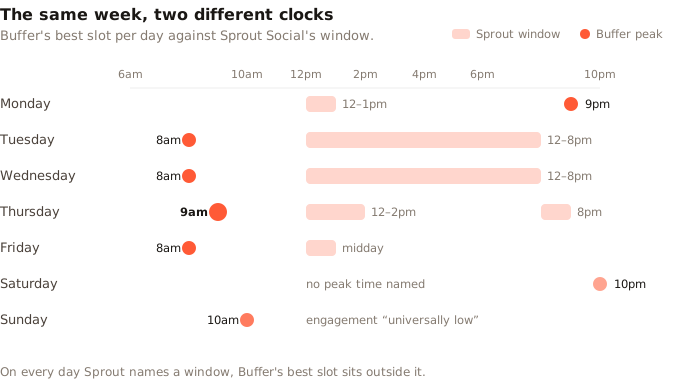
Put the two biggest on the same clock and the split is stark. On all five days Sprout names a window, Buffer's best slot for that day falls outside it. Buffer's best slot of the entire week, Thursday 9am, sits three hours before Sprout's Thursday window even opens. That is not a rounding difference between broadly similar recommendations. It is a disagreement about whether Facebook is a morning platform or an afternoon one.
Then SocialPilot breaks the tie. Compare its recommendations against Buffer's and the two share at least one slot on six of the seven days. Against Sprout, Buffer shares a slot on two. Sprout is the outlier here, not Buffer, and the direction is stark: not one of the windows in Sprout's all-industry table opens before noon.
Why do the studies disagree?
Because they count different things, on different clocks, over different periods. None of that makes any of them wrong, and the differences are specific enough to reason about.
- Different denominators. Buffer counts posts, 14 million of them. Sprout counts engagements, nearly 2 billion of them landing on 307,000 profiles. "Which hour earns the most engagement per post" is not the same question as "which hour accumulates the most engagement overall", and a long afternoon of moderate activity can out-total a sharp morning spike.
- Different clocks. Sprout states that all its times are local time. Buffer says its data team made the recommended times "universally applicable" so that no conversion is needed, which means time zones were normalised away. Two datasets reporting "9am" may not describe the same moment in anybody's day.
- Different periods, one of them unstated. Sprout gives an exact three-month window ending 27 February 2026. Buffer, published 26 February 2026, gives no collection window at all, and neither does SocialPilot. A 14-million-post sample spanning an unknown stretch of time cannot be checked for seasonality.
Worth knowing: all four companies cited on this page sell scheduling software, and every one of them closes its guide by telling you to test against your own audience instead of adopting its numbers. Treat these as well-built marketing assets with real data inside them, which is what they are.
Sprout's own data disagrees with Sprout's headline
Largely not. Sprout breaks its results into nine industries, and every one of the nine recommends at least one window starting before noon. The latest riser, government, opens at 10am on Thursday. The earliest, software and technology, opens at 7am.
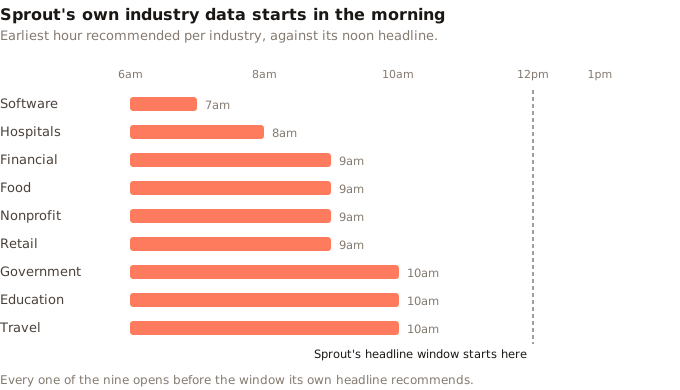
Software and technology is the clearest case. It opens at 7am on four separate days, earlier than any other industry, and it is the only one of the nine given weekend slots, at 7am to 9am on Saturday and 10am on Sunday. Note how carefully the same page words its weekend warning. Weekends are worst "across almost all industries". Software and technology is the industry that phrase is quietly excluding.
So the famous "Facebook is an afternoon platform" line traces to a single global average that Sprout's own segmentation does not support. The disagreement turns out to be with Sprout's headline rather than with Sprout's data, which lands much closer to where Buffer and SocialPilot already were.
Where do the datasets actually agree?
Buffer publishes three ranked slots per day, twenty-one in total. Exactly two of those fall inside a Sprout window: Tuesday at 7pm and Wednesday at 6pm. Neither is Buffer's first choice for that day: 7pm is its second pick for Tuesday, 6pm its third for Wednesday.
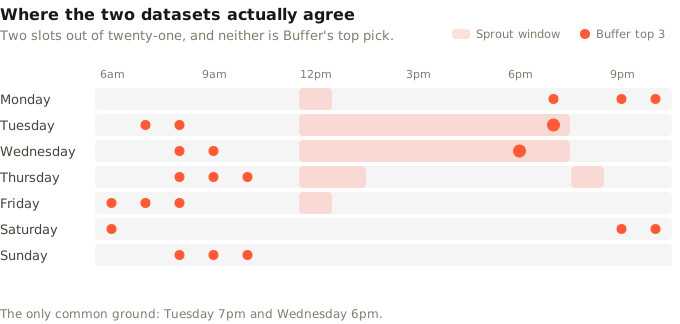
That gives you two defensible starting points rather than one, and they answer different appetites.
- Weekday 8am to 10am if you want the schedule the weight of evidence supports. Two of three datasets land here, as do eight of Sprout's nine industries; the ninth opens earlier still.
- Tuesday or Wednesday, 6pm to 7pm if you want the only ground both of the two biggest datasets actually endorse. It is nobody's stated favourite, which is precisely what makes it the safe opening bid.
Run them against each other. The fortnight test further down is built to do precisely that.
What is the best day to post on Facebook?
Wednesday, and here all three converge, the same day the Instagram question lands on despite its sources disagreeing far more sharply about the hour. Buffer names Wednesday the best day of the week, with "Thursday coming in a very close second" and Tuesday rounding out the top three. Sprout says Mondays through Thursdays "consistently show the highest engagement" and gives Wednesday its widest window of any day. SocialPilot names Monday to Friday. If you post once a week, post on Wednesday, and the cross-platform comparison lines that pattern up against every other network.
The weekend is where agreement collapses, and one of the collapses happens inside a single source.
- Saturday. Buffer calls it "the worst day of the week to post on Facebook". Sprout names no peak time for it in its all-industry table, as it also does for Sunday. But SocialPilot disagrees with both and gives Saturday three usable slots at 9am, 12pm and 3pm.
- Sunday. Sprout says engagement is "universally low" and calls it the worst day. SocialPilot also names Sunday its worst. Buffer's key takeaways say to "avoid the weekend" and that Sunday "still trails weekdays", yet its own Sunday section calls Sunday "the third-best day of the week", which its own top three of Wednesday, Thursday and Tuesday plainly rules out.
That matters because Buffer's page is one of the top results people land on for this exact question. The weight of evidence says Sunday is weak. Buffer's Sunday morning times are still real numbers, so if your audience is consumer-facing it earns one test slot, but not a standing commitment.
When is the best time to post on Facebook each day?
All three datasets, side by side. Buffer's are three ranked slots, best first. Sprout's and SocialPilot's are windows. Every sample here is drawn from business Pages and creator accounts, so these are best times to post on a Facebook business Page rather than a personal profile, and they cover feed posts rather than Reels.
| Day | Buffer (14M posts) | Sprout Social (2B engagements) | SocialPilot (700k posts) |
|---|---|---|---|
| Monday | 9pm, 10pm, 7pm | 12pm to 1pm | 9am, 12pm, 7pm |
| Tuesday | 8am, 7pm, 7am | 12pm to 8pm | 8am, 10am, 6pm |
| Wednesday | 8am, 9am, 6pm | 12pm to 8pm | 7am to 9am, 2pm to 5pm |
| Thursday | 9am, 8am, 10am | 12pm to 2pm, and 8pm | 9am to 11am, 8pm |
| Friday | 8am, 7am, 6am | Midday | 7am, 1pm, 5pm |
| Saturday | 10pm, 6am, 9pm | No peak time named | 9am, 12pm, 3pm |
| Sunday | 10am, 9am, 8am | Engagement "universally low" | 8am, 11am, 4pm |
What is the best time to post on Facebook today?
The safest general answer on any weekday is 8am to 10am: two of the three largest 2026 studies and eight of Sprout's own nine industries put their strongest window there. For a specific day, take that day's row in the table above and prefer the earlier option. Saturday is the exception, where the most defensible answer is to wait.
Best time to post on Facebook on Monday
Buffer's Monday peak is 9pm, then 10pm and 7pm, the one day of its week where all three slots fall after dark. Sprout gives Monday the narrowest window of its week, just noon to 1pm. SocialPilot splits the difference with 9am, 12pm and 7pm. There are two points of contact: Buffer and SocialPilot share 7pm, and SocialPilot's noon sits inside Sprout's window. Monday is a day all three struggle to find a strong hour in, so it is a poor place to spend your best post.
Best time to post on Facebook on Tuesday
Buffer's Tuesday order is 8am, then 7pm and 7am, and it places Tuesday third in its day ranking. SocialPilot agrees on 8am. Sprout opens a wide noon to 8pm block and ties Tuesday with Wednesday as its best day. Tuesday is unusual in offering two strong and well-separated options: 8am has two datasets behind it, and 7pm is one of only two slots Buffer and Sprout both endorse.
Best time to post on Facebook on Wednesday
Buffer peaks at 8am, then 9am and 6pm, and names Wednesday the best day of the week. SocialPilot's 7am to 9am window covers both of Buffer's morning slots. Sprout again runs noon to 8pm, its widest of any day. Wednesday is the strongest day on the calendar across all three and deserves your best content; the morning has the broader support.
Best time to post on Facebook on Thursday
Buffer peaks at 9am, its single best slot of the entire week, followed by 8am and 10am, and it ranks Thursday a very close second to Wednesday as a day. SocialPilot's 9am to 11am window contains two of those three. Sprout runs noon to 2pm with a second spike at 8pm, which SocialPilot also lists. The gap is only three hours, the narrowest of any weekday, but it is the most consequential: Buffer's strongest hour of all sits outside Sprout's window. It is the ideal day to run morning against afternoon.
Best time to post on Facebook on Friday
Buffer's Friday picks are 8am, 7am and 6am, the earliest set of the week, and SocialPilot opens at 7am. Sprout says simply that Friday's best time is midday. Attention drains as the day goes on, so all three point the same direction even where they disagree on how early. Front-load Friday.
Best time to post on Facebook on Saturday
Buffer's Saturday peak is 10pm, then 6am and 9pm, and it names Saturday the worst day of the week. Here the three part company completely. Sprout names no peak time for it in its all-industry table. SocialPilot disagrees with both and offers 9am, 12pm and 3pm. This is the day with the least usable consensus of any on the calendar. Treat anything you publish here as an experiment.
Best time to post on Facebook on Sunday
Buffer peaks at 10am, then 9am and 8am. SocialPilot's 8am matches Buffer's third slot, but it still calls Sunday its worst day, and Sprout calls engagement universally low. Buffer is the only voice for Sunday and it does not hold the position consistently, telling readers to avoid the weekend in one section and calling Sunday third best in another. Sunday morning is the cheapest open question here to answer for yourself.
When is the best time to post Facebook Reels?
Reels are the one format where the honest answer is that nobody has published real data. Neither Buffer nor Sprout nor SocialPilot breaks its sample down by format at all. Sprinklr does suggest a Reels window of Wednesday to Saturday, 10am to 12pm and 7pm to 8.30pm, but it publishes no sample size, no date range and no methodology, so treat that as an informed opinion rather than a finding (Sprinklr, 2026).
What is solid comes from Meta, and it points the same way regardless of the hour. Meta says it is "surfacing 50% more reels from creators published that day, so you see the newest content faster" (Meta, 2025), and reported separately in January 2026, against a Q3 2025 baseline rather than the same one, that Facebook is "now surfacing over 25% more same-day Reels" (Meta, 2026). The two are measured differently and are not a trend line.
Read that carefully, because most write-ups mangle it. Meta is describing the composition of the recommendation mix, not a per-post reach multiplier. It is surfacing more same-day Reels overall; it has not said that your Reel gets 50% more reach for being fresh. The practical implication still holds: for Reels specifically, publishing on the day matters more than the hour within it.
What is the worst time to post on Facebook?
There is no unanimous worst day, which is itself the answer before you delete a slot on someone's advice. Buffer condemns Saturday while SocialPilot gives it three slots. Sprout and SocialPilot condemn Sunday, while Buffer manages to do both, telling readers to avoid the weekend on one screen and calling Sunday the third-best day on another.
The only stretch no study names a slot in is overnight, roughly 11pm to 6am. None of them publishes hourly volume, so treat that as an absence of recommendation rather than measured emptiness, and note that low traffic cuts both ways. Fewer people are looking, but fewer accounts are posting, so a niche post can travel further against thin competition. Treat the quiet hours as untested rather than forbidden.
What none of these studies publish is a ranked list of losers. Buffer reports only its winning slots. So any article handing you a confident worst-hour table is extrapolating from the absence of data.
Facebook itself publishes no best time
No, and the silence is deliberate. No best-time guidance appears anywhere in the Business Help Center's articles on publishing, scheduling and Insights. For a company that could answer this question exactly, that is a choice.
What Meta ships instead is a per-account answer. Inside Meta Business Suite, when you compose a post and open Scheduling options, an Active times control recommends slots "based on when followers were most active on Facebook and Instagram over the past 7 days" (Meta). Separately, the Audience tab under Insights shows trends for when your followers are more active on the platform (Meta).
The 7-day lookback is the detail to carry away. Meta's own recommendation is computed from a single week of follower behaviour, which is precisely why your best time drifts, and why a static table published in February cannot be right for you in July. It also means checking during an atypical week, a holiday or a campaign spike, gives you a skewed answer. Look at it more than once.
One correction while you are in there: the old "when your fans are online" chart belonged to the retired Page Insights and Creator Studio interfaces. Plenty of 2026-dated guides still promise you a 28-day heatmap under that name. Meta's current documentation describes the Audience tab only as showing activity trends, so do not go hunting for a chart that is no longer there.
Does the Facebook algorithm reward posting at the right time?
Less directly than almost every guide implies, and the distinction matters. Meta's published description of Feed ranking runs in four steps: it gathers inventory, then evaluates signals, then makes predictions, then assigns each post a relevance score and orders by it (Meta).
Recency appears in step one and nowhere else. The inventory is "all potential new posts, or posts with new activity, that you could see when you open Facebook". That is a description of what is eligible to be ranked, not how it is ordered. Across the disclosed signal inventory for Feed, there is no signal describing a post's own age or publication time (Meta).
So timing does not make a post rank. It decides who is around to see it early, and early response is what the ranker actually scores. One of the disclosed signals is "a weighted count of the number of times a post has been viewed in 2 hours", which is the closest thing to a golden hour that Meta has confirmed. Publishing when your audience is awake matters because it buys you early traction, not because freshness itself earns distribution.
That reframe changes what you optimise. Being available to reply for the hour after you publish is worth more than moving your timestamp by thirty minutes.
How do you find your own best time in 14 days?
The studies disagree, so stop trying to pick a winner from the outside and generate your own data. Two weeks gives a directional answer.
- Pick three fixed slots that represent different camps. Thursday 9am represents Buffer and SocialPilot, Wednesday 2pm represents Sprout, and Tuesday 7pm is one of the two slots Buffer and Sprout both endorse. Testing three times inside one camp cannot tell you which camp your audience belongs to.
- Check Active times first. If Meta's 7-day recommendation for your Page disagrees violently with all three, use its suggestion as a fourth slot. It is the only one of the four computed from your actual followers.
- Hold everything else constant and let a queue hit the slots. Same rough length, same format, same topic mix. Change the content and the time together and you will not know which moved the number. A missed slot is a lost data point, which is what recurring weekly slots are for.
- Compare early reach, not lifetime totals. Totals are contaminated by how good each post was, while reach at the first snapshot after publishing isolates the timing effect. It reduces that contamination rather than removing it, and it is the number Meta's 2-hour view signal responds to.
- Drop the weakest, double the strongest, repeat. After three cycles the schedule is built on your audience rather than someone else's sample.
Then add Sunday morning as a fifth slot once the first ones have separated. It is the cheapest test of the set and the one with the most disagreement behind it.
One limit worth naming. A test like this only ever measures people already following your Page, so it will not tell you when Facebook at large is awake. That is fine. Your followers are who the Feed reaches first, and their early response decides whether anyone else sees the post at all.
How do you hold those slots without doing it by hand?
A morning-heavy schedule is the awkward kind to keep. Wednesday 8am and Thursday 9am are exactly the hours nobody wants to spend inside Meta Business Suite. Defining the slots once and letting a queue fire them is what makes a two-week comparison survive contact with a real week. Zilfu checks for due posts every minute, so an 8am slot goes out at 8am.
Two things matter for the test specifically. A post that fails to publish lands in an Error state with the reason attached, rather than quietly leaving a gap that reads as a weak slot when it was really a broken one. And per-post analytics pull reach, Like and Love counts, comments and shares back from Facebook. Those refresh every few hours rather than the instant you publish, so read each slot at the same point in its life and compare like with like.
Pages tend to come in groups. A main Page plus a regional or store Page on one workspace counts against a single flat cap, so running the same test across both does not change the bill. Zilfu publishes text, photo, multi-image and video posts to Facebook Pages, and the Facebook channel page sets out what is supported.
Start in the morning, then let your own data move you
So the best time to post on Facebook, on the weight of the published evidence, is a weekday morning between 8am and 10am, with Wednesday and Thursday the days to spend first. Two of the three largest datasets point here, and all nine of Sprout's industry tables open before noon even where its own headline does not. If you would rather stand on ground nobody disputes, take Tuesday or Wednesday at 6pm to 7pm.
None of those numbers were measured on your Page, though.
Open Active times, see what a week of your followers' actual behaviour suggests, and run it against one of the windows above for a fortnight. Zilfu's free plan carries 2 connected accounts and 15 posts a month, which covers three weekly slots for the full two weeks without paying to find out.
If you publish to more than one network, the cross-platform comparison of these studies sets Facebook's mornings against the six other networks and shows why no single hour survives all of them.
Sources
All sources retrieved 31 July 2026.
- Buffer. Best time to post on Facebook, new data from 14M posts. Published 26 February 2026. No collection window stated.
- Sprout Social. Best times to post on Facebook in 2026. Published 31 March 2026, covering 27 November 2025 to 27 February 2026.
- SocialPilot. Best time to post on Facebook. Published 14 December 2025. Around 700,000 posts from 50,000+ connected accounts.
- Sprinklr. Best times to post on Facebook in 2026. Published 3 February 2026. No sample size or methodology published.
- Meta. Create and manage posts in Meta Business Suite on desktop. Source for the Active times control and its 7-day lookback.
- Meta. About Insights in Meta Business Suite on desktop. Source for the Audience tab.
- Meta Transparency Center. Our approach to Facebook Feed ranking.
- Meta Transparency Center. Facebook Feed AI system card. Source for the disclosed Feed signals.
- Meta. Finding and sharing Reels on Facebook just got easier and more fun. Published 7 October 2025.
- Meta. 2026: AI drives performance. Published 28 January 2026.