← Back to blog

Best Time to Post on LinkedIn in 2026 (B2B Engagement Data)

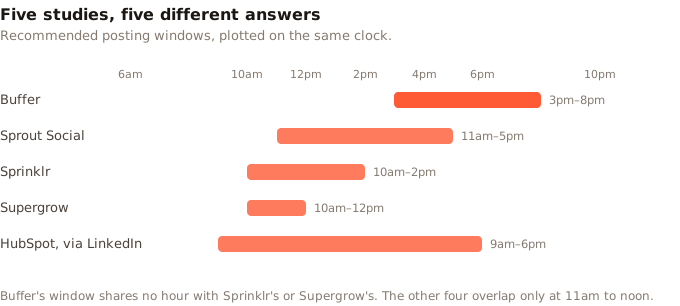
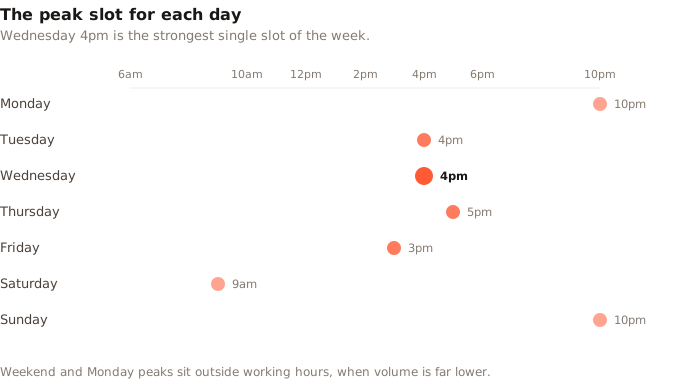
The best time to post on LinkedIn in 2026, triangulating Buffer's analysis of 4.8 million posts with industry-wide 2026 reports from Sprout Social, Hootsuite, and Metricool, is Tuesday through Thursday between 10am and 2pm in your audience's local time zone — with a fast-growing secondary window from 3pm to 6pm that barely existed a year ago. Buffer's 2026 data singles out Wednesday at 4pm as the single highest-engagement slot, a notable shift from the mid-morning peaks that dominated 2024–2025. But LinkedIn is a professional network, so the right answer for your page or profile depends on when your specific B2B audience is actually at their desk — and finding that takes about two weeks. This guide covers both.

Overall best times to post on LinkedIn in 2026

Here are the consensus best times to post on LinkedIn across the biggest 2026 datasets — Buffer (4.8M posts), Sprout Social (industry-wide), Hootsuite, and Metricool. Times are in your audience's local time zone, not yours, and they assume a professional B2B audience that is active during the working day. Treat this as your v1 schedule and refine from there.

DayPeak windowSecondary window
Monday10am – 12pm1 – 2pm
Tuesday10am – 12pm3 – 5pm
Wednesday11am – 1pm3 – 5pm
Thursday10am – 12pm1 – 5pm
Friday10 – 11am1 – 2pm
Saturday9 – 10am (weak)
Sunday6 – 8pm (weak)

Two patterns deserve a callout. First, LinkedIn is the most day-of-week-sensitive platform of all the major networks. Where Instagram and TikTok hum along seven days a week, LinkedIn's engagement is concentrated almost entirely into Tuesday–Thursday business hours and falls off a cliff at the weekend. If you have to pick one day, pick Wednesday — it tops every 2026 dataset we triangulated. Second, and this is the big 2026 story: the afternoon and early-evening window (3–6pm) is now genuinely strong. In 2024–2025, LinkedIn engagement was almost entirely confined to the 8am–noon working block and dropped sharply after 5pm. In 2026 the curve has stretched later, and Buffer now puts Wednesday 4pm ahead of every morning slot. The likeliest explanation: more professionals scroll LinkedIn during the late-afternoon lull and on the commute home, the way they once treated lunchtime.

One caveat the data won't tell you: LinkedIn's feed is less recency-weighted than Instagram's. A strong post published at 10am can keep accumulating reach into the next day because the algorithm keeps re-serving content that earns dwell time and meaningful comments. That makes the first 90 minutes after posting — when LinkedIn decides whether to widen distribution beyond your immediate network to 2nd- and 3rd-degree connections — far more important than the exact minute you hit publish.

Day-by-day breakdown

Each day on LinkedIn has its own rhythm, shaped entirely by the working week. Here's what the 2026 data says about each one — and the kind of content that tends to land best inside that day's peak windows.

Best time to post on LinkedIn on Monday

Monday is a slow starter. Most professionals spend the first two hours clearing weekend inboxes and sitting in stand-ups, so engagement is muted before 10am. It climbs through late morning and holds across the lunch hour. The strongest single window is 10am to 12pm, with a smaller pickup around 1–2pm. Buffer's data actually ranks Monday among the weaker weekdays, so don't burn your best content here.

Mondays favor "set the week up" content: industry-outlook posts, planning frameworks, and motivational-but-substantive thought leadership. Avoid hard pitches and gated-asset promotions on Monday morning — buying intent is low while people re-orient to the week. Save your strongest document carousel or original-data post for midweek.

Best time to post on LinkedIn on Tuesday

Tuesday is where the working week's attention switches on. Professionals are dialed into their roles, triaging email between meetings, and actively researching solutions. The reliable window is 10am to 12pm, with a meaningful afternoon block from 3–5pm in the 2026 data. It is one of the three days you should never skip.

Tuesdays reward practical, save-worthy content — how-to breakdowns, tactical checklists, and "here's exactly how we did X" posts. This is a strong day to publish a document/PDF carousel, because professionals are in problem-solving mode and will swipe through a useful framework. Sprout Social's 2026 data shows sustained Tuesday activity from late morning into mid-afternoon, which gives a strong post a long runway.

Best time to post on LinkedIn on Wednesday

Wednesday is the single best day to post on LinkedIn, full stop — it tops Buffer, Sprout, Hootsuite, and Metricool's 2026 rankings. The peak window is 11am to 1pm, but the headline 2026 finding is that Wednesday 4pm is the highest-engagement individual slot of the entire week in Buffer's 4.8M-post dataset. Sprout shows useful Wednesday reach all the way from 11am to 4pm.

Wednesday is the day to ship your hero post. If you have an original-data piece, a launch announcement, a strong native video, or a document carousel you spent real time on, publish it Wednesday late-morning or aim for the 4pm slot. Engagement compounds here: comments earned on a Wednesday post often keep arriving through Thursday, and because LinkedIn keeps re-distributing content that holds attention, that extended comment tail directly widens your reach.

Best time to post on LinkedIn on Thursday

Thursday is the quiet workhorse, and arguably the best day for the 2026 afternoon shift. Sprout's data shows sustained activity from 1pm to 5pm — an unusually long, reliable block — on top of the standard 10am–12pm morning window. LinkedIn behaves here like a late-day productivity and networking hub: people read thought leadership and source vendors before the week winds down.

Thursdays are excellent for B2B demand-gen content — webinar promotions, case studies, and "book a demo" CTAs land better here than earlier in the week because decision-makers are clearing lower-priority work. Thursday is also the strongest day to publish a LinkedIn newsletter; the issue lands in inboxes while professional readers still have headspace before Friday's drift.

Best time to post on LinkedIn on Friday

Friday is front-loaded. The morning window — 10–11am — still performs roughly on par with other weekdays, and there's a small 1–2pm pickup, but engagement fades fast after early afternoon as people coast toward the weekend. Interestingly, Buffer's 2026 data ranks Friday surprisingly well overall, driven almost entirely by that morning block and the early-afternoon 3–4pm slots — but the drop-off after 3pm is steep.

Friday morning suits lighter, more human content: team culture posts, week-in-review reflections, and personal-story thought leadership that travels well in feeds. Save your demand-gen pushes and document carousels for Tue–Thu — Friday afternoon is the worst weekday slot for anything that depends on measured, comment-driven engagement.

Best time to post on LinkedIn on Saturday

Saturday is genuinely weak on LinkedIn, and that's the honest answer. Most professionals are offline, and overall engagement drops sharply versus any weekday. If you must post, a late-morning slot around 9–10am catches the small audience that checks in over coffee. Reach will be a fraction of your Wednesday numbers.

The narrow exception is personal-brand and creator content — solo founders, coaches, and individual thought leaders sometimes find lower weekend competition lets a personal essay-style post over-perform relative to its day. But for company pages, agencies, and B2B demand-gen, Saturday is skippable. Spend the slot on Wednesday instead.

Best time to post on LinkedIn on Sunday

Sunday is the weakest day on LinkedIn alongside Saturday, but it has one quirk: a small 6–8pm "Sunday scaries" window when professionals start mentally re-entering work mode and browse for the week ahead. Engagement is still well below weekday levels, but competition is also thin, so a thoughtful post can catch early-week planners.

Sundays suit reflective, big-picture content — career advice, industry predictions, and longer-form personal narrative that someone might actually read in a quiet moment. Avoid product pushes and CTAs entirely; conversion intent is at its weekly low. Use Sunday evening, if at all, to seed a conversation that builds momentum into Monday.

Best time to post on LinkedIn by content format

LinkedIn distributes its formats very differently, and the optimal timing shifts depending on what you're publishing. Here's how to think about each of the five formats that matter most in 2026.

Text posts (and text-plus-image)

Plain text posts and text-with-a-single-image are LinkedIn's bread-and-butter and the most timing-sensitive format, because they live and die by first-90-minute engagement. They surface primarily through your network's home feed, and LinkedIn decides quickly whether to widen distribution based on early dwell time, comments, and reshares. For text posts, the day-by-day table above applies most strictly: aim for the peak window, not the secondary one, and post 60–90 minutes before your audience's busiest hour so the early-comment signal compounds. A strong hook in the first two lines (before the "see more" cutoff) matters as much as the time of day.

Document / PDF carousels

Document posts — the swipeable PDF "carousels" — are LinkedIn's highest-dwell-time format, and dwell time is one of the strongest distribution signals the algorithm uses. Buffer's 2026 data notes carousel-style posts dramatically out-engage text-only content. Because they reward time-on-post rather than instant reactions, carousels do well published slightly before peak (Tue–Thu, 10–11am) so they accumulate swipes during the busiest hours. They also keep earning reach for longer than text posts — a strong carousel published Tuesday morning can still be surfacing on Wednesday. This is the format to reserve for your most genuinely useful, framework-style content.

Native video

Native video (uploaded directly to LinkedIn, not a YouTube link) is the format the 2026 afternoon shift most clearly benefits. The 3–6pm window is now particularly strong for video, as professionals are more willing to watch a short clip during the late-day lull than to read a long text post. Keep videos short (under 90 seconds for feed video), front-load the hook, and add captions — most LinkedIn video is watched on mute. Wednesday and Thursday afternoons are your best video slots; the algorithm rewards watch-through rate, so a tight, well-captioned clip beats a long one regardless of timing.

Polls

Polls live and die on first-hour momentum — they need early votes to trigger algorithmic distribution, because each vote is a lightweight engagement signal that tells LinkedIn the post is sparking participation. That makes the Tuesday–Wednesday 10am–12pm mid-morning peak the ideal slot: maximum audience online, ready to tap an option in two seconds. Avoid posting polls on weekends or Friday afternoons, when there aren't enough early voters to build momentum. Keep the question genuinely useful (not bait), and reply in the comments to keep the conversation — and the distribution — alive for the poll's run.

Newsletters

LinkedIn newsletters behave unlike everything else because publishing one fires a notification and an email to every subscriber. That means the publish time should target when your subscribers check email and notifications, not just when the feed is busiest. Tuesday or Thursday mid-morning is the consensus sweet spot — it lands while professional readers are at their desks and still have attention before the day fills up. Pick one consistent day and time and hold it; newsletter audiences build a habit around a predictable cadence, and consistency matters more than chasing the perfect slot week to week.

Best time to post on LinkedIn by industry

"Best time to post on LinkedIn" averages shift once you account for industry, because different professional audiences keep different rhythms. Here's the industry-specific 2026 data, drawn mainly from Sprout Social's and SocialPilot's segmented reports. All times are local to your audience.

NicheBest windowWhy
B2B SaaS / SoftwareTue–Wed, 10am–4pmBuyers research tooling across the full workday; long midweek windows suit document carousels and demos.
Marketing & AdvertisingTue–Thu, 9am–12pmMarketers are early scrollers and heavy resharers; the new Thu 4pm wave catches afternoon attention.
Financial ServicesTue–Wed, 10am–3pmFinance pros track feeds during active market hours for macro and industry signals.
Recruiting & HRTue–Thu, 8–9am + 12–1pmCandidates and hiring managers scan early and at lunch when in planning mode.
Consulting & Professional ServicesTue + Thu, 9–11amDecision-makers read thought leadership before billable work fills the day.
HealthcareWed–Thu, 9am–5pmClinical schedules push engagement later and wider; afternoon windows hold up well.
EducationTue–Thu, 10am–4pmEducators and administrators engage across a long midday block between classes and meetings.
NonprofitTue–Thu, 10am–4pmMission-driven audiences engage steadily through business hours; storytelling travels midweek.
Agencies (multi-client)Wed, 11am–4pmWednesday is the safest universal slot when juggling many client audiences with different rhythms.

If your industry isn't listed, find the closest match — adjacent verticals share rhythms. A fintech startup behaves like B2B SaaS plus financial services. A staffing agency behaves like recruiting. Use these as your starting hypothesis, then validate against your own analytics. Agencies juggling many client audiences at once should default to the universal Wednesday 11am–4pm block and tune per client from there.

Time-zone strategy for distributed audiences

The biggest timing mistake on LinkedIn is posting in your local time instead of your audience's dominant business hours. Because LinkedIn engagement is so tightly bound to the working day, a post published at "Wednesday 11am" your time is worthless if 70% of your audience is in a time zone where it's 6am or 8pm. Professional audiences are even less forgiving than consumer ones — they're simply not on the platform outside business hours.

Three common scenarios and what to do:

  1. Single-region audience. If most of your audience sits in one country, post on that region's business hours. Confirm the split in LinkedIn analytics (your profile or Page → Analytics → Audience) before you assume.
  2. US + EU split. Pick a slot that hits both within working hours: 2–3pm GMT / 9–10am EST catches EU mid-afternoon and US mid-morning simultaneously — the classic transatlantic compromise. You give up the perfect slot for either region to reach both.
  3. Truly distributed audience (or multiple brands/clients). Post per region. Set up one recurring slot per major time zone and let the queue publish into each automatically. This is where managing several connected LinkedIn pages in one workspace pays off — Zilfu lets you connect unlimited LinkedIn accounts per workspace at no extra charge, so an agency can run a Wednesday-11am-local slot across every client without juggling logins or paying per seat.

To check your own audience's distribution, open LinkedIn on desktop, go to your profile or Page, click Analytics, then Audience to see geography and seniority, and Post performance to see when your posts actually earned engagement. Once you've identified your best windows, drop them into recurring slots and the queue handles the rest. The free plan covers 20 posts a month — plenty to validate a schedule — and plans and limits are public if you outgrow it.

How to find your own best time to post on LinkedIn in 14 days

The honest answer to "when should I post on LinkedIn?" is "let your audience tell you." Generic best-times guides — including this one — are starting points, not finished schedules. Here's the cheapest, most reliable way to find your own best time in two weeks, using LinkedIn's native analytics.

  1. Open LinkedIn analytics and read your audience. On desktop, go to your profile or Page → AnalyticsAudience to see where your followers are (geography, seniority, industry), then Post performance to see which recent posts earned the most engagement and roughly when. LinkedIn doesn't hand you a tidy \"most active times\" chart, so use the dominant time zone and your best past posts as your starting hypothesis.
  2. Pick four candidate slots. Spread them across Tuesday–Thursday: two mid-morning (around 10–11am) and two afternoon (around 3–4pm) to test the 2026 afternoon shift against the classic morning window. Aim to publish 60–90 minutes before your audience's busiest hour, since LinkedIn decides whether to widen distribution based on engagement in the first 90 minutes.
  3. Post the same kind of content in each slot. Don't put your best document carousel in the morning slot and a low-effort text post in the afternoon — you'll learn nothing about timing because content quality will swamp the signal. Use comparable formats and effort in each slot so the only variable that changes is the time.
  4. Run the test for two full weeks. Less than 14 days produces noise — one viral post or one flat day can swing a single slot hard. Two weeks gives you about four data points per slot, enough to see a real pattern rather than a fluke, and enough to average out the day-to-day variance LinkedIn's strict early-engagement check introduces.
  5. Compare early engagement, not just final totals. In Post performance, look at how quickly each post gained impressions, reactions, and comments in its first 90 minutes — that early velocity is what triggers wider distribution and is a far cleaner timing signal than final totals, which are contaminated by reshares and the comment tail. Rank your four slots by average early engagement, drop the worst, double the best, and test two new candidates next.

After 14 days you'll have a ranked list of your own best slots. Drop the worst, double up on the best, and run the next experiment with two new candidates. Repeat monthly until you've narrowed to your top 3–4 windows. On LinkedIn, where you can realistically publish once a day at most, those few windows are all you need — from there, consistency beats further optimization.

What the major studies say (compared)

The "best time to post on LinkedIn for engagement" consensus across the most-cited 2026 studies looks like this. Each used a different methodology, so triangulating between them is more useful than trusting any one in isolation.

SourceSampleTop finding
Buffer (2026)4.8M postsWednesday 4pm is the single best slot. Afternoon/evening (3–8pm) now leads mornings.
Sprout Social (2026)Industry-wideTue–Thu 11am–5pm; long sustained Thursday 1–5pm block. Weekends to avoid.
Hootsuite (2025)~1M posts (with Critical Truth)Tue–Wed mornings; Wednesday a consistent top day.
Metricool (2026)AggregateWeekday business hours; Wednesday peak; sharp weekend drop-off.

What's notable is where the sources agree versus where they split. They unanimously agree on two things: Wednesday is the best day, and weekends are weak. Where they diverge is the exact hour. Buffer's 4.8M-post dataset now puts the peak in the late afternoon (Wednesday 4pm), reflecting the genuine 2026 shift toward later engagement. Sprout and Hootsuite still lean toward the late-morning-to-midday block, partly because their data skews more enterprise and B2B, where audiences are more rigidly nine-to-five. The honest takeaway: both the late-morning and the new mid-afternoon windows are defensible. Pick one, run the 14-day test described above, and let your own LinkedIn analytics narrow further.

Sources: Buffer's 2026 analysis (4.8M posts), Sprout Social's 2026 report, Hootsuite's LinkedIn data article, Metricool's 2026 guide, and SocialPilot's industry breakdown.

Posting-time myths worth ignoring

LinkedIn timing has accumulated almost as much bad advice as Instagram. Here are the most common myths and what's actually true in 2026.

  • Myth: "Post first thing, 7–8am, before the workday." Outdated. Engagement before 10am is muted while people clear inboxes and sit in stand-ups. Mid-morning to early afternoon — and increasingly mid-afternoon — beats the early-bird slot in every 2026 dataset.
  • Myth: "Never post after 5pm on LinkedIn." True in 2024, false in 2026. The afternoon/evening window (3–6pm and beyond) is now one of the strongest, especially for native video. Buffer's single best slot is Wednesday 4pm.
  • Myth: "LinkedIn timing barely matters — it's a slow feed." Wrong direction. LinkedIn's first-90-minute engagement check is stricter than most platforms: it decides early whether to widen distribution beyond your network. A post that misses its window loses the early-comment signal it needs.
  • Myth: "Weekends are an untapped opportunity." They're not, for B2B. Engagement genuinely collapses Saturday and Sunday because professionals are offline. The only narrow exception is personal-brand content from individual creators.
  • Myth: "Perfect timing fixes a weak post." It doesn't. Timing is a modest lift on top of content quality — not a multiplier. A sharp document carousel posted at a mediocre time will always beat a thin text post published at the perfect minute.
  • Myth: "Post more often to get more reach." On LinkedIn, the opposite. Posting multiple times a day splits your audience's attention and can train the algorithm to ration your distribution. One strong post a day, in a peak window, outperforms three mediocre ones — see how often you should post for the per-platform cadence numbers.

How Zilfu turns this into an actual schedule

The reason most teams never run the 14-day test is that it's tedious. You have to remember the slots, publish manually at exact times, track results in a spreadsheet, and stay disciplined for two weeks straight. Almost nobody does it. The result: most LinkedIn pages post when someone happens to remember, not when their audience is actually at their desk.

Zilfu takes the timing decision off your plate. You define your candidate slots once — for example "Tuesday 11am, Wednesday 11am, Wednesday 4pm, Thursday 2pm" — drop content into the queue, and we publish into the next open slot automatically. The algorithm-friendly side effect is a perfectly consistent cadence, which matters more on LinkedIn than on any other network, without you having to think about it. After your posts run, you can see reach, reactions, comments, and reposts per post in the analytics view, so the "drop the worst, double the best" loop is straightforward: group your numbers by the slot you used and you have your answer.

If you want to size up the engagement you're earning per post before you tune the schedule, our free engagement rate calculator turns raw reactions and comments into a comparable rate, which makes it much easier to tell whether a slot is genuinely better or just had a bigger post. For agencies and multi-location teams, the bigger win is scale: the LinkedIn channel page walks through what's supported, and Zilfu lets you connect unlimited LinkedIn pages and profiles in one workspace at no per-account charge — so a single Wednesday-11am slot can run across every client. Approvals and free reviewers are included on every tier, so a client can sign off before anything publishes. Plans and limits are public, and the free plan's 20 posts a month is enough to run the experiment above.

If you've automated your stack with an AI agent or a workflow tool, you can drop posts into the same queue programmatically via our API or MCP server instead of the dashboard — same scheduling logic, programmatic input. And if you publish across networks, the same queue chains LinkedIn alongside Instagram, Threads, X, and the rest, each with its own timing windows — LinkedIn's afternoon-leaning curve looks nothing like Instagram's, so see our Instagram timing guide for that contrast or the cross-platform timing overview for how every network compares, then start free and build your first schedule.

Frequently asked questions

What is the best time to post on LinkedIn in 2026?

Triangulating Buffer's 4.8M-post analysis with Sprout Social, Hootsuite, and Metricool, the broadest reliable window is Tuesday through Thursday, 10am to 2pm in your audience's local time. Buffer's 2026 data names Wednesday at 4pm as the single highest-engagement slot, part of a real shift toward later-day engagement. These are starting points; your own LinkedIn analytics will narrow them within two weeks of consistent posting.

What is the best day to post on LinkedIn?

Wednesday, unanimously, across every 2026 dataset we checked. Tuesday and Thursday are close behind. If you only optimize one day, optimize Wednesday — it tops Buffer, Sprout Social, Hootsuite, and Metricool. Monday is a slow starter, and weekends are the worst days of all.

Is morning or afternoon better for LinkedIn?

Both work, and 2026 is the year that changed. Late morning (10am–12pm) remains strong, but the big shift is that mid-afternoon (3–6pm) is now genuinely competitive and, in Buffer's data, even leads — Wednesday 4pm is the single best slot. In 2024–2025 engagement fell off a cliff after 5pm; in 2026 the curve stretches later. The practical answer: mid-morning for text and carousels, mid-afternoon for native video.

What is the worst time to post on LinkedIn?

Saturday and Sunday, by a wide margin — LinkedIn is a professional network and engagement collapses when people are offline. The weakest weekday slot is Friday afternoon after 3pm, when professionals coast toward the weekend. Avoid these for anything that depends on comment-driven engagement, like demand-gen posts or polls.

How does the LinkedIn algorithm affect posting time?

LinkedIn judges your post almost entirely on engagement in its first 60 to 90 minutes. Strong early dwell time, comments, and reshares signal quality and prompt LinkedIn to widen distribution to 2nd- and 3rd-degree connections; a weak start caps your reach. That is why posting 60–90 minutes before your audience's peak hour matters more than the exact publish minute — you want the early signal to compound when the most people are online.

What is the best time to post a LinkedIn document carousel?

Document (PDF) carousels are LinkedIn's highest-dwell-time format, and dwell time is a powerful distribution signal. Publish them slightly before peak — Tuesday or Wednesday, 10–11am — so swipes accumulate during the busiest hours. Carousels also keep earning reach longer than text posts, so a strong one posted Tuesday morning can still surface on Wednesday. Reserve this format for your most genuinely useful, framework-style content.

When should I post native video on LinkedIn?

Native video benefits most from the 2026 afternoon shift: the 3–6pm window, especially Wednesday and Thursday, is now particularly strong because professionals will watch a short clip during the late-day lull. Keep it under 90 seconds, front-load the hook, and add captions — most LinkedIn video is watched on mute. The algorithm rewards watch-through rate, so a tight, captioned clip beats a long one regardless of timing.

When is the best time to post a LinkedIn poll?

Polls live on first-hour momentum — they need early votes to trigger distribution. Post them at the Tuesday–Wednesday 10am–12pm peak, when the most people are online and ready to tap an option in two seconds. Avoid weekends and Friday afternoons, when there aren't enough early voters to build momentum. Reply in the comments to keep the conversation — and the reach — alive over the poll's run.

When should I publish a LinkedIn newsletter?

Newsletters fire a notification and an email to every subscriber, so target when subscribers check email and notifications, not just the busiest feed hour. Tuesday or Thursday mid-morning is the consensus sweet spot — it lands while readers are at their desks with attention to spare. Pick one consistent day and time and hold it; newsletter audiences build a habit around a predictable cadence.

Should I post on LinkedIn on weekends?

Generally no, for B2B. Engagement drops sharply Saturday and Sunday because professionals are offline, so company pages, agencies, and demand-gen teams should concentrate posting on Tuesday–Thursday. The narrow exception is individual creators and personal-brand content, where thinner weekend competition can occasionally let a personal essay-style post over-perform. There is also a small Sunday 6–8pm \"Sunday scaries\" window when people browse for the week ahead.

How often should I post on LinkedIn?

For most pages and profiles, once a day at most, three to five times a week, is the sweet spot. Posting multiple times a day splits your audience's attention and can train the algorithm to ration your distribution. One strong post in a peak window outperforms several mediocre ones — on LinkedIn, consistency and quality beat volume more than on any other network.

Does posting time still matter on LinkedIn in 2026?

Yes — arguably more than on consumer platforms. Because LinkedIn's audience is tied to the working day and the algorithm's first-90-minute engagement check is strict, hitting a peak window gives you a measurable lift on top of content quality. It is not the dominant factor (a weak post stays weak), but on a platform where audiences are only present at specific hours, timing matters more than it does on always-on feeds.

How do I find my LinkedIn audience's most active time?

On desktop, go to your profile or Page, click Analytics, then Audience for geography and seniority and Post performance to see when your posts actually earned engagement. LinkedIn doesn't publish a simple \"most active times\" heatmap the way Instagram does, so the reliable signal is your own post-by-post performance: run the 14-day test in this guide, group results by the slot you used, and trust the slot that consistently earns the most early engagement.

Schedule once. Post everywhere.

Free forever, no credit card. Connect your accounts and ship your first post in under a minute.