The best time to post on TikTok is Thursday afternoon. It is the only day of the week where all three major studies put a slot inside the same window, 1pm to 5pm, and even then they do not agree on the hour. Ask about the weekend and the agreement collapses completely: Buffer calls Saturday the best day of the week, while Sprout Social calls the same day an algorithmic dead zone.
Key takeaways
- Buffer's best slot of the week, Sunday 9am, falls on a day Sprout says to skip and SocialPilot ranks worst.
- Sprout says avoid the weekend, then gives 4 of its 9 industries a weekend peak.
- TikTok's own For You documentation lists no time-of-day factor anywhere.
- Later's 2026 TikTok numbers are Buffer's restated, so there are three independent corpora, not four.
What is the best time to post on TikTok?
Thursday afternoon is the only window every study puts a slot inside. Sprout and SocialPilot centre on weekday afternoons generally, but Buffer only joins them on Thursday: its Tuesday primary is 6am and its Wednesday primary is 10pm. Past that the three disagree about the weekend so completely they cannot all be describing the same platform.
- Buffer analysed 7.1 million TikTok posts and names Sunday at 9am the single best slot, with Saturday the top-performing day (Buffer, 2026).
- Sprout Social identified peak windows between 27 November 2025 and 27 February 2026, lands on weekday afternoons, and tells readers to avoid posting on Saturdays and Sundays (Sprout Social, 2026).
- SocialPilot analysed 700,000 posts from more than 50,000 accounts and settles on 8am and 8pm, naming Sunday the worst day (SocialPilot, 2026).
A fourth name you will see quoted is Later, and it is worth separating its two pages. Its cross-platform guide restates Buffer's numbers for TikTok: same 7 million posts, same Sunday 9am. Its dedicated TikTok page is a different thing again, last updated in March 2025, titled for 2025, carrying no sample size, and offering a fourth incompatible answer of 10am PST on weekdays. Three independent corpora, not four, which matters when someone tells you the sources agree.
Why do the studies disagree about the weekend?
Here is the disagreement in its starkest form. The chart plots only Buffer's hours, because the studies do not share a clock, and shades the two days Sprout tells you to avoid.
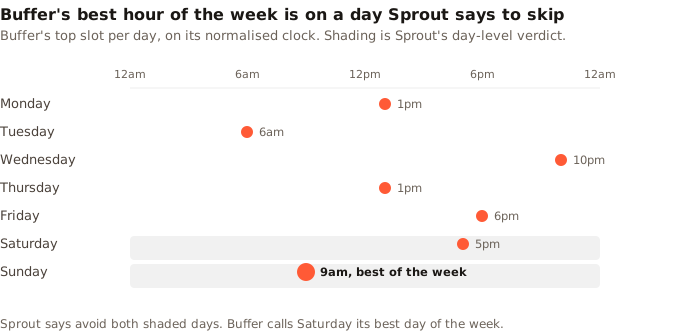
Buffer's best hour of the entire week sits on a day two other studies write off. Sprout's wording is not hedged: it calls Saturdays an algorithmic dead zone and tells you to avoid the day. SocialPilot ranks Sunday worst and Saturday second-worst. Buffer, which has the largest stated TikTok sample of the three, calls Saturday its top-performing day.
One detail makes this stranger still. SocialPilot lists Sunday 9am and 10am among its own slots while calling Sunday the worst day. So it agrees with Buffer on the hour and disagrees on whether the day is worth using at all.
Sprout says avoid the weekend, then schedules it
The contradiction is not only between studies. It is inside them.
Sprout's headline table gives Saturday and Sunday a single instruction: avoid posting. Then its own industry breakdown gives four of its nine industries a weekend peak.
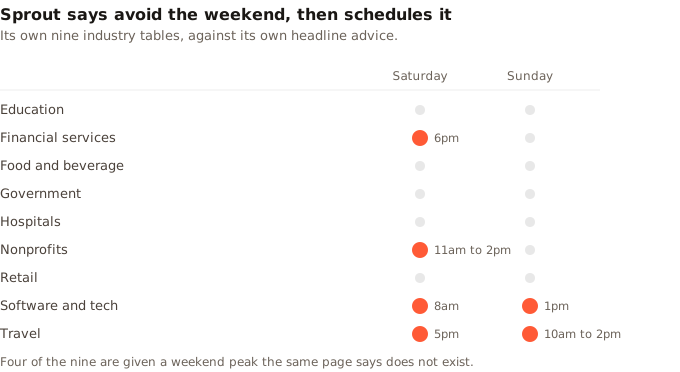
Financial services gets Saturday 6pm. Nonprofits get Saturday 11am to 2pm. Travel and hospitality get Saturday 5pm and Sunday 10am to 2pm. And software and technology is listed with best days of "Weekdays, Saturdays, Sundays", which is every day the same page tells you to skip.
SocialPilot does the same thing in miniature. It names Sunday the worst day to post, then makes Sunday the single best day for churches in its industry table, and puts photographers and real estate on "Friday to Sunday".
Neither page acknowledges the gap. In both cases the segmented data is more useful than the headline, and it is the headline that gets quoted.
When is the best time to post on TikTok each day?
All three, side by side, in each source's own words. Do not average these columns. Sprout reports in local time, Buffer says its times are normalised so no conversion is needed, and SocialPilot calls its times timezone-agnostic. They are not measured against the same clock.
| Day | Buffer (7.1M posts) | Sprout Social | SocialPilot (700K posts) |
|---|---|---|---|
| Monday | 1pm, then 11am or 8am | 3pm to 5pm | 5pm to 7pm, and 10pm to 11pm |
| Tuesday | 6am, then 10pm or 7am | 2pm to 6pm | 8am, 2pm to 4pm, 8pm |
| Wednesday | 10pm, then 6am or 9pm | 1pm to 8pm | 8am, 2pm to 4pm, 8pm |
| Thursday | 1pm, then 10pm or 6am | 1pm to 5pm | 9am, 2pm to 4pm, 8pm |
| Friday | 6pm, then 10pm or 8pm | 3pm to 5pm | 8am, 1pm to 3pm |
| Saturday | 5pm, then 4pm or 3pm | Avoid posting | 11am, 3pm, 8pm |
| Sunday | 9am, then 1pm or 12pm | Avoid posting | 9am, 10am, 4pm |
What is the best time to post on TikTok today?
If today is Tuesday, Wednesday or Thursday, post in the afternoon. That is the one recommendation every study supports, and Sprout's widest window of the week is Wednesday 1pm to 8pm.
If today is a weekend, you are choosing between studies rather than following them. Buffer has the largest stated TikTok sample, so Saturday 5pm or Sunday 9am is a reasonable bet. Just know you are betting against two other datasets while you do it.
Best time to post on TikTok on Monday
Buffer's Monday peak is 1pm, then 11am and 8am. Sprout gives a narrow 3pm to 5pm. SocialPilot goes later still with 5pm to 7pm and a second slot at 10pm to 11pm. The three spread from Buffer's 1pm to SocialPilot's 11pm, a ten-hour range. Sprout and SocialPilot meet at 5pm, but Buffer's 1pm sits two hours before Sprout's window opens, so no hour carries all three.
Best time to post on TikTok on Tuesday
Sprout runs 2pm to 6pm here and ranks Tuesday among its best days, with SocialPilot's 2pm to 4pm sitting inside that window. Buffer goes nowhere near either, peaking at 6am, its earliest primary of the week. Tuesday afternoon has two studies behind it, which is as much agreement as this topic offers.
Best time to post on TikTok on Wednesday
This is Sprout's widest window of the week, 1pm to 8pm, and SocialPilot puts both its 2pm to 4pm block and its 8pm slot inside it. Buffer goes the other way entirely with a 10pm primary. Wednesday afternoon carries two of the three studies with genuinely overlapping hours, 2pm to 4pm, the same overlap Tuesday and Thursday have. Wednesday's edge is only that Sprout's window is longer, not that the agreement is stronger.
Best time to post on TikTok on Thursday
Buffer peaks at 1pm, inside Sprout's 1pm to 5pm window, and SocialPilot's 2pm to 4pm sits inside it too. Thursday is the only day of the week where all three studies place a slot in the same window. They still do not share a single hour, but this is as close to consensus as the topic gets.
Best time to post on TikTok on Friday
Sprout and SocialPilot meet on Friday at 3pm, where Sprout's 3pm to 5pm window opens and SocialPilot's 1pm to 3pm block closes. Buffer sits outside both, peaking at 6pm an hour after Sprout's window ends, then later again at 10pm and 8pm. Friday afternoon carries two of the three, and Buffer pulls later than either.
Best time to post on TikTok on Saturday
Buffer calls Saturday the top-performing day of the week and gives it 5pm, then 4pm and 3pm. Sprout says avoid posting on Saturdays, calling the day an algorithmic dead zone. SocialPilot ranks it second-worst while still listing 11am, 3pm and 8pm. This is the single largest disagreement in the topic, and no amount of reading resolves it. Test it on your own account or leave it alone; the TikTok channel page covers what Zilfu can schedule while you do.
Best time to post on TikTok on Sunday
Buffer's Sunday 9am is the best slot of its entire week. Sprout says avoid the day. SocialPilot names Sunday its worst day and then lists 9am, 10am and 4pm anyway, agreeing with Buffer's hour while rejecting the day. If any single cell in this table deserves your own test, it is this one.
What is the worst time to post on TikTok?
The only quantified answer comes from SocialPilot, which names 11pm to 3am as the weakest window. Neither of the other two puts a number on it.
On days, the picture is the same argument in reverse. Sprout and SocialPilot both name Sunday worst, and Sprout adds Saturday. Buffer contradicts both by making the weekend its strongest stretch. There is no agreed worst day here, just one vendor's reading against another's.
What is the best day to post on TikTok?
Midweek, on the only reading two of three studies share. Sprout and SocialPilot both name Tuesday, Wednesday and Thursday their strongest days. Buffer breaks ranks and names Saturday.
That split matters more than it looks. Sprout and SocialPilot are describing a weekday-office rhythm; Buffer is describing a weekend-leisure one. Both patterns are plausible for a platform used mostly for entertainment, and which one applies to you depends on who follows you. The cross-platform comparison names the source behind every network's windows, because the answer changes with the source.
Does TikTok say when to post?
No, and unlike some platforms it does not come close. TikTok publishes no best time on any of its own properties.
Its explanation of how the For You feed recommends videos lists three groups of factors: your interactions such as likes, shares, follows and comments; information about the video such as captions, sounds and hashtags; and device and account settings such as language, country and device type (TikTok). Time of day, posting time and video age appear in none of them.
The nearest thing to a timing factor is elsewhere: TikTok says a video may be recommended because it is "content posted recently in your region" (TikTok). That is a stated reason a video showed up, not a published ranking weight, and it is about region as much as recency.
Worth knowing: TikTok's own post announcing its scheduling tool says creators "want to post at the right time for maximum impact", and then never says what that time is (TikTok). The closest thing TikTok has published to timing guidance contains no clock times at all.
Does posting time affect the TikTok algorithm?
Not in any way TikTok documents. What TikTok does describe is a prediction and ranking architecture rather than a chronological feed: it predicts how likely you are to like, share, comment on or skip each video, combines those into a score, and orders by it (TikTok).
That structure matters, because it leaves one very popular explanation unsupported. You will read everywhere that TikTok shows your video to a small test group first and expands its reach if that group engages. Buffer and SocialPilot both describe it. TikTok documents no such mechanism anywhere, so treat it as a vendor's model of the system rather than a description of it.
TikTok is unusually direct about what does not count, which is a useful corrective in a topic full of confident claims: "neither follower count nor whether the account has had previous high-performing videos are direct factors in the recommendation system" (TikTok).
Be careful where TikTok timing numbers come from
Search for TikTok posting times and you will land on tiktok.com/discover/... pages carrying specific hours. They look authoritative because they sit on TikTok's own domain.
They are not TikTok's guidance. Those pages are assembled programmatically from creator videos, and a fetch of one returns a login wall rather than readable content. While researching this article, a search summary confidently attributed a set of hours to "TikTok's Creative Center and official sources"; those numbers came from creator videos on Discover pages, not from TikTok.
This is the second platform where this happens. Instagram's parent company has confirmed it uses AI to generate the titles of Instagram posts as they appear in search results, and acknowledged they are not always accurate (Social Media Today, 2025). The Instagram version of this question covers it in full. The practical rule is the same for both: if a timing claim matters, trace it to a page the platform actually publishes, not to a platform-hosted page assembled from user content.
How do you find your own best time in 14 days?
The three studies disagree most about the weekend, so build the test around that rather than around the hour.
- Take the one slot everyone supports and one nobody agrees on. Thursday early afternoon is where all three land closest. Sunday 9am is Buffer's best of the week and the other two say skip it. Those two slots answer the actual question.
- Check TikTok Studio first. It reports when your own followers are most active, drawn from your audience rather than a vendor's customer base. If it disagrees with all three studies, believe it. Note the older TikTok Creator Center, which is not the live Creative Center, is retired, so guides pointing you there are out of date.
- Hold everything else constant and let a queue fire the slots. Same rough format, length and topic. A slot missed by an hour is a data point lost, which is what recurring weekly slots are for.
- Read every video at the same age. Compare posts on equal footing by measuring them the same number of hours after publishing, rather than all at one wall-clock moment.
- Drop the weakest, double the strongest, repeat. Three cycles gives you a schedule built on your audience rather than someone else's customers.
The honest caveat: three vendor studies drawn from their own customers cannot tell you about your niche. A test of six posts can.
How do you hold those slots without doing it by hand?
A weekend test is exactly the one that dies from good intentions. Sunday 9am and Saturday 5pm are the slots people mean to hit and then do not, and a fortnight of comparisons falls apart when half the posts land whenever somebody remembered. Defining the slots once and letting a queue fire them is what makes the comparison worth running. Zilfu checks for due posts every minute, so a 9am slot goes out at 9am.
Two details matter for the test. A post that fails to publish lands in an Error state with the reason attached, so a broken slot never gets mistaken for a weak one. And per-post analytics pull views, likes, comments and shares back from TikTok, which is the comparison the exercise depends on. They refresh every few hours rather than instantly, so read each video at the same age.
If you post to more than one TikTok account, several accounts on one workspace count against a single flat cap. The TikTok channel page covers what is supported. Note the tool shows Sprout's windows, which peak on Wednesday rather than the Thursday this article lands on.
Start on Thursday afternoon, then test the weekend
The three studies converge on one thing and split violently on another. Thursday early afternoon is where all three land closest, so start there. It is the least contested hour in a topic with very little agreement.
Then run the disagreement as an experiment rather than reading more about it. Put a Sunday 9am post against your Thursday slot for a fortnight and let your own account settle whether TikTok's weekend is Buffer's or Sprout's. Zilfu's free plan carries 2 connected accounts and 15 posts a month, which covers three weekly slots for the full two weeks.
TikTok is the network whose numbers get quoted as everyone's. The cross-platform comparison traces how Buffer's TikTok slot ended up being served as the universal answer.
Sources
All sources retrieved 31 July 2026.
- Buffer. The best time to post on TikTok in 2026: new data from 7M posts. Published 20 July 2026, 7.1 million posts, collection window not stated.
- Sprout Social. Best times to post on TikTok in 2026. Published 31 March 2026, covering 27 November 2025 to 27 February 2026. Sample spans all networks; no TikTok-only figure is given.
- SocialPilot. Best time to post on TikTok in 2026. Published 6 January 2026, 700,000 posts from 50,000+ connected accounts, covering January to 10 December 2025.
- Later. Best time to post on TikTok. Last updated 7 March 2025, no sample size stated.
- Later. Best time to post on social media in 2026. Published 6 May 2026; its TikTok figures restate Buffer's.
- TikTok. Introducing Video Scheduler. TikTok's closest thing to timing guidance, containing no clock times.
- TikTok. How TikTok recommends videos #ForYou. Source for the three factor groups and for what is not a factor.
- TikTok. Learn why a video is recommended for you. Source for "content posted recently in your region".
- TikTok. The For You feed: explaining how your TikTok feed is shaped.
- TikTok. Helping creators bring their creativity to life with TikTok Studio. Source for TikTok Studio replacing Creator Center.