The most-recommended Hootsuite alternative is Buffer, and unusually for this category that is not one company's opinion. All eight ranked lists on page one name it, including six published by rivals that put themselves first. The harder question is what you are leaving, because Hootsuite's own pricing page renders no prices at all.
Key takeaways
- Hootsuite's plan cards print "per month per user/mo" with no number.
- Page one puts it at $99, $149 and $18,000.
- $99 is the annual rate. Two page-one pages call it monthly.
- Above the entry tier, extra accounts are free and extra people cost.
- None of the nine lists mentions its June 2026 rebrand.
How much does Hootsuite actually cost?
You cannot tell from the pricing page. Fetched on 1 August 2026, all three of Hootsuite's plan cards render the literal string "per month per user/mo" with no figure attached (Hootsuite). The prices load client-side, so what the page ships is a currency-less placeholder.
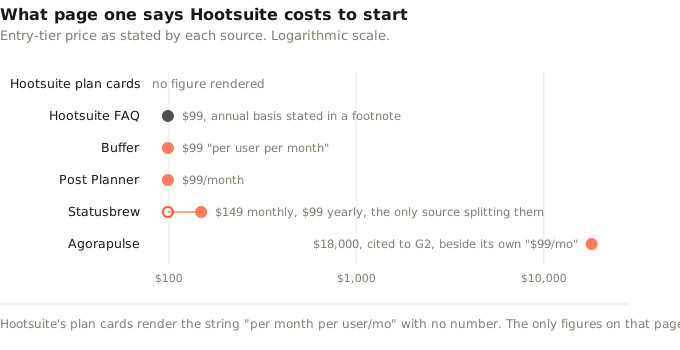
Figures do exist on that page, in exactly one place: an FAQ answer reading "Paid plans start at $99 for a Standard plan, $199 for a Professional plan, and range up to $399 for an Advanced plan." A footnote further down supplies the missing half: "Prices displayed in , based on annual billing, but do not include applicable taxes." The empty comma is Hootsuite's, not ours; the currency token is missing too.
So $99 is the annual-billed per-user rate, not the monthly one. That single unstated word is where the SERP falls apart.
Three page-one pages, three different answers
Buffer writes that Hootsuite "starts at $99 per user per month". Post Planner writes that "Hootsuite's lowest plan is $99/month". Both take the annual rate and present it as the monthly one.
Statusbrew is the only page-one source that separates them, publishing a table with Monthly and Yearly columns: Standard at "$149 per user" monthly against "$99 per month" yearly, and Advanced at "$399 per user" against "$249". If that is right, the two pages above understate Hootsuite's month-to-month entry price by about a third.
And then there is Agorapulse's row. Its comparison block runs three figures across one row under the heading "Here's how Hootsuite's pricing compares": "Pricing for Teams $99/mo" for itself, a literal "???" for Sprout Social, and "$18,000" for Hootsuite, credited to "Source: G2 Inc". Three numbers, no shared unit, no basis, on the page ranking seventh for this search.
None of this is exotic. It is what happens when a vendor renders its prices in JavaScript and states the billing basis only in a footnote, and everybody downstream copies the headline.
What do you get at each tier?
The account model is the part worth understanding, because it inverts halfway up. Hootsuite sells per user, and its own cards state that Standard covers "up to 10 social media accounts" while Professional covers "unlimited social accounts" (Hootsuite).
That matters more than the sticker price. Above the entry tier, connecting a fiftieth Instagram account costs nothing, and adding a second person costs a full seat. It is the exact opposite of the per-channel model Buffer uses, where accounts are the meter and users are not.
Approvals sit on Advanced, the third tier, described on Hootsuite's own card as "Streamline approvals and co-work across teams" and adding "Review and approve content with your team". On the FAQ's numbers that is $399 per user, annual basis. If a client signs off on posts, that is your entry price, not $99.
There is no free plan. Hootsuite offers a 14-day trial with no credit card, and notes that "Trial accounts have daily posting limits (10-20 posts per organization, depending on plan)". Worth knowing, because the demand on this search is explicitly for free: hootsuite alternatives free runs at roughly 390 searches a month against 880 for the head term, and hootsuite free adds another 320.
What does page one actually agree on?
Now the useful part. Across the eight ranked lists, Buffer is named by every single one, which is the first unanimous result we have found in this category.
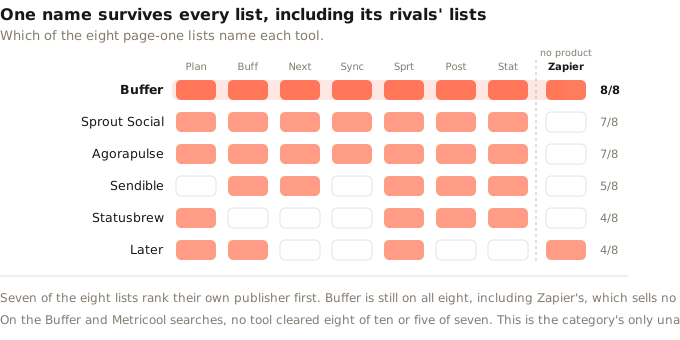
That is worth more than it looks, because seven of the eight lists are published by companies selling a scheduler, and all seven rank their own product first: Planable, Buffer, Nextiva, Syncly, Sprout Social, Post Planner and Statusbrew. Buffer still appears on the other six. The eighth list is Zapier's, which sells automation rather than scheduling, and it also opens with Buffer.
So a name that survives six competitors' lists and the one disinterested list is carrying real signal. Behind it, Sprout Social and Agorapulse appear on 7 of 8 and Sendible on 5, with Statusbrew, Later, Planable and eClincher on 4 each. In total the eight lists name 39 tools across 85 slots, 23 of them exactly once.
We took the self-ranking pattern apart properly in our Buffer alternatives piece, where it held nine times out of nine. The difference here is who is doing it: these are not small SaaS blogs but Hootsuite's largest competitors, and Buffer refreshed its entry the day before we fetched it.
They are all describing a product that was renamed six weeks ago. On 24 June 2026 Hootsuite rebuilt its portfolio into "Social OS", splitting it into Perch for publishing, Nest for the inbox, Lumen for listening and Parliament for employee advocacy, with an AI agent called Wisdom on top. Not one of the nine pages we fetched mentions Social OS, Perch, Nest, Lumen, Parliament or Wisdom. Three still call the advocacy product Amplify, which Hootsuite's own page says "has evolved into Parliament". That is not a gotcha so much as a warning about the shelf life of this genre: the fastest-moving thing about a tool is rarely what the listicles are comparing.
Worth knowing: Zilfu sells a scheduler, so this page has the same conflict as the seven above. What we can do instead of asking for trust is quote Hootsuite's own pages, show the counts, and say plainly below where Hootsuite beats us.
Four questions to ask about any apps like Hootsuite
Hootsuite is unusual on two of these, which is why the generic feature grid misleads here.
- What is the bill counted in? Seats, accounts, channels or brands. Hootsuite counts seats, and above Standard the account cap disappears entirely.
- What does a second account on the same network cost? On Hootsuite above Standard, nothing. On per-channel tools it is another full charge. If you run many accounts per network, Hootsuite's model is actually generous.
- Which tier unlocks approvals? Hootsuite's is Advanced at $399 per user. Price the tier you will be on.
- Is there an API, webhooks and an MCP server? Hootsuite has all three, on three different terms: the REST API is free but gated by developer approval, MCP arrived in 2026 and needs the relevant product, and webhooks cover only the inbox CRM and require Advanced.
Here are the answers for Hootsuite, for Zilfu, and for the tools that recur most across the eight lists. Every unmarked cell is quoted or paraphrased from the vendor's own pricing page or help centre, checked on 1 August 2026; cells we could not source that way carry an asterisk.
| Tool | Bill counted in | Second account, same network | Free forever plan | Approvals from | API / webhooks / MCP |
|---|---|---|---|---|---|
| Hootsuite | Seats | One of 10 on Standard, free above it | No, 14-day trial | Advanced, $399 | Free, by developer approval / Advanced, inbox only / yes, per product |
| Zilfu | Accounts | One ordinary slot | Yes: one owner, 2 accounts, 15 posts/mo | Every paid plan, from $19 | Yes / yes / yes, every plan |
| Buffer | Channels | Another billed channel | Yes: 3 channels, 10 queued each | Team | Yes / no / yes, every plan |
| Sprout Social | Seats | One of 5, free on Professional up | No, 30-day trial | Professional * | Advanced / no / no |
| Later | Social sets of 8 profiles | Not sold on Starter; Growth includes 2 sets, then $11.25 | No, 14-day trial | Growth | None offered |
| SocialPilot | Social media accounts | One slot, then $4 a month | No, 14-day trial | Standard * | Enterprise / no / no |
| SocialBee | Social profiles | Its own slot, extra in blocks of 5 | No, 14-day trial | Accelerate | No public API |
| Metricool | Brands | A whole brand, so possibly a tier step | Yes: 1 brand, 20 posts, no LinkedIn or X | Advanced, $53 | Advanced / undocumented * / every plan |
| Publer | Social accounts | Add-on, $4 to $7 a month | Yes: 3 accounts, no X | Not stated * | Business / no / no |
| Planable | Workspaces | Social pages in a workspace * | No, 50 posts total then paid | Basic, and it is the tier ladder | Pro / no / MCP on paid plans |
| Zoho Social | Brands | A second brand, $17 a month up * | Yes: 1 brand, unlimited posts, X included | Premium | Not stated * |
* Marks an answer the vendor does not state outright. SocialPilot's pricing page renders its approval tiers inconsistently between passes. Sprout's approval tier comes from a support article rather than its live pricing page. Publer names no approval tier and Zoho Social names no API on the pages checked; Zoho's brand add-on price comes from a 2021 help article. Planable does not say whether two same-network accounts can share a workspace. None of the Metricool pages we checked describes a webhook either way. Agorapulse and Sendible recur high on the lists but are not in the table, because we have not verified them against their own pricing pages to the standard used here.
Read row one against row two and the trade is clear. Hootsuite is expensive per person and generous per account. Flat-priced tools are the reverse. Which one wins depends entirely on whether your constraint is headcount or account count, and that is a question no ranking can answer for you.
Where Zilfu fits, and where Hootsuite genuinely wins
Zilfu has no per-seat charge on paid plans, which is the axis that matters against a per-user tool: team members and client reviewers are unlimited from Pro upward, while Free is owner-only. The whole ladder is $0, $19, $79 and $179 a month for 2, 10, 100 and 300 connected accounts. Approvals with unlimited client reviewers start on Pro; the REST API, webhooks and MCP server ship on all four. Against Hootsuite's Advanced at $399 per user, a team of three needing approvals is the comparison that tends to decide it, and the Zilfu and Hootsuite comparison works that arithmetic through.
Where Hootsuite wins is not close, and it is the reason it still costs what it costs. Its Professional tier automates inbox replies and forecasts social trends up to 90 days out; Advanced routes approvals across teams and assigns work. Zilfu has no social listening, no unified inbox, no ads reporting and no built-in AI writer, its client reports are branded share links rather than a white-label dashboard, its approvals are single-reviewer, and it publishes to seven networks. If listening and inbox at scale are the job, none of the cheap tools on this page are substitutes, and Sprout Social or Agorapulse are the honest comparisons rather than us.
If it is per-channel billing you are weighing against per-seat, the Buffer alternatives piece does that side.
How do you leave Hootsuite without a surprise?
Model the bill before you move, because the seat model makes the naive comparison wrong in both directions. Count people who need logins and accounts you connect separately, then price both tools on both numbers. A solo operator with thirty accounts is cheap on Hootsuite Professional and expensive on per-channel tools; a team of five with six accounts is the reverse.
Then check the tier your workflow actually needs. If a client or manager approves posts, you are pricing Advanced, and the gap between $99 and $399 per user is the whole decision. Trialling is cheap either way: no scheduler in this comparison imports another tool's history, so switching means reconnecting accounts and scheduling forward, and your published posts stay live on each platform regardless.
One practical note on the trial. Hootsuite's 14 days come with daily posting limits of 10 to 20 posts per organisation, so a genuine side-by-side of publishing volume is not something the trial supports. Test the workflow, not the throughput.
Zilfu's free plan covers one owner, 2 accounts, and 15 posts a month with the API included rather than gated. Collaborative approvals and team invitations start on Pro, so Free is enough to check whether the core account model fits before anything is at stake.
Sources
All pages fetched 1 August 2026. The page-one listicles were retrieved as raw HTML and parsed programmatically rather than read.
- Hootsuite. Plans and pricing.
- Hootsuite. Advanced plan.
- Hootsuite. Developer FAQ and webhooks overview.
- Hootsuite. MCP connectors.
- Hootsuite. Social OS, 24 June 2026 and Parliament.
- Planable. The 7 best Hootsuite alternatives in 2026.
- Zapier. The 5 best Hootsuite alternatives.
- Buffer. 7 best Hootsuite alternatives for 2026.
- Nextiva. 15 Hootsuite alternatives for social media teams.
- Syncly. 7 best Hootsuite alternatives for 2026.
- Agorapulse. The best alternative to Hootsuite.
- Sprout Social. Top 15 Hootsuite alternatives to consider in 2026.
- Statusbrew. 15 Hootsuite alternatives and competitors 2026.
- Post Planner. 12 best Hootsuite alternatives that cost less.
- Buffer. Pricing: per-channel plans.
- Metricool. Pricing and MCP versus API access.
- Later. Pricing: social sets and add-ons.
- SocialPilot. Pricing.
- SocialBee. Pricing.
- Sprout Social. Pricing: per seat.
- Publer. Plans and pricing.
- Planable. Pricing: per workspace.
- Zoho Social. Free edition.