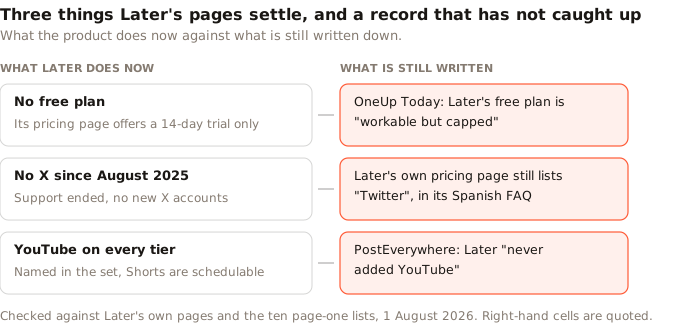
Later has no free plan and no X support, and the Later alternatives lists ranking for this search have not caught up with either. Its pricing page now offers "Free for 14 days" and starts at $18.75 a month; it dropped X in August 2025. Page one still argues about both, and so, in one place, does Later.
Key takeaways
- Starter holds one profile per network, and refuses to sell you a second one at any price, so the cheapest second Instagram is the $18.75 jump to Growth.
- Approvals start at Growth too, and Starter is single-user.
- No Later page we checked offers an API, webhooks or MCP.
- Its entry tier does publish to all eight networks, including YouTube, which one list says it never added.
- Nine of the ten page-one lists rank their own publisher first, and all ten name Buffer.
Does Later still have a free plan?
No. Later's pricing page reads "Manage your entire social media strategy. Free for 14 days" and lists three paid tiers starting at Starter, $18.75 USD a month, billed yearly (Later). There is no zero-cost option anywhere on it.
Page one cannot agree about this. OneUp Today tells readers "Later's own free plan is workable but capped". Carly titles its list "7 Best Later Alternatives in 2026 (Free Plan Is Gone)". Blotato ranks Buffer second as the pick for "creators who left Later for the free plan it killed". Three results on the same page of one search, disagreeing about whether the plan exists at all. The same pattern holds on X and on YouTube, both below.
This correction matters because one of the queries feeding this search, free alternative to Later, arrives expecting that free tier to be the fallback. It is not there any more. The free plans that do still exist, ours among them, are counted in the table below.
What does Later actually cost, and what do you get?
Later pricing is annual-billed by default and runs Starter $18.75, Growth $37.50 and Scale $82.50 a month, presented on the page as "3 months free | 25% off" (Later). Extra social sets cost $11.25 a month and extra users $3.75, which sounds modest until you see which tier can actually buy them.
What the Starter card actually says
Narrower than its headline suggests, and not in the place the headline points at. Starter's card sells "1 social set (8 profiles total) (1 of each)" and 1 user, caps you at 30 posts per profile per month, and closes with "Extra Social Sets, users and AI credits not available".
Read the parenthesis rather than the total. Eight profiles sounds generous; one of each is the constraint. Later defines a set as "one of each profile we support: Instagram, Facebook, TikTok, Pinterest, LinkedIn, YouTube, Threads and Snapchat" (Later), so the eight are one apiece. You get every network Later supports and exactly one account on each, with no way to buy a ninth.
The "Instagram, Facebook, & TikTok" line is not the network list
One line on that card invites a misreading, because it looks exactly like a network list. It reads "Instagram, Facebook, & TikTok Best Time to Post", and it is one feature rather than three networks. The plan comparison lower down the same page settles it: Auto Publish Posts is marked "Yes" on all three tiers, and the Social Sets row gives Starter one profile on each of the eight networks (Later). The entry plan publishes to everything Later publishes to.
The real three-network limit is the timing feature itself. Best Time to Post covers Instagram, Facebook and TikTok and nothing else Later publishes to, on every tier including Scale (Later). Growth adds only the multi-profile view of those same three, described on the comparison as optimal times "for Instagram, Facebook, and TikTok profiles". If your question is when to post on LinkedIn or Pinterest, no Later plan answers it.
What else Starter caps: 30 posts a profile, one user
Volume is the other ceiling, and it is counted per profile: 30 posts per profile per month, against 180 on Growth and unlimited on Scale. Thirty a month is roughly one a day, so any profile you post to daily is already at the ceiling, however few networks you run.
Approvals sit on Growth too, so a client sign-off loop doubles the entry price on its own. Starter is single-user, which means there is nobody on it to approve anything.
Later's own pricing page still lists Twitter
Later ended X support on 28 August 2025 and stopped accepting new X connections. Eleven months later, the Spanish-language FAQ block on later.com/pricing still answers a question about auto-publishing with a list of profiles including "Twitter". The English copy was updated; the localised copy was not.
Why this small thing is in a pricing comparison: it is the clearest illustration of why the rest of this page checks vendor claims against vendor pages rather than against each other. If a company's own pricing page can be eleven months stale in one language, a competitor's blog post about that company is not evidence of anything.
The social set is what decides your bill
Later counts social sets rather than accounts, and a set holds exactly one profile per network. That single rule decides most Later bills, and it makes the tool expensive for a shape of customer it otherwise suits well: anyone running more than one account on the same platform.
A second Instagram account requires an entire second social set, and Starter cannot buy one at any price: its card refuses extras outright. The cheapest second account on any network is therefore not an add-on line at all. It is Growth at $37.50, which doubles the bill and arrives as "2 social sets (16 profiles total) (2 of each)". Anyone running two brands, or a personal account alongside a business one, meets that doubling rather than an add-on.
Only at the third same-network account does the $11.25 add-on start applying. It buys a whole set rather than a slot, which covers a third account on every network at once: generous if you are growing evenly, wasteful if you are not.
Then it runs out of road. Scale ships "6 social sets (48 profiles total) (6 of each)" for $82.50, and Growth plus four add-on sets is $37.50 + $45.00. That is $82.50 exactly. Same money, same six sets, except Scale also lifts the post cap and doubles the users. Which makes the add-on worth buying for a third, fourth or fifth set and never for a sixth. On Scale it starts mattering again only at a seventh.
This is the same trap Metricool sets with brands, and we work the arithmetic through properly in the Metricool alternatives piece. If you run several accounts on one network, it is the first question to ask of anything on your shortlist, ahead of price.
Does Later have an API, webhooks or an MCP server?
Not for its scheduler. No Later page denies it in as many words; rather, nothing on the pages we checked offers one, and the only API among them belongs to Later Influence, a separate creator-marketing product. That is unusual in 2026, when Buffer, Metricool, Planable and Hootsuite all ship something.
It matters more than it did two years ago, because the thing people now want to point at a scheduler is an assistant. If you plan to publish from a script, a workflow tool or an AI agent, Later is the wrong shape at any price, and no tier changes that.
Later's competitors write the Later alternatives lists
Later competitors, almost without exception. Of the ten ranked lists on page one, nine rank their own publisher first: Blotato, Planable, Sprout Social, PostEverywhere, Postoria, Post Planner, GudSho, RADAAR and OneUp Today. That is not a scandal so much as a structural fact worth pricing in before you read any ordering.
The tenth is Carly, a booking and scheduling-link tool with no social scheduler to sell, and it opens with Buffer. We found the same shape on the Buffer and Hootsuite searches: the one publisher with nothing in the race names somebody else.
Self-ranking is the visible bias, and the easy one to correct for. Harder is that these pages describe a moving product from memory. PostEverywhere's entry puts it in one sentence: "Later supports Instagram, Facebook, TikTok, Pinterest, LinkedIn, and Threads, but dropped X/Twitter and never added YouTube."
Half of that is right. Later did drop X. But its own pricing page names YouTube among the eight networks in a social set and lists YouTube Shorts among the post types it schedules, and the same six-network list quietly drops Snapchat as well. A reader who needs either one is being told to rule out a tool that does both. A list can be current on the change everybody wrote about and stale on the one nobody did.
Worth knowing: Zilfu sells a scheduler too, so this page is written by an interested party like the other nine. What we can offer instead of a ranking is Later's own pages quoted directly, and a plain statement below of what Later does better than us.
Which Later alternatives do the lists actually agree on?
One: Buffer. Strip the orderings out and count names instead, because how often a tool recurs is the single signal no individual publisher controls. The ten lists fill 90 ranked slots with 31 distinct tools, and 13 of those tools are named by exactly one list.
Buffer is on all ten. It is the only unanimous name on the page, and it earns that from a jury made up mostly of its competitors: nine of the ten rank their own publisher above it, four of them putting Buffer immediately second anyway. Hootsuite is next on 8, then Planoly and Agorapulse on 6, Sprout Social and Loomly on 5, and a cluster of four on 4 each: Publer, SocialPilot, Metricool and Planable.
Notice what that unanimity is actually about, because the lists are consistent on it: they name Buffer for the price and the free plan, not for the thing Later was used for. Blotato's entry is "Buffer: Best for creators who left Later for the free plan it killed", and the same lists that pick Buffer for that reason name Planoly separately for the visual grid.
Buffer's free tier covers 3 channels at 10 queued posts each, and it bills per channel above that, which makes a second Instagram another billed channel rather than a tier jump (Buffer). It solves the money question and leaves the grid question open.
Ten lists, then, produce ten different first picks and one tool nobody leaves out. Read the recurring names as a shortlist you will keep meeting rather than a verdict on fit. Zilfu appears on none of them.
Four questions to ask of any tool similar to Later
Later is unusual on the first and the last of these, billing in sets rather than accounts and offering no developer surface at all, which is why a straight feature grid flatters it and a structural comparison does not. Ask them of everything on your shortlist and the field sorts itself without anybody's ranking.
- What is the bill counted in? Later counts social sets of eight profiles, one per network. Not accounts, not seats.
- What does a second account on the same network cost? A whole extra set. Starter cannot buy one, so the second costs the jump to Growth, $18.75 a month more. The third costs $11.25, and buys a set rather than a slot.
- Which tier unlocks approvals? Growth, at double the entry price, and Starter is single-user.
- Is there an API, webhooks or an MCP server? Later advertises none of the three on any plan.
Every unmarked cell below is quoted or paraphrased from the vendor's own pricing page or help centre, checked on 1 August 2026.
| Tool | Bill counted in | Second account, same network | Free forever plan | Approvals from | API / webhooks / MCP |
|---|---|---|---|---|---|
| Later | Social sets of 8 profiles | Not sold on Starter. Growth includes 2 sets, then $11.25 * | No, 14-day trial | Growth, $37.50 | None offered * |
| Zilfu | Accounts | One ordinary slot | Yes: one owner, 2 accounts, 15 posts/mo | Every paid plan, from $19 | Yes / yes / yes, every plan |
| Buffer | Channels | Another billed channel | Yes: 3 channels, 10 queued each | Team | Yes / no / yes, every plan |
| Metricool | Brands | A whole brand, so possibly a tier step | Yes: 1 brand, 20 posts, no LinkedIn or X | Advanced, $53 | Advanced / undocumented * / every plan |
| Hootsuite | Seats | One of 10 on Standard, free above it | No, 14-day trial | Advanced, $399 | Free, by developer approval / Advanced, inbox only / yes, per product |
| Sprout Social | Seats | One of 5, free on Professional up | No, 30-day trial | Professional * | Advanced / no / no |
| SocialPilot | Social media accounts | One slot, then $4 a month | No, 14-day trial | Standard * | Enterprise / no / no |
| SocialBee | Social profiles | Its own slot, extra in blocks of 5 | No, 14-day trial | Accelerate | No public API |
| Publer | Social accounts | Add-on, $4 to $7 a month | Yes: 3 accounts, no X | Not stated * | Business / no / no |
| Planable | Workspaces | Social pages in a workspace * | No, 50 posts total then paid | Basic, and it is the tier ladder | Pro / no / MCP on paid plans |
| Zoho Social | Brands | A second brand, $17 a month up * | Yes: 1 brand, unlimited posts, X included | Premium | Not stated * |
* Marks an answer the vendor does not state outright. Later's own row carries two of them. Its second-account cell is a derivation, not a quote: the Starter card refuses extras and the Growth card includes two sets, and nothing on the page joins those facts up for you. Its API cell reads "none offered" rather than "none exists", because no Later page advertises an API, webhooks or MCP and none denies them either.
Among the rest:
- SocialPilot renders its approval tiers inconsistently between passes.
- Sprout Social's approval tier comes from a support article rather than its live pricing page.
- Publer names no approval tier anywhere we looked, and Zoho Social names no API; Zoho's brand add-on price is the one figure here taken from a 2021 help article rather than a live page.
- Planable does not say whether two same-network accounts can share a workspace.
- Metricool has no page we checked that describes a webhook either way.
Planoly is absent from the table because we have not costed it against its own pricing page to this standard, not because the lists ignore it.
Where Zilfu fits, and where Later still wins
Zilfu counts accounts, one at a time, with no set to buy. The question that forces a Later tier jump never arises here: a second Instagram is one ordinary slot at exactly the price of the first, and the ladder runs $0, $19, $79 and $179 a month for 2, 10, 100 and 300 of them.
Approvals with unlimited client reviewers arrive on every paid plan from $19 rather than on a higher team tier, while the REST API, webhooks and MCP server are available even on Free. The Zilfu and Later comparison works the set arithmetic through against your own profile counts.
Where Later wins is the thing it was built for. Its visual planner and grid preview have no equivalent here, because Zilfu has no grid planner at all. Later also runs a creator and affiliate network through Later Influence, and its Link in Bio is more developed than our link-in-bio page. Zilfu has no social listening, no unified inbox, no built-in AI writer, and its approvals are single-reviewer. Its client reports are branded share links rather than a white-label dashboard.
If the visual grid is why you used Later, Planoly is the name 6 of the 10 lists keep giving, uncosted here for the reason set out under the table.
How do you leave Later without losing your queue?
Copy your scheduled posts out first, because that is the one thing genuinely at risk. None of the pricing or help pages we checked describes importing another tool's queue. Nothing you have queued in Later will follow you out, then, and it needs copying before you cancel rather than after. Published posts stay live on each platform regardless of which tool queued them.
Then count profiles per network before you price any of the Later alternatives above. If you run exactly one account on each network you use, Later's Starter is competitive and the comparison is close. If you run two Instagram accounts, or two of anything, the entry tier cannot do it at any price and the honest comparison is against Growth at $37.50, not Starter at $18.75.
Zilfu's free plan covers 2 accounts and 15 posts a month, which is enough to connect the second same-network account that would have cost you a tier on Later and see whether the difference matters.
Sources
All pages fetched 1 August 2026. The page-one listicles were retrieved as raw HTML and parsed programmatically rather than read.
- Later. Pricing: social sets, tiers and add-ons.
- Later. Create and manage social sets.
- Later. Ending support for X (formerly Twitter).
- Blotato. 6 best Later alternatives for multi-platform creators.
- Planable. 7 best Later alternatives in 2026.
- Sprout Social. 15 best Later alternatives.
- PostEverywhere. 8 best Later alternatives.
- RADAAR. Top 10 alternatives to Later.
- GudSho. 10 Later alternatives to consider in 2026.
- Post Planner. 11 best Later alternatives.
- OneUp Today. 6 best Later alternatives in 2026.
- Postoria. 10 best Later alternatives.
- Carly. 7 best Later alternatives in 2026.
- Buffer. Pricing: per-channel plans.
- Metricool. Pricing and MCP versus API access.
- Hootsuite. Plans and pricing.
- SocialPilot. Pricing.
- SocialBee. Pricing.
- Sprout Social. Pricing: per seat.
- Publer. Plans and pricing.
- Planable. Pricing: per workspace.
- Zoho Social. Free edition.